

Applying to US Universities With A Levels: A Complete Guide
How A Level students apply to US universities: recognition, how admissions read A Levels and predicted grades, SAT/ACT, essays and how A Level results can earn college credit.



Yes, you can apply to US universities with A Levels. Cambridge says over 600 US universities accept Cambridge International A Levels, and many US and Canadian universities give A Level students up to a full year of college credit (Cambridge International, 2026). In 2026, the US was also the third-largest source of international UCAS applicants, with 8,270 students applying to UK universities (The PIE News, 2026).
But US admissions work very differently from UCAS. This guide explains how A Level students fit into the US system and how to present your qualifications well.
Key Takeaways
- Over 600 US universities accept Cambridge International A Levels.
- US applications look at your whole school record, not just predicted A Level grades.
- Strong final A Level grades can earn college credit, up to a year at some universities.
- Credit policies vary widely; some universities, such as Harvard, no longer award pre-college credit.
Do US Universities Accept A Levels?
Yes. A Levels are well known to US admissions offices, especially at selective universities that recruit internationally. Cambridge says over 600 US universities accept Cambridge International A Levels (Cambridge International, 2026). Edexcel International and UK A Levels are similarly familiar to US admissions offices.
US universities don't make offers based on A Level grades the way UK universities do. Instead, they look at your whole academic record alongside essays, activities and recommendations.
How Is a US Application Different From UCAS?
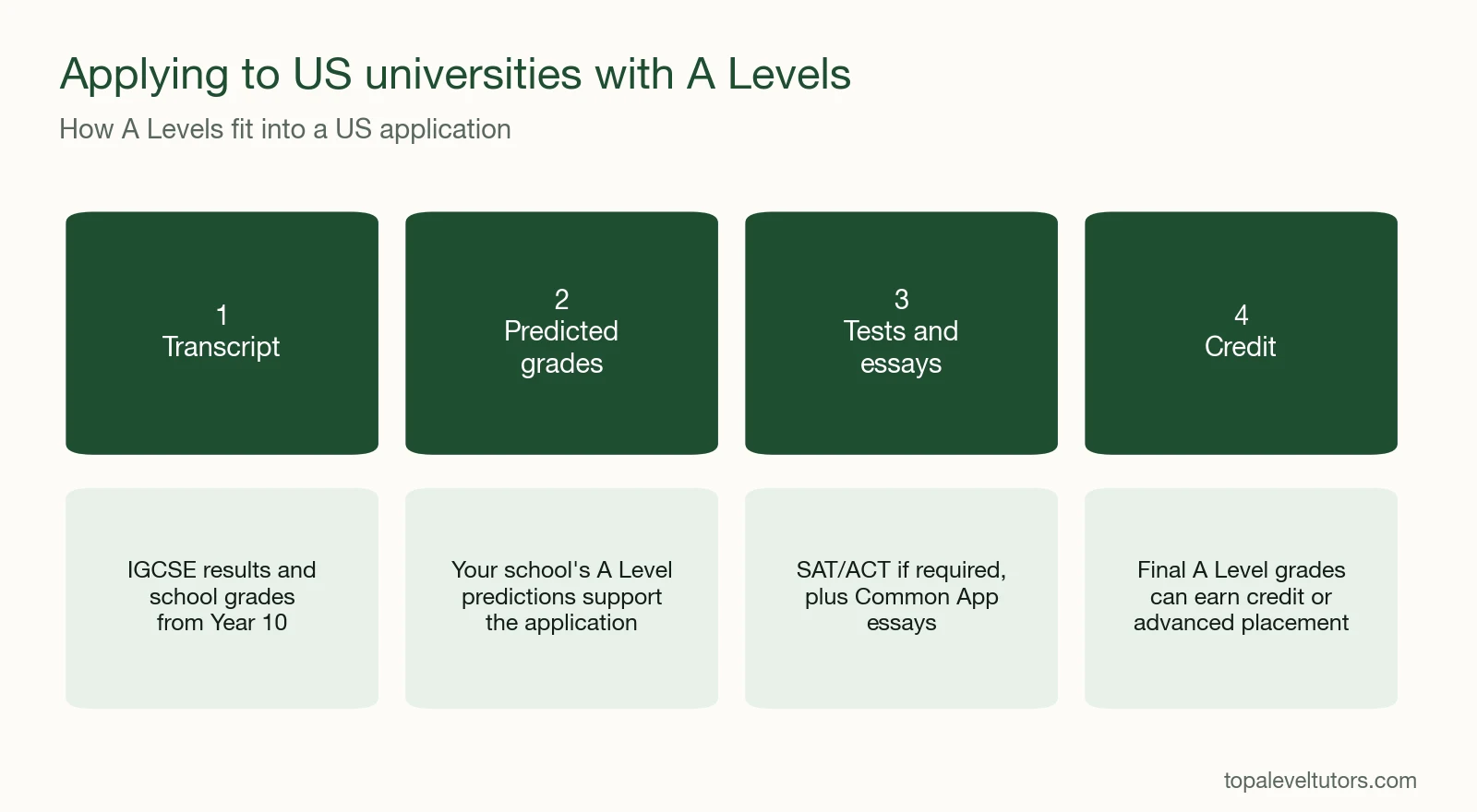
A US application is holistic. Admissions officers review your school transcript, including IGCSE results and school grades from Year 10 onwards, your predicted A Level grades, recommendation letters, essays and activities. Many universities use the Common App, which lets you apply to multiple universities with one main essay.
| UK (UCAS) | US | |
|---|---|---|
| What matters most | Grades in relevant subjects | Whole profile: grades, essays, activities |
| Offer type | Conditional on A Level grades | Usually unconditional once admitted |
| Number of applications | Up to 5 courses | No fixed limit |
| Subject focus | Apply for one subject | Choose a major later at many universities |
A US offer is usually not conditional on your final A Levels, but that doesn't mean your grades stop mattering. Your final results can earn credit and placement, and universities can withdraw an offer if your performance drops sharply. Keep working through Year 13 as if every grade counts, because for credit, it does.
Do You Need the SAT or ACT?
It depends on the university. Some US universities require the SAT or ACT, others are test-optional, and policies have changed often in recent years. Check each university's current testing policy before you register. Strong A Level grades show academic ability, but they don't automatically replace a test where one is required.
Plan any testing for Year 12 or early Year 13, so it doesn't clash with your A Level exams.
Can A Levels Earn US College Credit?
Yes, at many universities. Cambridge says A Level students can receive up to a full year's college credit at some US and Canadian universities, and AS Level students up to a semester (Cambridge International, 2026). At Washington State University, for example, three AS Levels and three A Levels can earn 24 credits, equal to a full first year (Cambridge International blog, 2022).
Policies vary a lot, though. Harvard stopped awarding course credit for work completed before enrolment for students entering from 2020 (Harvard Magazine, 2018), although strong results can still affect course placement. Always check each university's credit policy.
How Should You Present A Levels on a US Application?
Make sure your counsellor explains your school's system. A US reader needs to know that taking three A Levels is normal, that A* is the top grade and how rare top grades are. In 2026, only 28.5% of UK A Level results were A or A* (JCQ, 2026). A school profile that explains this helps your grades read correctly.
Show depth in your activities too. A Level students often have fewer subjects than US students, so use your essays to show curiosity beyond the syllabus.
Students we support who apply to both the UK and the US face two different timelines. UK deadlines are October or January; many US early deadlines fall on 1 November. The students who manage both well plan their essays over the summer before Year 13 and keep their A Level revision on track at the same time.
Should You Apply to the US or the UK?
Choose the UK if you know what you want to study and want a three-year, focused degree. Choose the US if you want flexibility to explore subjects before choosing a major. Many A Level students apply to both. Our guide to applying to UK universities as an international student covers the UCAS side.
Aiming for the US With A Levels?
Strong A Level grades help your US application and can earn credit once you're admitted. Our tutors combine top recent A Level graduates and qualified teachers and examiners, supporting international students on Cambridge, Edexcel International and UK A Levels in subjects from Mathematics and Economics to English Literature.
Submit an application and we'll match you with a tutor for your subjects.
Frequently Asked Questions
Do Ivy League universities accept A Levels?
Yes. Selective US universities, including the Ivy League, regularly admit students with A Levels. Cambridge says over 600 US universities accept its A Levels (Cambridge International, 2026). They review your whole application, not just grades.
How much college credit can A Levels earn?
Up to a full year at some US universities, and up to a semester for AS Levels (Cambridge International, 2026). Others give placement but no credit. Check each university's published credit policy.
Are A Levels better than AP for US universities?
Neither is automatically better. AP is designed for the US system, but A Levels go deeper in fewer subjects and are well known to admissions offices. Over 600 US universities accept Cambridge A Levels (Cambridge International, 2026).
Do I need predicted grades for US applications?
Many US universities ask your school to report predicted A Level grades alongside your transcript. Unlike UCAS, these usually aren't used for conditional offers. Predictions are often generous: one study found 75% of UK applicants were over-predicted (Murphy and Wyness, 2020).
The Bottom Line
- Over 600 US universities accept Cambridge International A Levels.
- US admissions are holistic: transcript, essays, activities and recommendations.
- Strong A Level grades can earn up to a year of credit at some universities.
- Check testing and credit policies university by university.
Weighing up qualifications? Read our A Level vs IB comparison.
Find the right A-Level tutor this week
If you are not happy after your first session with your tutor, please let us know and we will give you a full refund and find you another tutor for free.