

A Level vs IB: Which Is Better for You? (2026 Comparison)
An honest comparison of A Levels and the IB Diploma using 2026 results: structure, workload, grading, UCAS points, university entry in the UK and abroad, and how to decide which route suits your strengths and goals.



A Levels suit students who want to specialise in about three subjects; the IB Diploma suits all-rounders who want six subjects plus a compulsory core. Both are Level 3 qualifications and both are accepted by universities worldwide (GOV.UK, 2026). In 2026, 104,369 students sat the final IB Diploma exams (Top IB Tutors, 2026), while 349,917 students took UK A Levels (JCQ, 2026).
Many international schools offer both, which makes this one of the biggest decisions families face at 16. This guide compares them honestly. We run tutoring companies for both A Level and IB students, so we see the strengths of each.
Key Takeaways
- A Levels: usually 3 subjects, chosen freely, graded A* to E.
- IB Diploma: 6 subjects (3–4 at Higher Level) plus TOK, the Extended Essay and CAS, scored out of 45.
- Both are accepted by UK and international universities, and both convert to UCAS points.
- Choose A Levels if you're a specialist; choose the IB if you're an organised all-rounder.
How Are A Levels and the IB Different?
The core difference is breadth. A Level students typically study three subjects; in England, 63.9% of A Level students took exactly three in 2026 (Ofqual, 2026). IB Diploma students must take six subjects across set groups, including a language, a science and maths, plus Theory of Knowledge, a 4,000-word Extended Essay and CAS.
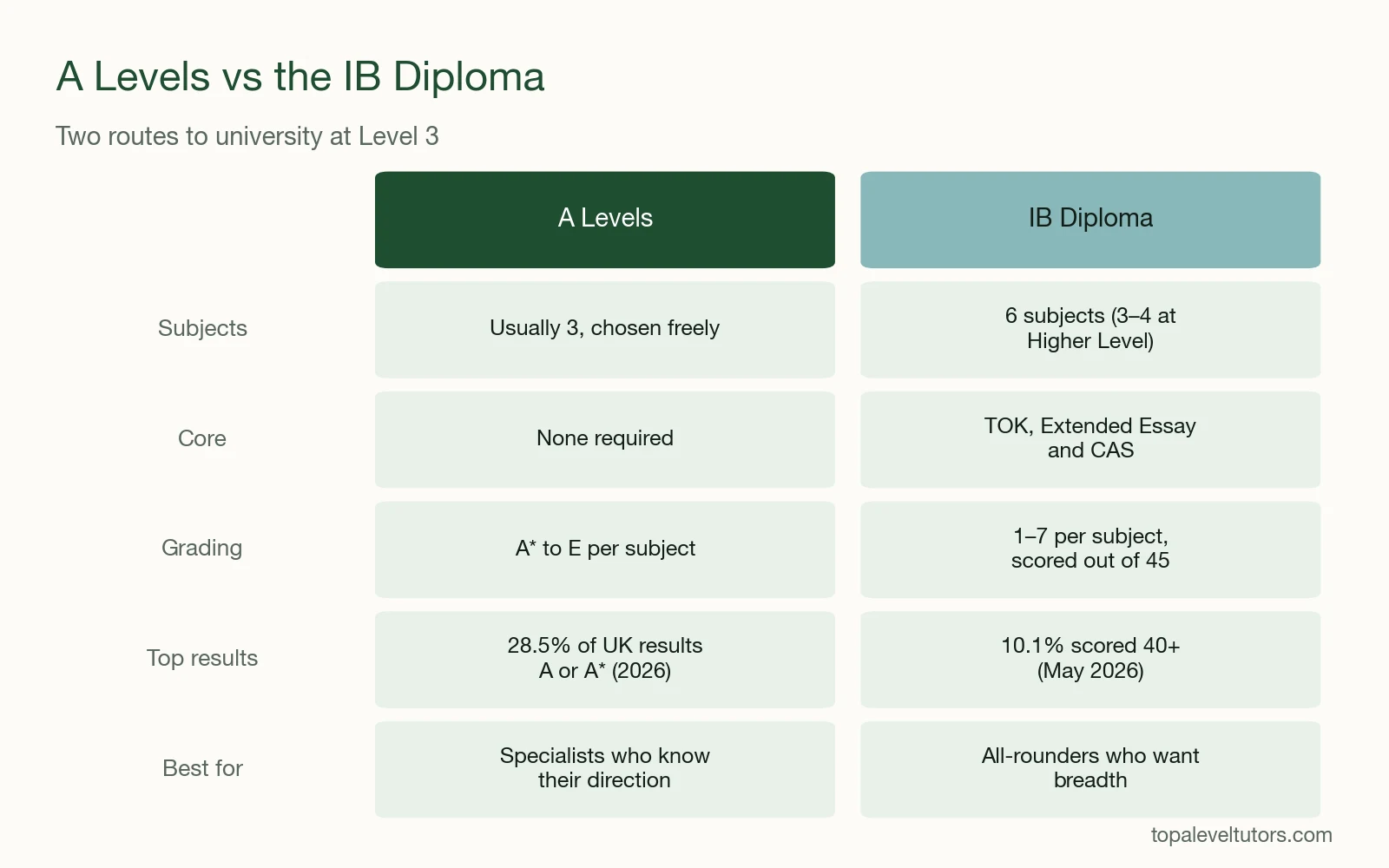
| Feature | A Levels | IB Diploma |
|---|---|---|
| Subjects | Usually 3, any combination | 6 across set groups (3–4 at Higher Level) |
| Compulsory core | None | TOK, Extended Essay, CAS |
| Grading | A* to E per subject | 1–7 per subject, total out of 45 |
| Assessment | Mostly final exams, some coursework | Exams plus internal assessments in every subject |
| Top results | 28.5% of UK results A or A* (2026) | 10.1% of candidates scored 40+ (2026) |
Which Is Harder, A Levels or the IB?
They're hard in different ways. A Levels go deeper in fewer subjects; the IB demands breadth and time management across six subjects and the core. In May 2026, the IB Diploma pass rate was 82.6% and the average score was 30.8 out of 45 (Top IB Tutors, 2026). For UK A Levels, 97.5% of results were a pass (JCQ, 2026).
Those pass rates aren't directly comparable. An IB pass needs a combined score and several conditions across all subjects, while an A Level pass is per subject. But they do show that the IB has more ways to fall short. A weak subject or an E in Theory of Knowledge can cost the whole Diploma.
From working with both groups of students, the clearest pattern is this: the IB punishes disorganisation, and A Levels punish shallow understanding. IB students who struggle are usually overwhelmed by deadlines across six subjects. A Level students who struggle usually haven't gone deep enough in one subject to handle unfamiliar exam questions.
How Do Universities Compare A Levels and the IB?
UK universities accept both and publish offers for each. Cambridge University, for example, asks for A*A*A at A Level for Computer Science, or 41–42 IB points with 776 at Higher Level (University of Cambridge, 2026). The UCAS Tariff gives an IB Higher Level 7 the same 56 points as an A* at A Level (Save My Exams, 2026).
Outside the UK, both are widely recognised. Cambridge says over 600 US universities accept Cambridge International A Levels (Cambridge International, 2026), and the IB is accepted around the world. Specific courses, especially medicine, have their own subject requirements under either route.
Who Should Choose A Levels?
A Levels are a strong choice if you already know your direction. A future engineer can take Mathematics, Further Mathematics and Physics and nothing else. That focus helps for competitive courses: over 97% of Cambridge Computer Science entrants who took A Levels also took Further Mathematics (University of Cambridge, 2026).
A Levels also suit students who are much stronger in some subjects than others. There's no compulsory language or science dragging down your overall result.
Who Should Choose the IB?
The IB suits students who enjoy many subjects, are well organised and like extended writing. The Extended Essay and Theory of Knowledge develop research and argument skills that universities value. It also keeps options open if you're unsure what to study, since you continue a language, a science and maths to 18.
The IB is more demanding on time. Internal assessments in every subject, plus the core, mean coursework deadlines run throughout both years.
We often meet families who chose the IB because it "keeps doors open", only for the student to find that a compulsory subject they dislike limits their total. If a student is clearly stronger in two or three areas, A Levels usually produce a stronger application. If they're consistently good across the board, the IB can showcase that.
Can You Switch Between A Levels and the IB?
Switching early in Year 12 is sometimes possible, but it gets harder quickly because the courses are structured so differently. If you're unsure, compare the subject combinations you'd take under each route, then check the entry requirements for two or three courses you might apply for. Our guide on how to choose A Level subjects walks you through that process.
Need Help With Either Route?
We support both: Top A-Level Tutors for A Level students and our sister company, Top IB Tutors, for IB students. Our tutors combine top recent graduates with qualified teachers and examiners, so you get support that matches your programme exactly.
Submit an application and we'll match you with the right tutor.
Frequently Asked Questions
Do universities prefer A Levels or the IB?
Neither. UK universities publish offers for both, such as A*A*A or 41–42 IB points for Cambridge Computer Science (University of Cambridge, 2026). What matters is your grades and whether your subjects match the course.
How many UCAS points is the IB worth compared with A Levels?
Each IB Higher Level 7 is worth 56 UCAS points, the same as an A* at A Level, and a Standard Level 7 is worth 28 (Save My Exams, 2026). Most competitive universities use grades or IB points rather than Tariff totals.
Is the IB more stressful than A Levels?
Many students find it more intense, because they juggle six subjects, internal assessments and the core at once. The IB pass rate was 82.6% in May 2026 (Top IB Tutors, 2026). A Levels concentrate pressure into fewer subjects and final exams.
Is the IB better for US universities?
Not necessarily. US universities accept both. Cambridge says over 600 US universities accept its A Levels, and many award credit for strong grades (Cambridge International, 2026). See our guide to A Levels for US universities.
The Bottom Line
- A Levels suit specialists; the IB suits organised all-rounders.
- Both are Level 3 qualifications accepted by universities worldwide.
- The IB has more ways to fall short; A Levels demand more depth per subject.
- Choose based on your strengths and the courses you're aiming for.
New to A Levels? Read our guide to what an A Level is.
Find the right A-Level tutor this week
If you are not happy after your first session with your tutor, please let us know and we will give you a full refund and find you another tutor for free.