

Predicted Grades: How They Work and How to Improve Yours
What predicted A Level grades are, how schools set them, how universities use them, how accurate they really are, and practical steps to earn higher predictions before your UCAS application.



Predicted grades are your teachers' professional judgement of the A Level grades you're likely to achieve, and UK universities use them to decide offers before you sit your exams. They're often wrong: a major study of UCAS data found only 16% of applicants' predicted grades were accurate, while 75% were over-predicted (Murphy and Wyness, 2020).
That gap matters, because predictions open or close doors months before results day. This guide explains how predictions are set and what you can do to earn strong, realistic ones.
Key Takeaways
- Predicted grades are set by your teachers, usually in Year 12 or early Year 13.
- Universities use them to decide whether to make you an offer.
- Only 16% of predictions were accurate in UCAS data; the average student was over-predicted by 1.7 grades.
- Mock exams, coursework and AS results are the main evidence teachers use.
What Are Predicted Grades?
A predicted grade is the grade your school believes you're likely to achieve if you keep working at your current level. Your school adds predictions to your UCAS application, along with a reference. Because most UK applications go in by 15 October or 13 January (University of Exeter, 2026), predictions are usually set many months before your exams.
Universities compare your predictions with their entry requirements. If a course asks for AAA and you're predicted AAB, you may not get an offer, even if you'd have achieved AAA on the day.
How Accurate Are Predicted Grades?
Not very. Analysing UCAS applications data across three years, Murphy and Wyness found that only 16% of applicants' predicted grades were accurate across their best three A Levels, 75% were over-predicted and the average student was over-predicted by 1.7 grades (Murphy and Wyness, 2020). About 8% were under-predicted (UCL IOE blog, 2020).
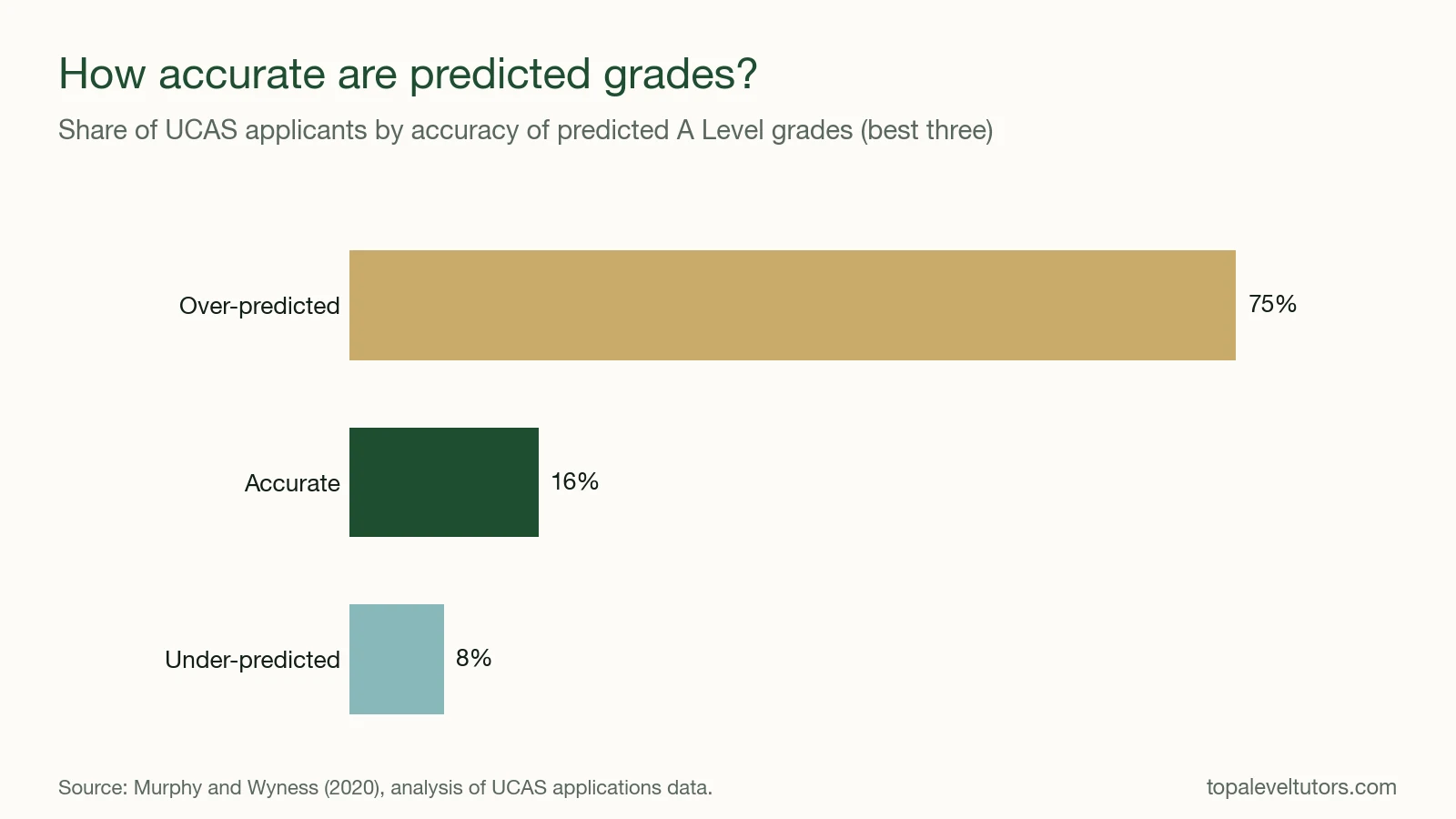
The study also found that high-attaining students were more likely to be predicted accurately, while lower-attaining students were most likely to be over-predicted. The data comes from before the pandemic, but universities still rely on the same system.
Because predictions tend to run high, universities know a predicted A* isn't a guarantee. That's why the most selective universities add admissions tests and interviews. An over-predicted student can get an offer and then miss it on results day. Your goal isn't just a high prediction; it's a prediction you can actually meet.
How Do Schools Set Predicted Grades?
Schools set predictions using evidence: Year 12 mock exams, end-of-topic tests, coursework, classwork and, where available, AS or unit results. Each school has its own policy, and teachers usually agree predictions in a department meeting, so one strong test rarely changes a prediction on its own.
Students on Cambridge International staged routes or Edexcel International A Levels have an extra source of evidence: real exam results by the end of Year 12. Our guide to AS Level vs A Level explains how those routes work.
How Can You Improve Your Predicted Grades?
Improve the evidence your teachers see. The Year 12 summer mocks are usually the single most important input, so prepare for them like real exams. Practice testing and spaced practice are the two most effective study methods in learning research (Dunlosky et al., 2013), and they work especially well for mock preparation.
Beyond that:
- Hand in every piece of homework and coursework on time and to a high standard.
- Ask each teacher what it would take to move your prediction up a grade.
- Show progress: a clear upward trend across Year 12 matters more than one result.
- If you have AS or unit exams, treat them as the most important tests of Year 12.
The students we work with who earn higher predictions usually do one thing differently: they ask their teachers for specific targets in the spring of Year 12, then show evidence of meeting them by the summer. Teachers want to predict high when the evidence supports it. Give them that evidence.
What If Your Predictions Are Too Low?
Talk to your teachers early and politely. Ask what evidence would change their view and whether a retest or extra assessment is possible. Don't wait until your UCAS application is being written, because by then predictions are usually fixed.
If your predictions stay below your target courses, apply to a mix: a couple of aspirational choices and some that match your predictions. In 2026, 28.5% of UK A Level results were A or A* (JCQ, 2026), so AAA predictions already put you ahead of most applicants.
What If You Miss Your Predicted Grades?
Many students do, given how often predictions run high. If you miss your offer, contact the university on results day; it may still accept you. Otherwise, your insurance choice or Clearing are next. Our guide to A Level results day 2027 explains every option.
Want to Earn Higher Predictions?
Strong Year 12 results are the best route to strong predicted grades. Our tutors combine top recent A Level graduates and qualified teachers and examiners, and they help students on UK, Cambridge International and Edexcel International A Levels prepare for the mocks and exams that shape predictions, in every major subject from Mathematics and Chemistry to Economics.
Submit an application and we'll match you with a tutor for your subjects.
Frequently Asked Questions
Who decides my predicted grades?
Your subject teachers, usually agreed within the department and approved by your school. They use mocks, tests, coursework and any AS or unit results. Universities know predictions tend to run high: only 16% are accurate (Murphy and Wyness, 2020).
When are predicted grades given?
Most schools set them in the summer term of Year 12 or early in Year 13, before UCAS applications. The earliest UCAS deadline for 2027 entry is 15 October 2026 (University of Exeter, 2026), so predictions for Oxbridge and medicine applicants are set very early.
Can predicted grades be changed?
Sometimes, if you show strong new evidence before your application is sent. After that, they're usually fixed. Ask your teachers early what would justify a higher prediction, and focus on your Year 12 mocks, which are the most influential evidence.
Do universities trust predicted grades?
They use them, but carefully, knowing 75% of applicants are over-predicted (Murphy and Wyness, 2020). Selective universities also use GCSE or IGCSE results, admissions tests and interviews to judge applicants.
The Bottom Line
- Predicted grades are teachers' judgements, and universities use them for offers.
- Only 16% are accurate; most run high, by 1.7 grades on average.
- Year 12 mocks, coursework and AS results are the main evidence.
- Earn higher predictions with strong, steady evidence across Year 12.
Next, see how to apply in our guide to UK universities for international students.
Find the right A-Level tutor this week
If you are not happy after your first session with your tutor, please let us know and we will give you a full refund and find you another tutor for free.