

Best A Levels for Computer Science: Maths First, Then What?
Which A Levels you need for a computer science degree: why Maths and Further Maths matter most, whether A Level Computer Science helps, typical offers, the TMUA and how competitive top courses are.





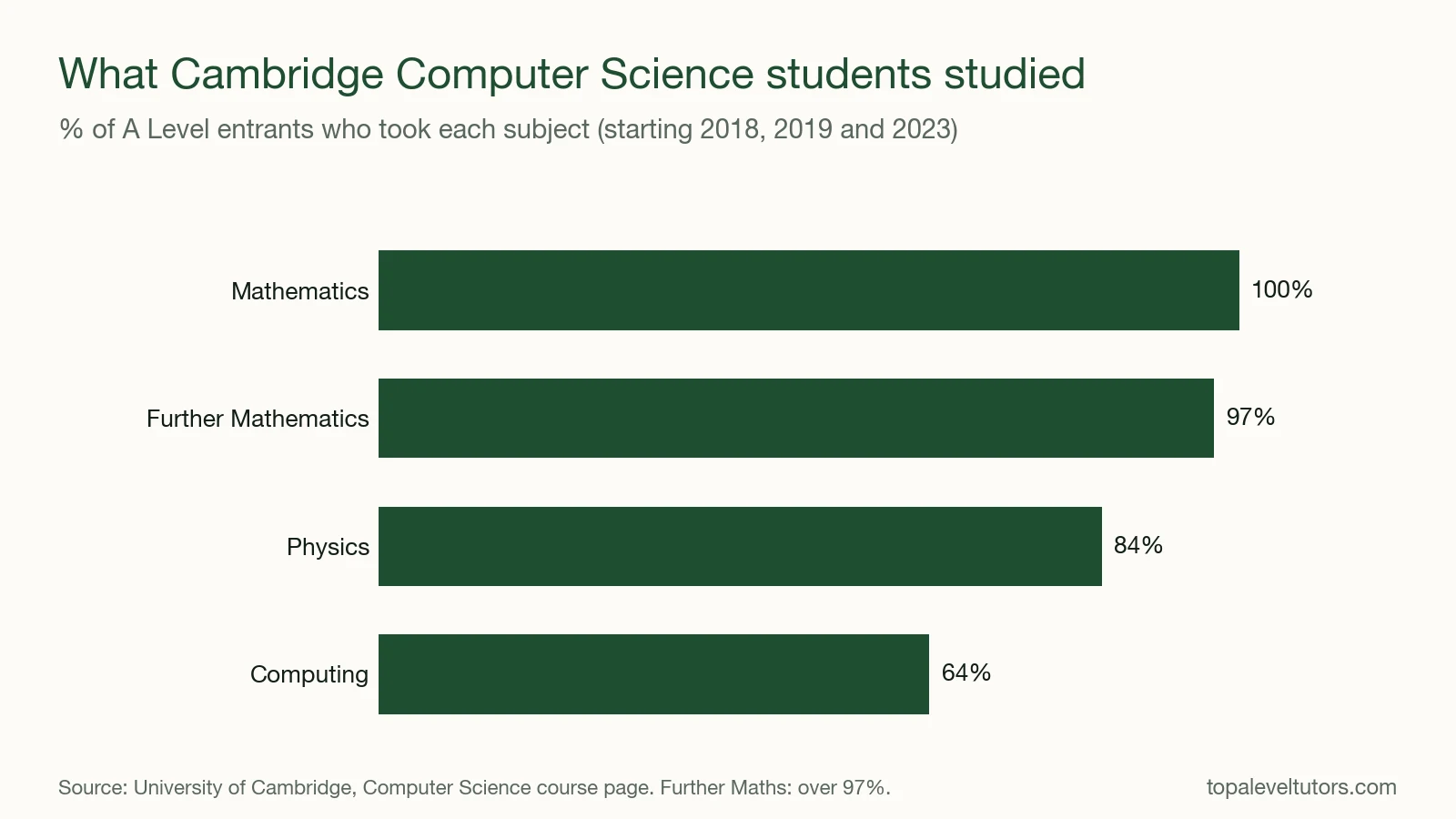
The best A Levels for computer science are Mathematics and Further Mathematics, with Physics or Computer Science as a third subject. At Cambridge, every Computer Science entrant who took A Levels studied Mathematics, over 97% also took Further Mathematics, 84% took Physics and 64% took Computing (University of Cambridge, 2026).
That pattern surprises many students, who expect A Level Computer Science to matter most. This guide explains why maths comes first and what top universities expect.
Key Takeaways
- Mathematics is essential; Further Mathematics is required or expected at top universities.
- A Level Computer Science is useful but not usually required.
- Cambridge Computer Science had 14 applications per place in 2025 and requires the TMUA.
- Cambridge's minimum offer is A*A*A, usually with an A* in Maths and/or Further Maths.
Which A Levels Do You Need for Computer Science?
Mathematics is required by almost every computer science degree, and top universities usually want an A* in it. Cambridge requires Mathematics and requires Further Mathematics to AS or A Level if your school offers it (University of Cambridge, 2026). Cambridge's subject guidance says Further Maths is "essential" for Computer Science (University of Cambridge, 2026).
| Subject | Role in a computer science application |
|---|---|
| Mathematics | Essential, usually at A* |
| Further Mathematics | Required or expected at top universities |
| Physics | Strong third subject Shows problem-solving |
| Computer Science | Useful, especially for programming experience |
Is A Level Computer Science Needed?
Usually not. Universities teach programming from the start, and most care more about mathematical ability. Only 64% of Cambridge Computer Science entrants took Computing at A Level (University of Cambridge, 2026). It's a good choice if you enjoy it, but it isn't a substitute for Further Maths.
It's also demanding. In June 2026, 30.1% of Cambridge International Computer Science candidates achieved A or A*, against 60.8% in Further Mathematics (Cambridge International, 2026).
Computer science degrees are closer to applied mathematics than to coding. Topics like algorithms, discrete maths, logic and probability dominate the first year. That's why Further Maths matters so much: it covers the kind of abstract reasoning these modules require, while most programming can be learned quickly at university.
How Competitive Is Computer Science?
At top universities, extremely. Cambridge Computer Science had 14 applications per place in the 2025 cycle and accepted 128 students (University of Cambridge, 2026). All applicants take the TMUA, and those applying to some Colleges also take the Computer Sciences Aptitude Test.
Grades are very high too: 87% of Cambridge Computer Science entrants who took A Levels achieved at least A*A*A*. Strong Maths and Further Maths results are the foundation of any competitive application.
What If Your School Doesn't Offer Further Maths?
Check with your target universities. Cambridge asks students to contact their shortlisted Colleges if Further Maths isn't available (University of Cambridge, 2026). Some students take it as a private candidate or study it independently with support. Our guide on whether Further Maths is worth it covers your options.
We work with many international students whose schools don't offer Further Maths. Studying it with a tutor alongside the school timetable is demanding but realistic, especially on Edexcel International, where you can sit units across several series. It's one of the most valuable things a computer science applicant can do.
Should You Learn to Code Before University?
It helps, but it isn't required. Building small projects shows genuine interest and gives you something to discuss in your personal statement and interviews. Focus first on Maths, Further Maths and the TMUA, then add coding projects you genuinely enjoy.
Aiming for Computer Science?
Top computer science degrees need excellent Maths and Further Maths. Our tutors combine top recent A Level graduates with qualified teachers and examiners, supporting Mathematics, Further Mathematics, Physics and Computer Science across UK, Cambridge International and Edexcel International boards.
Submit an application and we'll match you with a specialist tutor.
Frequently Asked Questions
Do you need A Level Computer Science for a computer science degree?
No. Most universities don't require it. At Cambridge, only 64% of Computer Science entrants took Computing at A Level, while all took Mathematics (University of Cambridge, 2026).
Is Further Maths required for computer science?
At top universities, effectively yes. Cambridge requires it where your school offers it, and over 97% of its Computer Science entrants took it (University of Cambridge, 2026). Many other universities recommend it.
What grades do you need for computer science at Cambridge?
The minimum offer is A*A*A, and Colleges usually ask for an A* in Mathematics and/or Further Mathematics. In practice, 87% of A Level entrants achieved at least A*A*A* (University of Cambridge, 2026).
Is Physics good for computer science?
Yes. It's the most common third subject among Cambridge Computer Science entrants, taken by 84% (University of Cambridge, 2026). It shows mathematical problem-solving and suits hardware-related courses.
The Bottom Line
- Mathematics is essential, and Further Mathematics is expected at top universities.
- A Level Computer Science helps but isn't required.
- Top courses are highly competitive and use admissions tests like the TMUA.
- Physics is the most common strong third subject.
Compare with the best A Levels for engineering.
Find the right A-Level tutor this week
If you are not happy after your first session with your tutor, please let us know and we will give you a full refund and find you another tutor for free.