

How to Choose A Level Subjects: A Step-by-Step Guide
A practical, step-by-step guide to choosing A Level subjects: how to check university requirements, which subjects keep options open, popular combinations for medicine, engineering, law and more, and mistakes to avoid.



The best way to choose A Level subjects is to work backwards from the degrees you might study, then pick subjects you're strong in and enjoy. It's an important decision: about two-thirds of A Level students in England take just three subjects (Ofqual, 2026), and those three can open or close university courses.
There's plenty of choice too. Cambridge International alone offers 55 AS & A Level subjects (Cambridge International, 2026). This guide gives you a clear four-step method, with advice from university admissions teams.
Key Takeaways
- Check degree requirements first: some courses need specific A Levels.
- If you're unsure, keep options open with traditional academic subjects such as maths, sciences, English, history and languages.
- Choose subjects where your GCSE or IGCSE results and interest are strongest.
- Cambridge University usually bases offers on three A Levels (University of Cambridge).
Why Do A Level Choices Matter So Much?
A Level choices matter because many degrees list required subjects, and you can't easily add an A Level later. Cambridge University, for example, says Further Mathematics is "essential if you want to study Mathematics or Computer Science" (University of Cambridge, 2026). Without it, those courses are effectively closed.
Choices also affect your grades. You'll spend two years and hundreds of hours on these subjects. Students who enjoy what they study tend to work harder and do better, and grades matter as much as subjects for most offers. Not sure how A Levels work yet? Start with our guide on what an A Level is.
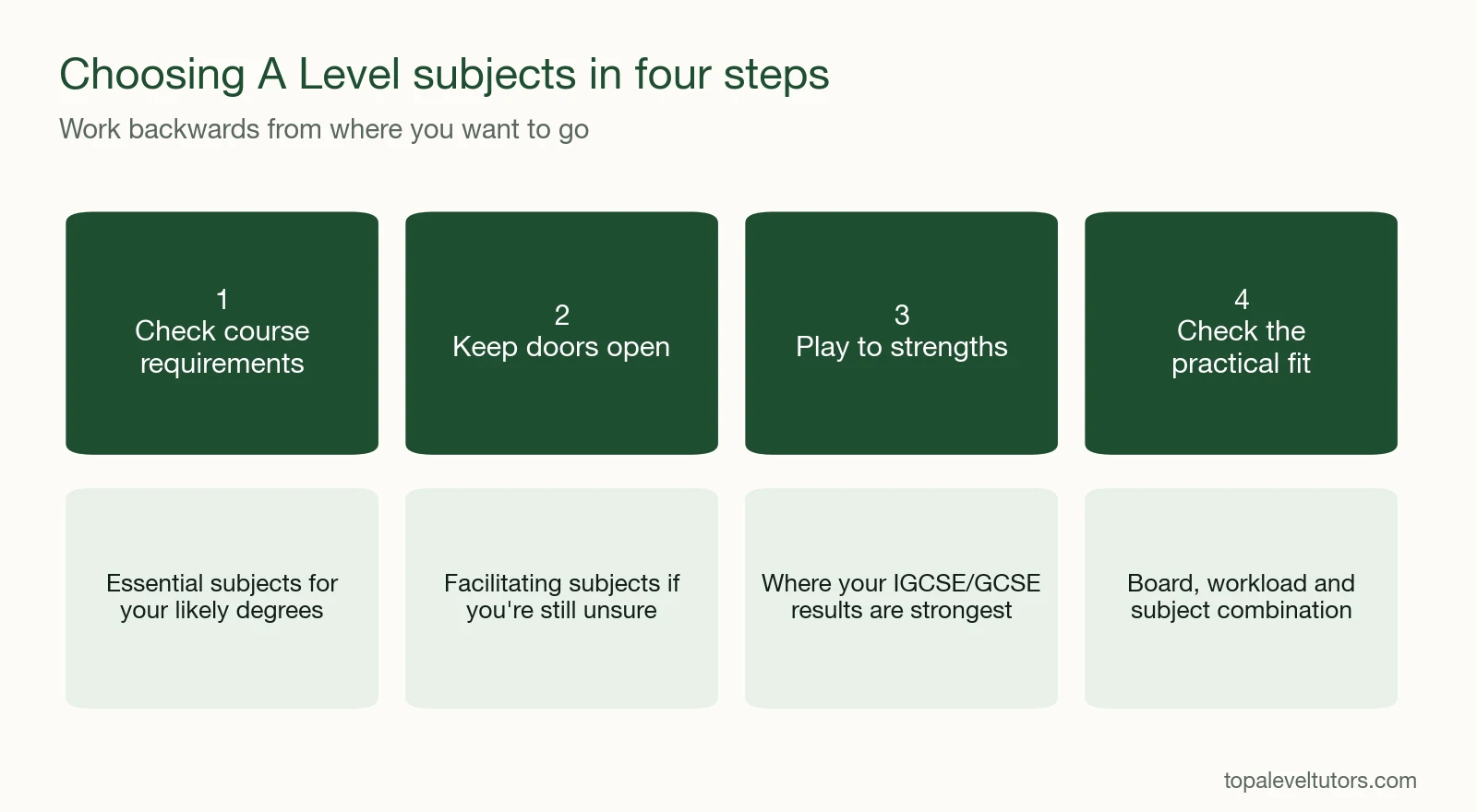
Step 1: Check Course Requirements
Start by listing two or three degree areas you might apply for, then check their entry requirements on university websites. Cambridge "strongly recommends" that science applicants choose three from Biology, Chemistry, Physics, Mathematics and Further Mathematics (University of Cambridge, 2026). Look for words such as "required", "essential" and "preferred".
Here are common patterns for UK degrees. Always confirm with each university, because requirements vary.
| Degree area | Usually required | Often useful |
|---|---|---|
| Medicine and dentistry | Chemistry, plus Biology or another science | Mathematics, Physics |
| Engineering | Mathematics, Physics | Further Mathematics |
| Mathematics | Mathematics, Further Mathematics | Physics |
| Computer Science | Mathematics (Further Maths at top universities) | Physics, Computer Science |
| Economics | Mathematics at many top universities | Further Mathematics, Economics |
| Law | No fixed subjects | History, English Literature, a language |
| Psychology | Often a science or Mathematics | Biology, Psychology |
If you're applying outside the UK, check there too. Universities in the US, Canada and Australia accept A Levels, but some programmes have their own subject rules, especially in medicine and engineering.
Step 2: Keep Your Options Open If You're Unsure
If you don't know what you want to study yet, choose subjects that many degrees accept. For arts, humanities and social sciences, Cambridge recommends choosing two of English Literature, a language, History or Mathematics (University of Cambridge, 2026). Maths and the sciences keep the widest range of STEM options open.
Mathematics deserves special mention. It's the most popular A Level in England, accounting for about one in eight results in 2026 (Ofqual, 2026). That's because it supports so many degrees, from Economics to Engineering to Psychology.
Be careful with subjects that top universities value less. Cambridge describes vocational A Levels such as Business, Media Studies, Photography and Travel and Tourism as "less useful" for its courses (University of Cambridge, 2026). They're fine as part of a mix, but don't build your whole programme around them if you're aiming for the most selective universities.
Step 3: Play to Your Strengths
Choose subjects where you've done well at GCSE or IGCSE and where you enjoy the work. A Levels are much harder than GCSEs, so a subject you found difficult at 15 is unlikely to get easier. In Cambridge International Physics, only 33.1% of candidates achieved A or A* in June 2026 (Cambridge International, 2026).
A useful test is to look at the A Level specification for each subject. Read the topic list and a sample exam paper. Ask yourself honestly whether you'd want to spend two years on this material.
Interest is a better predictor than a single good GCSE grade. We regularly see students choose a subject because they got a 9 or an A* at GCSE, then lose motivation when the A Level turns out to be very different. History at A Level is about argument and sources, not stories. Maths is far more abstract. Read the specification before you decide, not after.
Step 4: Check the Practical Fit
Finally, check that your combination actually works in practice. Look at your school's timetable blocks, the exam board for each subject and the workload. Some combinations overlap helpfully: Mathematics with Physics, or Biology with Chemistry. Others pile up essays, such as History, English Literature and Politics.
Think about assessment style too. Some students thrive in essay subjects; others prefer problem-solving. The share of top grades varies by subject. In England in 2026, 42.2% of Maths results were A or A*, against 24.8% in History (Tes, 2026).
At international schools, the subjects on offer may be limited. If your school doesn't offer a subject you need, ask whether you can take it as a private candidate. Cambridge advises students whose school limits their subject choices to contact a College admissions office for advice (University of Cambridge, 2026).
Should You Take Three or Four A Levels?
Three is the standard, and Cambridge says its offers "are usually based on 3 A levels taken together in Year 13" (University of Cambridge, 2026). A fourth only helps if it's Further Mathematics for a maths-heavy degree, or if you're unsure in Year 12 and plan to drop one.
For Computer Science, Economics, Engineering and Physical Natural Sciences, Cambridge usually expects Further Maths as a fourth A Level if your school offers it. For most other courses, three strong grades beat four average ones. Our guide to A Level points explains why extra subjects rarely add value.
What Mistakes Should You Avoid?
The most common mistake is choosing subjects because of friends, a favourite teacher or a reputation for being "easy". Subjects seen as easy often aren't. In Cambridge International Sociology, only 14.6% of candidates got A or A* in June 2026 (Cambridge International, 2026).
Other mistakes to avoid:
- Not checking requirements until Year 13, when it's too late to change.
- Taking four subjects with no plan to drop one, and spreading yourself too thin.
- Ignoring how a subject is assessed, such as heavy coursework or long essays.
- Picking a subject you've never studied without reading the specification first.
We often help students who chose a subject for the wrong reason and want to switch in the first term of Year 12. Switching is possible early on, but the later you leave it, the more catching up you'll have to do. If you're having doubts, talk to your school in the first half-term, not after the mocks.
Comparing subjects by difficulty? See our analysis of the hardest A Levels and easiest A Levels.
Need Help With Your A Level Choices?
Choosing well, then doing well, is the strongest foundation for a university application. Our tutors are a combination of top recent A Level graduates and qualified teachers and examiners. They can help you understand what each subject really involves and support you through UK, Cambridge International or Edexcel International A Levels.
Submit an application and we'll match you with the right tutor.
Frequently Asked Questions
What are the best A Level subjects to take?
The best subjects are the ones your target degrees require and that you're strong in. If you're unsure, Mathematics, the sciences, English Literature, History and languages keep the most options open. Maths is England's most popular A Level, at about one in eight results in 2026 (Ofqual, 2026).
Do universities care which A Levels you take?
Yes, especially for competitive courses. Cambridge requires Further Mathematics for Mathematics and Computer Science and calls vocational subjects like Media Studies "less useful" (University of Cambridge, 2026). Less selective courses are usually more flexible about subjects.
What A Levels do you need for medicine?
Most UK medical schools require Chemistry, and many also want Biology or another science. Strong grades matter too: in Cambridge International Chemistry, 38.0% of candidates achieved A or A* in June 2026 (Cambridge International, 2026). Check each medical school's requirements.
Can I change my A Level subjects after starting?
Usually, yes, within the first few weeks of Year 12, depending on your school's timetable. The later you switch, the more content you'll need to catch up on. With about two-thirds of students in England taking three subjects (Ofqual, 2026), most schools build some flexibility into Year 12.
Is it better to take four A Levels?
Usually not. Cambridge bases most offers on three A Levels, and only expects a fourth (Further Mathematics) for some STEM and economics courses (University of Cambridge, 2026). Three excellent grades are worth more than four good ones.
The Bottom Line
- Work backwards from the degrees you might apply for.
- Keep options open with traditional academic subjects if you're unsure.
- Choose subjects you're strong in and genuinely interested in.
- Check timetable, board and workload before you commit.
Next, find out what grades you'll need in our guide to A Level grades.
Find the right A-Level tutor this week
If you are not happy after your first session with your tutor, please let us know and we will give you a full refund and find you another tutor for free.