

Best A Levels for Engineering: Maths, Physics and What Else?
Which A Levels you need for engineering: why Maths and Physics are essential, how much Further Maths helps, the best third subject for each branch of engineering, typical grades and admissions tests.



The best A Levels for engineering are Mathematics and Physics, with Further Mathematics as a third subject if your school offers it. Cambridge requires Mathematics and Physics, strongly encourages Further Mathematics and asks for at least A*A*A (University of Cambridge, 2026). Most UK engineering degrees require Maths, and nearly all want Physics.
This guide explains why those subjects matter, which third subject suits each branch of engineering and what grades top universities expect.
Key Takeaways
- Mathematics and Physics are essential for almost every engineering degree.
- Further Mathematics is strongly encouraged by top universities.
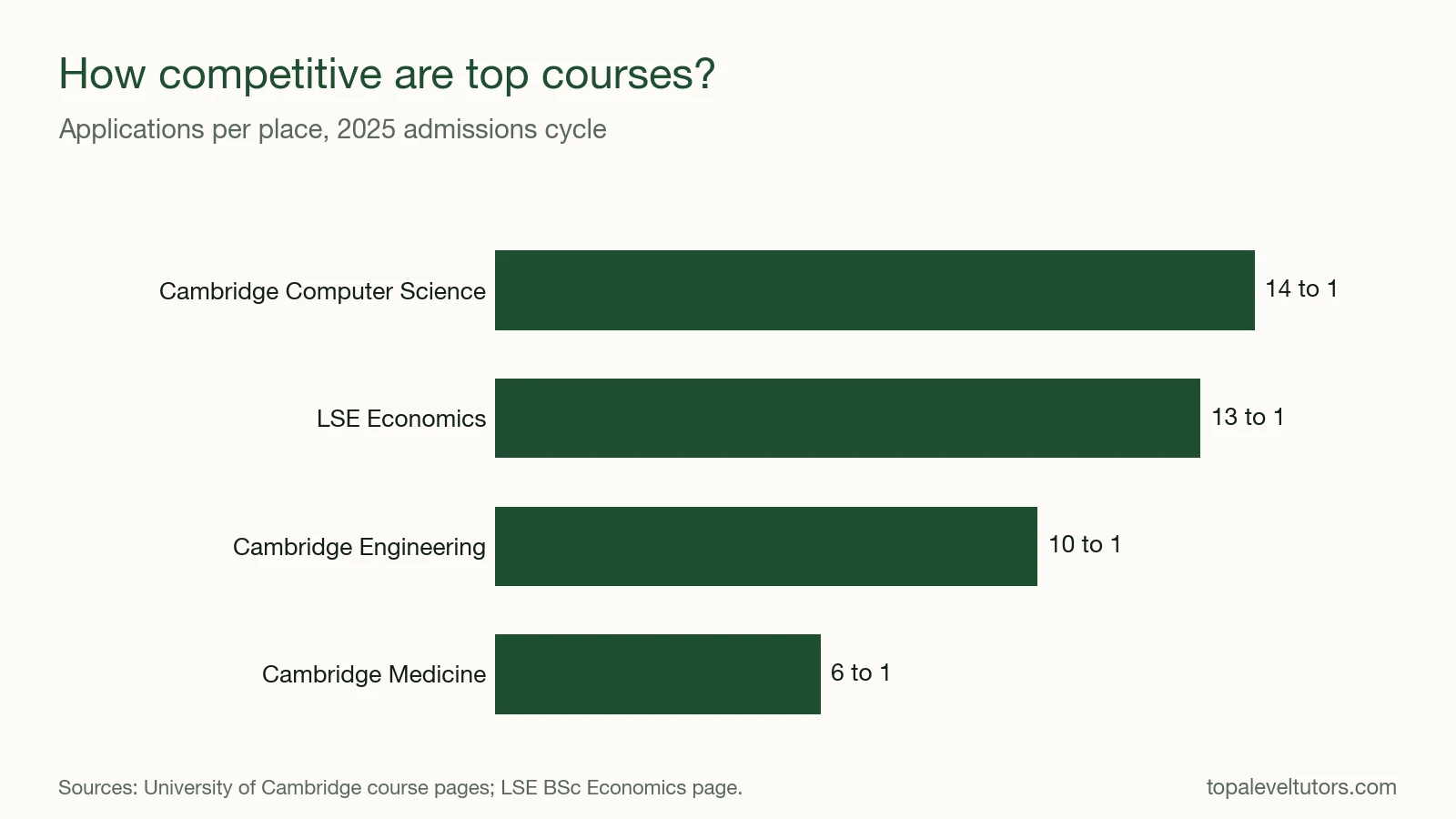
- Cambridge Engineering had 10 applications per place in 2025 and requires the ESAT.
- Chemistry is the best third subject for chemical engineering.
Which A Levels Do You Need for Engineering?
Mathematics is required for almost every engineering degree, and Physics is required or strongly preferred by nearly all of them. Cambridge requires both and usually asks for an A* in Mathematics and/or Further Mathematics, often with an A* in Physics or another science too (University of Cambridge, 2026).
Engineering is applied maths and physics, so these subjects are the foundation of the first year at university. Students without them struggle to keep up, which is why universities insist on them.
| Branch of engineering | Essential | Best third subject |
|---|---|---|
| Mechanical, civil, aeronautical | Maths, Physics | Further Maths |
| Electrical and electronic | Maths, Physics | Further Maths or Computer Science |
| Chemical | Maths, Chemistry | Physics or Further Maths |
| Biomedical | Maths, Physics or Chemistry | Biology or Further Maths |
| Software and computer | Maths | Further Maths, Physics or Computer Science |
Is Further Maths Needed for Engineering?
It isn't always required, but it's strongly encouraged at top universities. Cambridge says Further Mathematics is "very useful" for Engineering, and usually expects it as a fourth A Level where it's offered (University of Cambridge, 2026). It covers topics, such as complex numbers and differential equations, that appear early in engineering degrees.
Students who take it do very well: in June 2026, 60.8% of Cambridge International Further Mathematics candidates achieved A or A* (Cambridge International, 2026). Our guide to whether Further Maths is worth it looks at the trade-offs.
How Competitive Are Top Engineering Courses?
Very competitive at the top. Cambridge Engineering had 10 applications per place in the 2025 cycle and accepted 335 students (University of Cambridge, 2026). Applicants also sit the ESAT (Engineering and Science Admissions Test), covering two maths sections and physics.
Admissions tests like the ESAT don't test new content. They test whether you can use A Level Maths and Physics quickly and flexibly under pressure. The best preparation is solid A Level knowledge plus timed practice on unfamiliar problems, which is also exactly what wins top A Level grades.
What Grades Do You Need for Engineering?
Top universities ask for A*A*A to A*AA, usually with an A* in Mathematics. Many other strong universities ask for AAA to ABB. In June 2026, only 33.1% of Cambridge International Physics candidates and 37.1% of Mathematics candidates achieved A or A* (Cambridge International, 2026).
Those figures show how demanding the core subjects are. Strong grades in both are what separates successful engineering applicants.
The engineering applicants we work with usually find Physics harder than Maths, mostly because Physics questions combine maths with unfamiliar contexts. We focus on problem-solving method: sketching the situation, identifying the principle and only then calculating. That approach lifts Physics grades and ESAT scores together.
Should Your Third Subject Be Chemistry or Computer Science?
Choose based on the branch of engineering. Chemistry is essential for chemical engineering and helpful for materials and biomedical engineering. Computer Science suits electrical, electronic and software engineering. If you're unsure, Further Mathematics is the safest choice because every branch values it.
Avoid choosing a third subject only because it seems easier. Engineering admissions tutors want evidence you can handle mathematical, technical work.
When Should You Prepare?
Start in Year 12. Cambridge's ESAT and similar tests are taken in the autumn of Year 13, and most applications are due by 13 January 2027, or 15 October 2026 for Oxford and Cambridge (University of Exeter, 2026). Build strong maths habits early and practise test-style questions alongside your A Levels.
Aiming for Engineering?
Engineering needs top grades in Maths and Physics. Our tutors combine top recent A Level graduates with qualified teachers and examiners, supporting Mathematics, Further Mathematics and Physics students across UK, Cambridge International and Edexcel International boards.
Submit an application and we'll match you with a specialist tutor.
Frequently Asked Questions
Can you do engineering without A Level Physics?
At some universities, yes, especially for chemical or software engineering, but most want Physics. Cambridge requires both Mathematics and Physics for Engineering (University of Cambridge, 2026). Without Physics, your choice of courses narrows significantly.
Do you need A Level Maths for engineering?
Yes, almost always. Mathematics is the core of every engineering degree, and top universities usually ask for an A* in it. In June 2026, 16.9% of Cambridge International Mathematics candidates achieved A* (Cambridge International, 2026).
What is the ESAT?
The Engineering and Science Admissions Test is used by Cambridge for Engineering and other science courses. It covers Mathematics 1, Mathematics 2 and Physics, and must be taken at an authorised centre (University of Cambridge, 2026).
Is Design and Technology useful for engineering?
It can show practical interest, but it doesn't replace Mathematics or Physics. Most top universities prefer Further Mathematics or Chemistry as a third subject. Cambridge strongly encourages Further Mathematics for Engineering (University of Cambridge, 2026).
The Bottom Line
- Mathematics and Physics are essential for engineering.
- Further Mathematics is strongly encouraged by top universities.
- Top courses ask for A*A*A to A*AA and admissions tests like the ESAT.
- Choose your third subject based on your branch of engineering.
Comparing courses? See the best A Levels for computer science.
Find the right A-Level tutor this week
If you are not happy after your first session with your tutor, please let us know and we will give you a full refund and find you another tutor for free.