

A Level Physics Past Papers: Where to Find Them and How to Use Them
Where to find official A Level Physics past papers for AQA, Edexcel, OCR, Cambridge International and Edexcel International, how each board's exams work, including practical skills, and how to grade your practice.



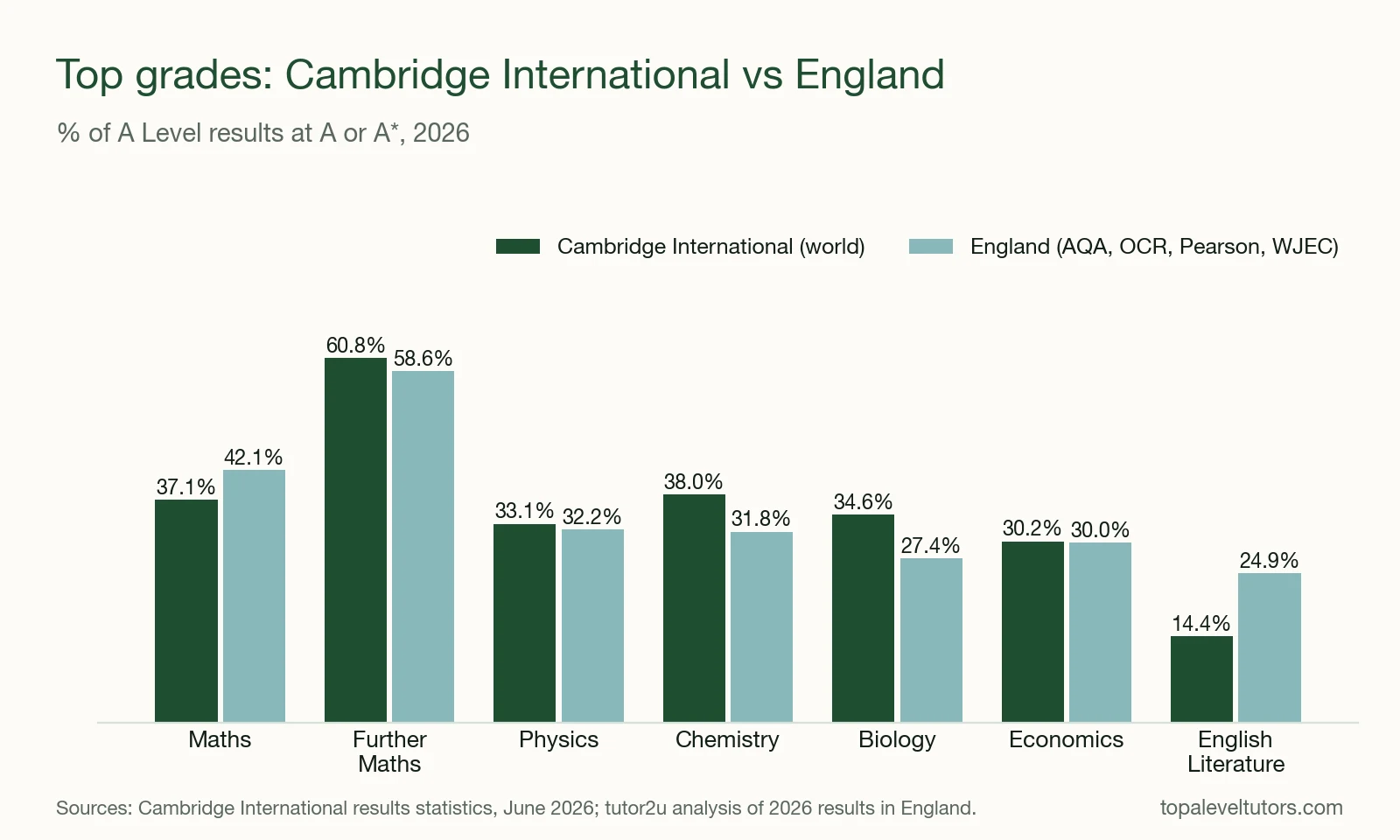
Official A Level Physics past papers come from your exam board: AQA, Pearson Edexcel or OCR in the UK, and Cambridge International or Pearson Edexcel International at most international schools. Top grades are scarce on every board. In 2026, 32.2% of Physics results in England were A or A\* (tutor2u, 2026), and 33.1% of Cambridge International candidates achieved A or A\* (Cambridge International, 2026).
This guide shows where to find official papers for each board, how the exams are structured and how to turn past papers into marks.
Key Takeaways
- Use official papers and mark schemes from your own board and specification.
- UK boards set three papers; Cambridge sets five; Edexcel International sets six units.
- Practical skills are examined on every board, so practise graphs, uncertainties and planning.
- About a third of Physics students get A or A\*, in the UK and internationally.
Where Can You Find Official Physics Past Papers?
Every board publishes papers free, with different rules. Pearson keeps papers from the most recent 12 months for teachers only (Pearson, 2026). AQA's summer 2026 papers reach its public website on 9 July 2027 (AQA, 2026).
| Board | Specification | Where to find papers | Access |
|---|---|---|---|
| AQA | Physics 7408 | AQA past papers | Public about a year after the exam |
| Pearson Edexcel (UK) | Physics 9PH0 | Pearson past papers | Free, except papers from the last 12 months |
| OCR | Physics A H556 | OCR past paper finder | Public The newest papers may be restricted |
| Cambridge International | Physics 9702 | Cambridge 9702 past papers | Public selection Full archive for schools |
| Pearson Edexcel International | Physics YPH11 | Pearson past papers | Free, except papers from the last 12 months |
Cambridge's public 9702 page offers a selection, such as the June 2024 question papers, mark schemes, examiner report and practical instructions, with the full archive on the School Support Hub (Cambridge International, 2026). On any board, your school can usually give you newer papers.
How Are AQA, Edexcel and OCR Physics Papers Structured?
UK A Level Physics is linear, with three papers at the end of Year 13. AQA's three papers are each 2 hours, worth 85, 85 and 80 marks (AQA, 2026). OCR's Physics A uses two 2 hour 15 minute papers and a shorter unified paper (OCR, 2026).
| Board | Paper 1 | Paper 2 | Paper 3 |
|---|---|---|---|
| AQA (7408) | 2 hr, 85 marks (34%) | 2 hr, 85 marks (34%) | 2 hr, 80 marks (32%): practical skills, data analysis and an optional topic |
| Pearson Edexcel (9PH0) | 1 hr 45 min, 90 marks | 1 hr 45 min, 90 marks | 2 hr 30 min, 120 marks: general and practical principles |
| OCR (H556) | 2 hr 15 min, 100 marks | 2 hr 15 min, 100 marks | 1 hr 30 min, 70 marks: unified physics |
Practical skills are tested inside these written papers. In England, you also receive a separate practical endorsement, reported as a pass alongside your grade. AQA papers include multiple choice questions in Papers 1 and 2, so practise those under time pressure too.
How Are the Cambridge 9702 Physics Papers Structured?
Cambridge A Level Physics has five papers. Paper 4, the A Level structured paper, is the largest at 38.5% of the A Level. Papers 3 and 5 test practical skills and together make up 23% (Cambridge International, 2026).
| Paper | Time | Marks | Weighting |
|---|---|---|---|
| 1: Multiple Choice | 1 hr 15 min | 40 | 31% of AS / 15.5% of A Level |
| 2: AS Level Structured Questions | 1 hr 15 min | 60 | 46% of AS / 23% of A Level |
| 3: Advanced Practical Skills | 2 hr | 40 | 23% of AS / 11.5% of A Level |
| 4: A Level Structured Questions | 2 hr | 100 | 38.5% of A Level |
| 5: Planning, Analysis and Evaluation | 1 hr 15 min | 30 | 11.5% of A Level |
Paper 3 is a laboratory practical, so its past papers come with confidential instructions for your school to set up the apparatus. Even without a lab, you can practise the graph drawing, gradient and uncertainty parts.
How Are Edexcel International Physics Papers Structured?
Pearson Edexcel International A Level Physics (YPH11) has six units. Units 1 and 2 are 1 hour 30 minutes and 80 marks; Units 4 and 5 are 1 hour 45 minutes and 90 marks; Units 3 and 6 are 1 hour 20 minute written papers on practical skills, worth 50 marks each (Pearson, 2018).
For the A\*, you need an A overall and at least 270 uniform marks on the A2 units (Pearson, 2026). Our guide to how A Level grades are calculated explains how each board totals marks.
How Should You Use Physics Past Papers?
Use them as tests. Practice testing was rated one of only two "high utility" techniques in a major review of learning methods (Dunlosky et al., 2013). Physics papers reward applying ideas to unfamiliar situations, and only practice with real questions builds that skill.
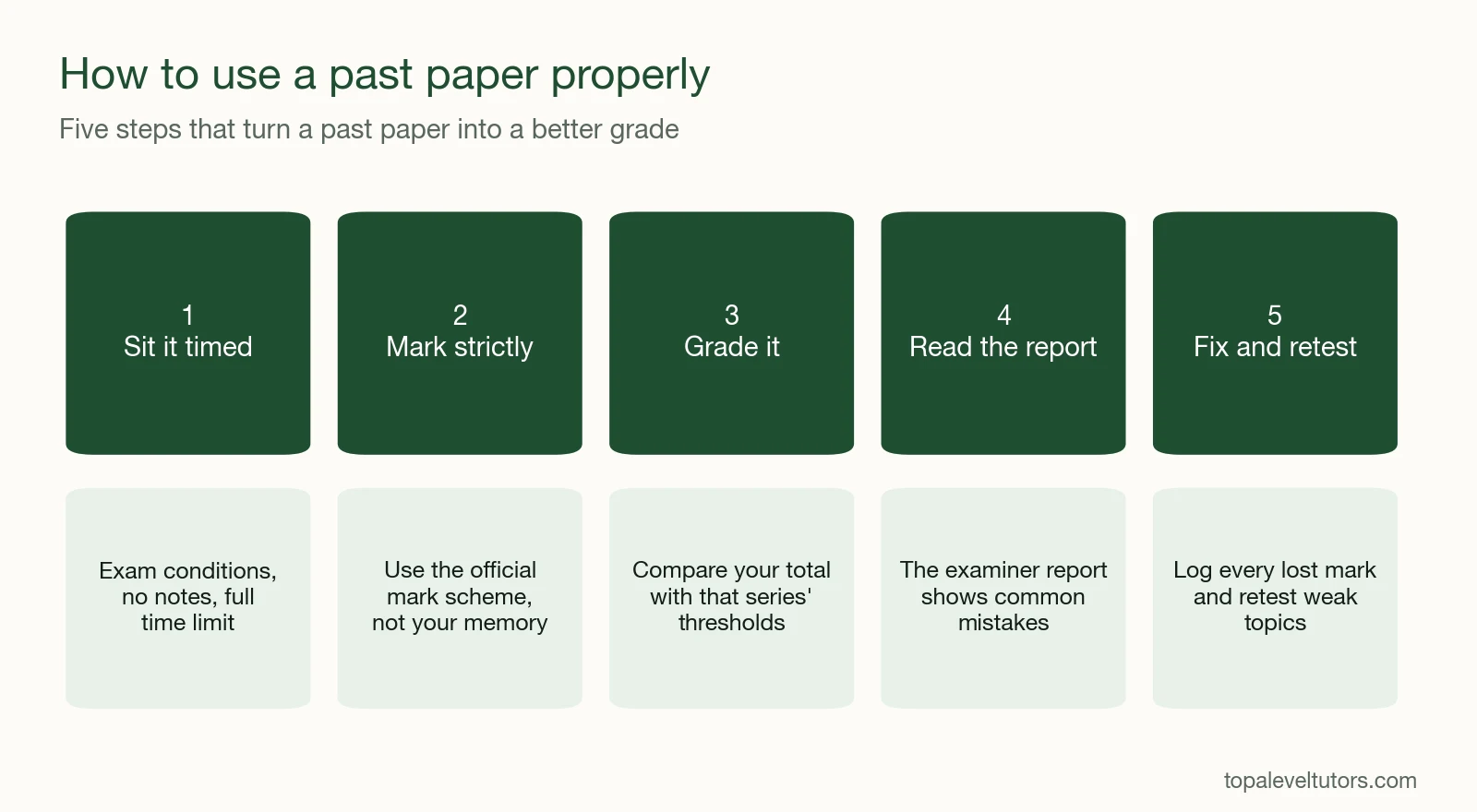
Mark strictly against the mark scheme. Physics mark schemes on every board are precise about units, significant figures and key words. An answer of "9.8" with no unit, or a definition missing one key word, can lose a mark you thought you'd earned. Keep a list of these slips; they're usually the easiest marks to recover.
Some papers are marked much harder than others, so grade each with its own boundary. In Cambridge's June 2026 series, an A on Paper 4 needed 59 out of 100, but an A on the practical Paper 3 needed 33 out of 40 (Cambridge International, 2026). The lesson applies to every board: careless errors on accessible papers are costly, and partial answers to hard questions still count. Never leave a question blank.
When Should You Start Physics Past Papers?
Start with topic questions after each topic in Year 12, then move to full papers once the course is covered. Practise practical and planning questions early, because they need a different skill from recalling theory: designing an experiment and analysing data. Spaced practice over months works better than cramming (Dunlosky et al., 2013).
Save the most recent series for timed mocks in the final month. Our guide on how to revise for A Levels includes a month-by-month plan.
What Grade Can You Expect in A Level Physics?
Physics is one of the harder subjects for top grades. In England in 2026, 11.4% of Physics results were A\* and 32.2% were A or A\* (tutor2u, 2026). Among Cambridge International candidates, 13.6% got A\* and 33.1% got A or A\* (Cambridge International, 2026).
The Physics students we tutor often know the theory well but lose marks on multi-step calculations and "explain" questions. The fix is practice with feedback: working through structured questions, comparing each line with the mark scheme and learning the exact phrasing examiners reward. Our hardest A Levels guide explains why Physics is so demanding.
Want Help With A Level Physics?
Physics past papers show exactly where marks slip away. Our tutors combine top recent A Level graduates and qualified teachers and examiners, with specialists in AQA, Edexcel, OCR, Cambridge and Edexcel International Physics. See our A Level Physics tutoring.
Submit an application and we'll match you with a Physics tutor.
Frequently Asked Questions
Where can I find AQA and Edexcel A Level Physics past papers?
On each board's website. AQA publishes papers about a year after the exam, and Pearson makes them free once they're more than 12 months old (AQA, 2026; Pearson, 2026). Ask your teacher for anything newer.
Where can I find Cambridge 9702 Physics past papers?
Cambridge publishes a selection, such as the June 2024 papers, mark schemes and examiner report, on its public 9702 page. The full archive is on the School Support Hub for registered schools (Cambridge International, 2026).
How can I practise practical questions without a lab?
Focus on the parts that don't need apparatus: recording data, plotting graphs, finding gradients and calculating uncertainties. On Cambridge, the two practical skills papers are worth 23% of the A Level (Cambridge International, 2026), and UK boards test the same skills in written papers.
Is the multiple choice section worth practising?
Yes. Cambridge's Paper 1 is worth 15.5% of the A Level, with 40 questions in 75 minutes (Cambridge International, 2026), and AQA includes 25 multiple choice questions in each of Papers 1 and 2. Practise under time pressure and review every wrong answer.
The Bottom Line
- Use official papers and mark schemes from your own board.
- UK boards: three papers; Cambridge: five; Edexcel International: six units.
- Practise practical skills, units and significant figures, not just theory.
- About a third of Physics students get A or A\*, wherever they sit the exam.
Studying Chemistry too? See our A Level Chemistry past papers guide.
Find the right A-Level tutor this week
If you are not happy after your first session with your tutor, please let us know and we will give you a full refund and find you another tutor for free.