

Best A Levels for Law: What Top Universities Really Want
Which A Levels are best for a law degree: why no subjects are required, which ones build the skills law schools value, whether A Level Law helps, typical grades and how the LNAT works for 2027 entry.





No specific A Levels are required for law. Cambridge says plainly: "We don't ask for any specific subjects to apply to Law" (University of Cambridge, 2026). But essay-based subjects such as History, English Literature and a language build exactly the skills law degrees demand: reading closely, building arguments and writing precisely.
What matters most is grades and the LNAT. This guide explains which subjects help, whether A Level Law is worth taking and what top law schools expect.
Key Takeaways
- No A Levels are required for law, even at Cambridge.
- History, English Literature, languages, Economics and Mathematics all suit law well.
- Cambridge's minimum offer for Law is A*AA, plus the LNAT.
- A Level Law isn't needed and isn't preferred by top law schools.
Which A Levels Are Best for Law?
The best A Levels for law are rigorous, essay-based or analytical subjects in which you can achieve top grades. Common choices among past Cambridge Law applicants include English, History, languages, Economics, Law, Mathematics, Psychology and a science, although Cambridge notes that this doesn't mean those subjects are preferred (University of Cambridge, 2026).
| Subject | Why it helps for law |
|---|---|
| History | Evaluating evidence and building arguments |
| English Literature | Close reading and precise written analysis |
| A modern language | Precision with language Useful for international law |
| Economics | Analytical thinking Links to commercial law |
| Mathematics | Logical reasoning Valued by many law schools |
Is A Level Law Useful for a Law Degree?
It's not needed, and top law schools don't prefer it. Cambridge doesn't require it, and Cambridge's general subject advice lists English Literature, History and languages among the most useful choices for arts and humanities courses (University of Cambridge, 2026). A Level Law covers some degree content, but universities start from scratch anyway.
It's also not an easy option. In June 2026, only 13.1% of Cambridge International A Level Law candidates achieved A or A*, and 16.5% were ungraded (Cambridge International, 2026).
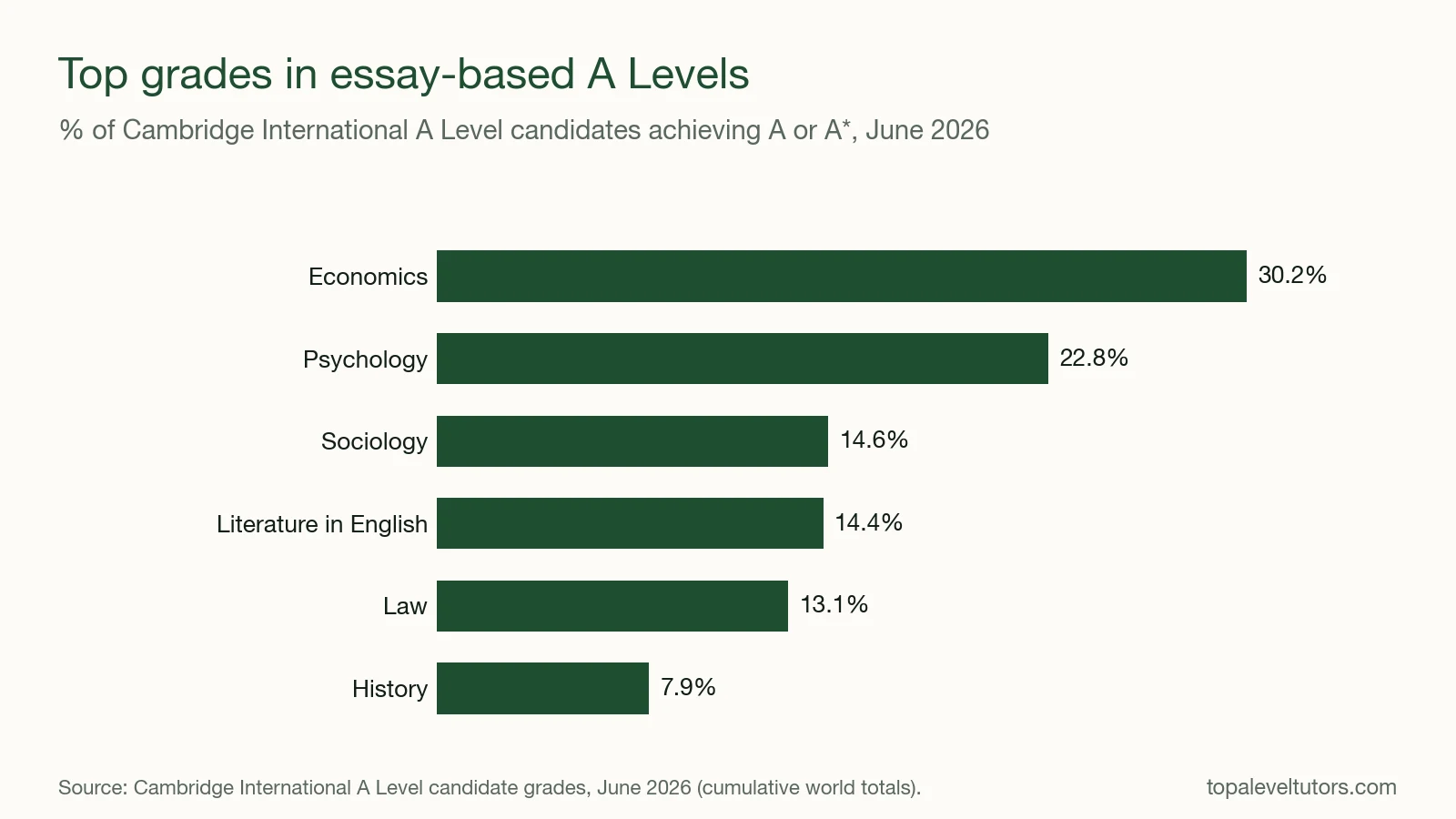
The data shows that essay-based A Levels are among the hardest to get top grades in. That's actually good news for law applicants: a top grade in History or English Literature is a strong signal to admissions tutors, precisely because it's hard to achieve. It's evidence of the reading and argument skills law demands.
What Grades Do You Need for Law?
Top law schools ask for A*AA to AAA. Cambridge's minimum offer for Law is A*AA (University of Cambridge, 2026). In England in 2026, only 24.8% of History results and 25.0% of English Literature results were A or A* (Tes, 2026), so these offers put you well above average.
What Is the LNAT?
The LNAT (National Admissions Test for Law) is required by a group of leading UK law schools, including Oxford, Cambridge, UCL, LSE, King's College London, Durham, Bristol and Glasgow. All Cambridge Law applicants must take it at an authorised centre (University of Cambridge, 2026). It tests reading comprehension and argument, plus a short essay.
For 2027 entry, LNAT testing began on 1 September 2026 (LNAT, 2026). Deadlines differ by university, so Oxford and Cambridge applicants need to sit the test well before other applicants. Check each university's LNAT deadline as soon as you shortlist.
Students preparing for the LNAT with us often find that their best preparation is the same as for A Level History or English: reading opinion pieces critically, spotting assumptions and writing tight arguments under time limits. Strong essay subjects and LNAT practice reinforce each other.
How Should International Students Approach Law?
Think about where you want to practise. A UK law degree (LLB) is valued internationally and is the standard route in many Commonwealth countries, but qualifying in your home country may need extra steps. English language skills matter more in law than almost any other subject, so strong A Level essay grades help your application and your degree.
Our guide to applying to UK universities as an international student covers deadlines, visas and offers.
Aiming for Law?
Law rewards strong writing and top grades in essay subjects. Our tutors combine top recent A Level graduates with qualified teachers and examiners, supporting History, English Literature, Economics and Law students across UK, Cambridge International and Edexcel International boards.
Submit an application and we'll match you with a tutor for your subjects.
Frequently Asked Questions
Do you need A Level Law to study law?
No. Cambridge states that it doesn't ask for any specific subjects to apply to Law (University of Cambridge, 2026). Most top law schools are happy with any rigorous combination, especially essay subjects.
Is A Level Law hard?
Yes, for top grades. In June 2026, only 13.1% of Cambridge International A Level Law candidates achieved A or A* (Cambridge International, 2026). It requires precise application of legal rules and evaluation.
Is Maths a good A Level for law?
Yes. Maths shows logical reasoning, and it's the most popular A Level in England, at about one in eight results (Ofqual, 2026). Pair it with at least one essay subject to show strong writing.
What grades do you need for law at Cambridge?
Cambridge's minimum offer for Law is A*AA, and some Colleges ask for more. All applicants must also take the LNAT (University of Cambridge, 2026).
The Bottom Line
- No A Levels are required for law, but essay subjects help most.
- A Level Law isn't needed and isn't preferred.
- Top law schools ask for A*AA to AAA, plus the LNAT at many of them.
- Choose subjects you can get top grades in and that build writing skills.
Compare with the best A Levels for economics.
Find the right A-Level tutor this week
If you are not happy after your first session with your tutor, please let us know and we will give you a full refund and find you another tutor for free.