

Best A Levels for Economics: Why Maths Matters Most
Which A Levels you need for an economics degree: why Mathematics matters more than A Level Economics, when Further Maths is expected, typical offers at LSE and Cambridge, the TMUA and how to choose your third subject.



The most important A Level for an economics degree is Mathematics, not Economics. LSE's BSc Economics requires A Level Mathematics, asks for A*AA with an A* in Mathematics and calls Further Mathematics "desirable" (LSE, 2026). Cambridge usually expects Further Mathematics as a fourth A Level for Economics where it's offered (University of Cambridge, 2026).
University economics is highly mathematical: statistics, calculus and modelling from the first term. This guide explains the subjects that best prepare you and what top universities expect.
Key Takeaways
- Mathematics is essential for economics at almost every top university.
- Further Mathematics is desirable at LSE and usually expected at Cambridge where offered.
- LSE Economics had 2,885 applications for 217 places in 2025 and requires the TMUA.
- A Level Economics is useful but not required.
Which A Levels Do You Need for Economics?
Mathematics is the one subject top economics courses require. LSE asks for an A* in it (LSE, 2026). After that, Further Mathematics, Economics, History, Physics or a language all make strong choices.
| Subject | Role in an economics application |
|---|---|
| Mathematics | Essential at top universities, often at A* |
| Further Mathematics | Desirable at LSE Usually expected at Cambridge where offered |
| Economics | Useful background, not required |
| History or Politics | Shows essay skills and context |
| Physics | Shows mathematical problem-solving |
Do You Need A Level Economics for an Economics Degree?
No. It's useful background, but universities teach economics from first principles, and the mathematical side matters far more. A Level Economics is growing fast, though: it had the largest rise in UK entries in 2026 and is now the fifth most popular A Level (JCQ, 2026). In England, 45,915 students took it (Ofqual, 2026).
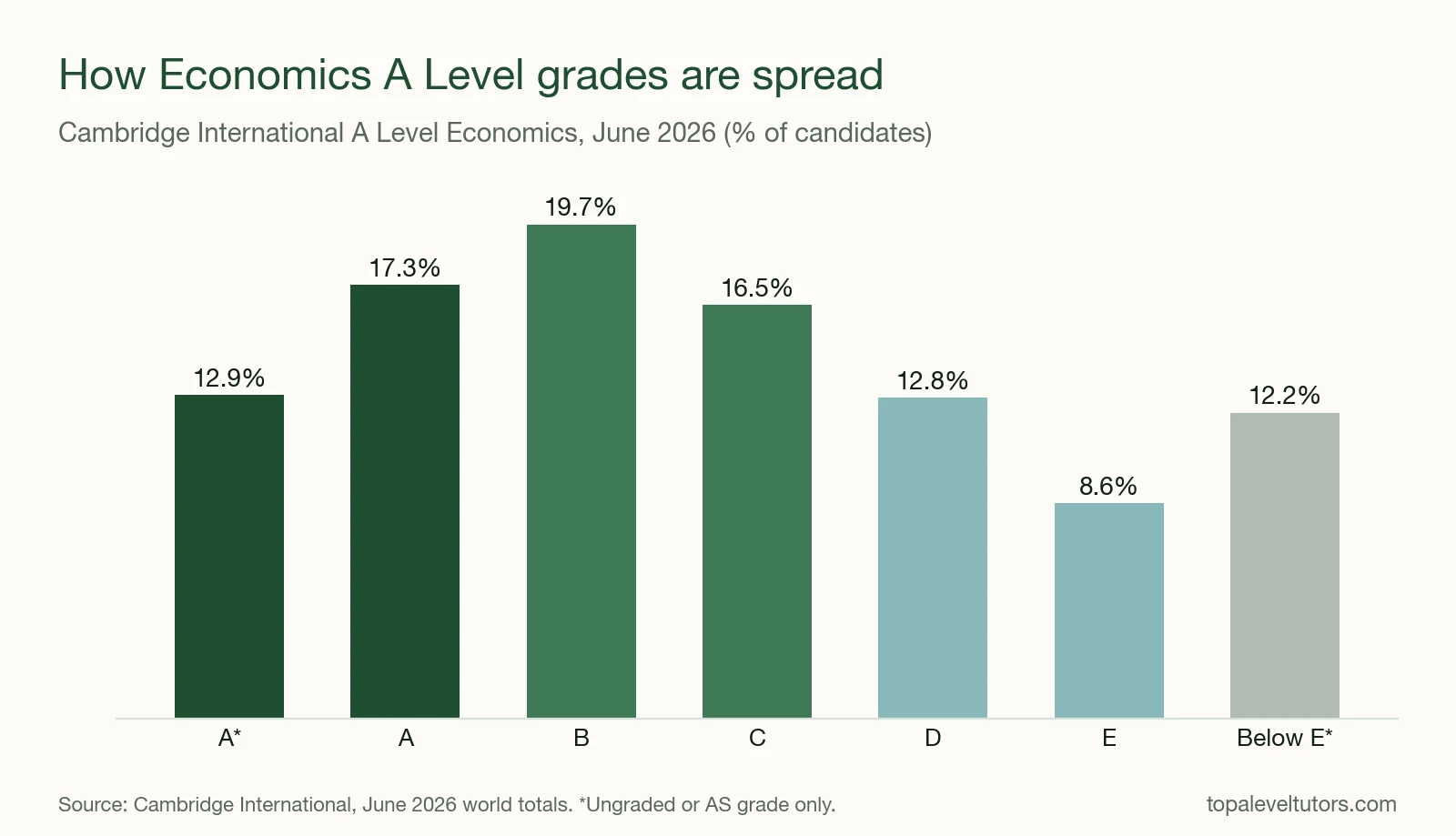
If you take it, aim high. In June 2026, 30.2% of Cambridge International Economics candidates achieved A or A* (Cambridge International, 2026).
A common mistake is taking Economics and two essay subjects without Maths, then discovering top economics degrees are closed. The reverse combination, Maths and Further Maths without A Level Economics, keeps every economics degree open. If you can only fit one, choose Maths.
How Competitive Are Top Economics Courses?
Very. LSE received 2,885 applications for 217 places in BSc Economics in 2025, a ratio of 13 to 1 (LSE, 2026). Applicants must also take the TMUA (Test of Mathematics for University Admission), which LSE describes as mandatory.
The TMUA tests mathematical thinking using A Level-standard content. Strong A Level Maths preparation, plus timed practice on unfamiliar problems, is the best way to prepare.
Is Further Maths Worth It for Economics?
For top universities, usually yes. Cambridge says Further Mathematics is "very useful" for Economics and usually expects it as a fourth A Level where available (University of Cambridge, 2026). LSE calls it desirable but says applicants whose school doesn't offer it won't be disadvantaged (LSE, 2026).
If your school doesn't offer it, don't worry about the requirement, but do extra maths reading. Our guide on whether Further Maths is worth it covers the trade-offs in detail.
Economics applicants we support often underestimate the TMUA. It rewards speed and confidence with algebra, functions and logic more than advanced content. Students who practise it alongside A Level Maths from the spring of Year 12 usually find both improve together.
What Should Your Third Subject Be?
Choose a subject you can get an A or A* in that adds something different. Economics gives useful background; History or Politics shows essay skills and context; Physics shows mathematical problem-solving. For LSE, Further Mathematics counts alongside Mathematics and one other A Level (LSE, 2026).
Our guide on how to choose A Level subjects walks through the decision step by step.
Aiming for Economics?
Top economics degrees need top Maths grades. Our tutors combine top recent A Level graduates with qualified teachers and examiners, supporting Mathematics, Further Mathematics and Economics across UK, Cambridge International and Edexcel International boards.
Submit an application and we'll match you with a tutor for your subjects.
Frequently Asked Questions
Do you need A Level Maths for economics?
At most top universities, yes. LSE requires A Level Mathematics and asks for an A* in it for BSc Economics (LSE, 2026). Some universities offer economics courses without Maths, but your options narrow significantly.
Is A Level Economics required for an economics degree?
No. It's helpful background but not required, even at LSE or Cambridge. Mathematics matters much more. A Level Economics had the largest rise in UK entries in 2026 (JCQ, 2026), so it's popular but not essential.
What is the TMUA?
The Test of Mathematics for University Admission is a maths reasoning test used by LSE, Cambridge and other universities. LSE describes it as mandatory for BSc Economics (LSE, 2026).
What grades do you need for economics at LSE?
LSE's standard offer for BSc Economics is A*AA with an A* in Mathematics, and the contextual offer is A*AB with an A* in Mathematics (LSE, 2026).
The Bottom Line
- Mathematics is the essential A Level for economics.
- Further Mathematics is desirable or expected at top universities.
- A Level Economics helps but isn't required.
- Top courses are highly competitive and often require the TMUA.
Compare with the best A Levels for computer science.
Find the right A-Level tutor this week
If you are not happy after your first session with your tutor, please let us know and we will give you a full refund and find you another tutor for free.