

GCSE and IGCSE Grades Explained: 9–1 vs A*–G
A clear guide to GCSE and IGCSE grades: the 9–1 and A*–G scales, how they line up, what counts as a standard or strong pass, how many students get top grades and what universities ask for.



GCSEs in England are graded 9 to 1, with 9 the highest. Cambridge IGCSEs are usually graded A\* to G, and Edexcel International GCSEs use 9 to 1. The two scales line up at three points: grade 7 with A, grade 4 with C and grade 1 with G. In 2026, 22% of UK GCSE results were 7/A or above and 67.3% were 4/C or above (JCQ, 2026).
This guide explains both scales, what counts as a pass and what grades you need for the next step.
Key Takeaways
- 9–1: 9 is highest. A*–G: A* is highest. U means ungraded on both.
- Grades 7, 4 and 1 line up with A, C and G; the other grades don't convert exactly.
- Grade 4 is a "standard pass" and grade 5 a "strong pass" in England.
- Many universities ask for grade 5 or more in English and Maths.
How Does the 9–1 Scale Work?
The 9–1 scale runs from 9 (highest) to 1, with U for ungraded. It's used for all GCSEs in England, for Pearson Edexcel International GCSEs and for some Cambridge IGCSEs. AQA notes that "grade 9 is the highest grade" and that "around 20% of all grades at 7 or above will be a grade 9" (AQA, 2026).
Two grades have official labels. The UK government calls grade 4 a "standard pass" and grade 5 a "strong pass", which AQA describes as "equivalent to a high C and low B on the old grading system" (AQA, 2026).
How Does the A*–G Scale Work?
Cambridge IGCSE is "reported worldwide on a grade scale from A\* (highest) to G (minimum required performance)" (Cambridge International, 2026). Below G is U, ungraded. Cambridge statements of results show each grade twice, such as B(b), as a security feature.
Some Cambridge International schools can choose 9 to 1 instead. This option is available in administrative zone 3, which includes Europe, Africa and parts of the Middle East (Cambridge International, 2026).
How Do 9–1 Grades Convert to A*–G?
Only three points convert exactly. Cambridge says 9–1 standards at grades 7, 4 and 1 "are the same as the standards at the thresholds of grades A, C and G", with the grades in between spaced evenly (Cambridge International, 2026).
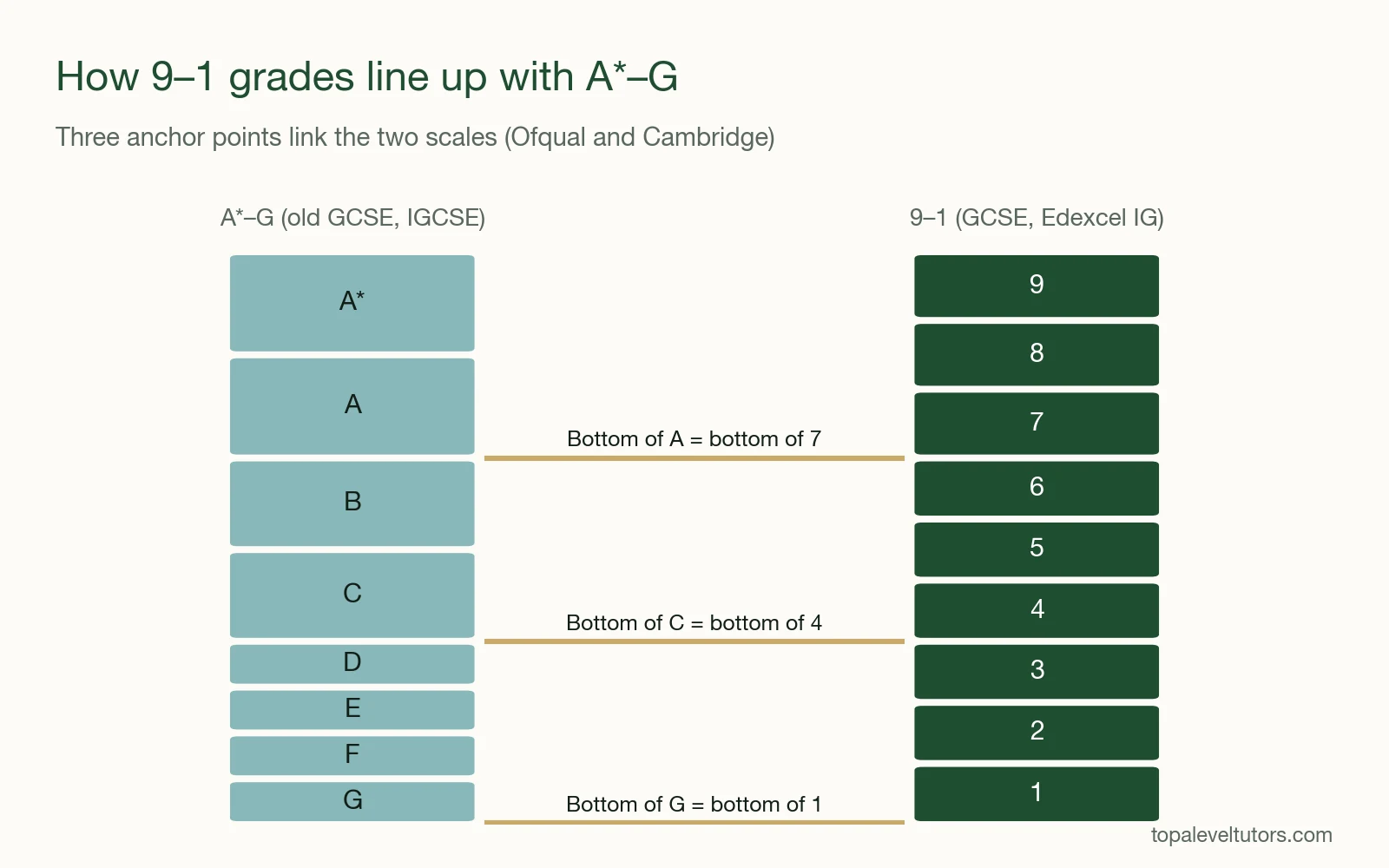
| 9–1 grade | Rough A*–G equivalent |
|---|---|
| 9 | High A\* |
| 8 | Low A\* / high A |
| 7 | A (bottom of 7 = bottom of A) |
| 6 | High B |
| 5 | Low B / high C ("strong pass") |
| 4 | C (bottom of 4 = bottom of C "standard pass") |
| 3 | D / E |
| 2 | E / F |
| 1 | F / G (bottom of 1 = bottom of G) |
Treat the in-between rows as approximate. A 9 is rarer than an A\*: it's roughly the top fifth of grades at 7 and above.
Because 9 sits above A\, a 9–1 certificate can show more detail at the top. That matters for competitive courses, where a 9 stands out. For Cambridge IGCSE students graded A\–G, an A\* is treated as the top grade by universities, so there's no disadvantage, but it's worth knowing which scale your school uses.
What Counts as a Pass at GCSE and IGCSE?
Technically, any grade from 9 to 1 or A\* to G is a pass. In practice, the important line is grade 4 or C. In England, students without grade 4 in English and maths must keep studying them after 16 (Department for Education, 2026).
Many universities set a higher bar. UCL, for example, asks every applicant for English Language and Mathematics at grade 5 or above (UCL, 2026). Sixth forms usually ask for higher grades in subjects you want to take at A Level. See what grades you need for A Level.
How Many Students Get Top Grades?
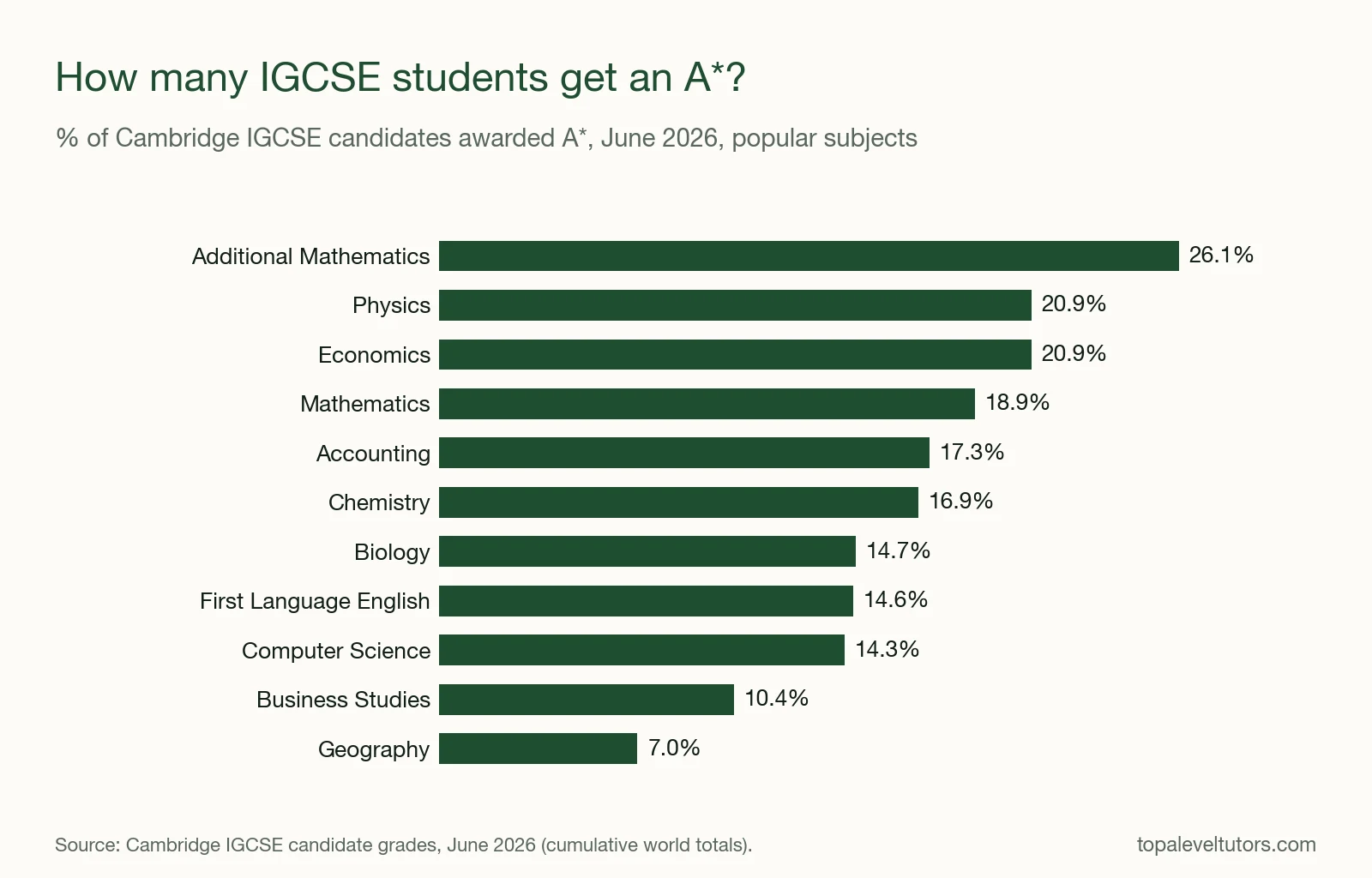
Top grades are achievable but not common. Across the UK in 2026, 22% of GCSE results were 7/A or above, 67.3% were 4/C or above and 97.9% were 1/G or above (JCQ, 2026). For Cambridge IGCSE, A\* rates ranged widely by subject, from 7.0% in Geography to 26.1% in Additional Mathematics (Cambridge International, 2026).
Parents often ask us whether a 6 is "good". It's a solid result, above a strong pass, but it's usually below what sixth forms want for A Level Maths or sciences, where many ask for a 7. Knowing the target grade for each subject early makes revision much more focused.
Want Help Reaching a 7, 8 or 9?
Our tutors combine top recent graduates and qualified teachers and examiners, and support students on GCSE, Cambridge IGCSE and Edexcel International GCSE.
Submit an application and we'll match you with a tutor for your subjects.
Frequently Asked Questions
Is a grade 4 a pass at GCSE?
Yes. The government calls grade 4 a "standard pass" and grade 5 a "strong pass" (AQA, 2026). Students in England without grade 4 in English and maths must continue studying them after 16.
What is an A* in the 9–1 system?
There's no exact match. Grades 8 and 9 together roughly cover the old A\, and grade 9 is harder to achieve than an A\ was. Around 20% of grades at 7 or above are 9s (AQA, 2026).
Do universities accept A*–G IGCSE grades?
Yes. Cambridge reports that UK universities "will continue to welcome applications with A\*-G for Cambridge IGCSE" (Cambridge International, 2026). A C is treated like a 4 and an A like a 7.
The Bottom Line
- 9–1 runs from 9 (highest) to 1; A*–G from A* to G.
- 7, 4 and 1 line up exactly with A, C and G.
- Grade 4 is a standard pass; many universities want 5 or more in English and Maths.
- In 2026, 22% of UK GCSE results were 7/A or above.
Next, see how IGCSE grades are calculated.
Find the right A-Level tutor this week
If you are not happy after your first session with your tutor, please let us know and we will give you a full refund and find you another tutor for free.