

How Are IGCSE Grades Calculated? Marks, Tiers and Boundaries
How Cambridge IGCSE, Edexcel International GCSE and UK GCSE grades are worked out: how paper marks are combined, how grade boundaries are set, how tiers limit your grade, and a worked example.



IGCSE and GCSE grades are calculated by adding up your marks across all the papers you sit and comparing the total with grade boundaries set after each exam series. In June 2026, an A\* in Cambridge IGCSE Mathematics needed 162 out of 200 on the most common Extended paper combination (Cambridge International, 2026).
This guide explains how marks become grades on each board, how tiers limit your grade and how to use boundaries in revision.
Key Takeaways
- Your grade comes from your total marks across all papers, not from grades on each paper.
- Boundaries are set after marking, so they change every series.
- Your tier (Core/Extended or Foundation/Higher) caps the grades you can get.
- Different versions of the same paper can have very different boundaries.
How Do Marks Become a Grade?
Every board follows the same basic steps. You get raw marks on each paper. They're combined, using each paper's weighting, into an overall mark. Senior examiners then set grade boundaries, and your grade depends on where your total falls. Pearson describes exactly this process for Edexcel International GCSEs (Pearson, 2026).
Cambridge International works the same way. Raw marks may be adjusted for fairness, then multiplied by a weighting factor and added up. The total is compared with the grade thresholds; component grades on individual papers "are not used in the calculation" (Cambridge International, 2026).
A Worked Example: Cambridge IGCSE Mathematics
Cambridge IGCSE Mathematics (0580) Extended candidates sit Paper 2 (non-calculator) and Paper 4 (calculator), each out of 100 (Cambridge International, 2026). Here's how one student's marks become a grade, using the June 2026 thresholds for papers 21 and 41.
| Marks | |
|---|---|
| Paper 21 (non-calculator) | 74 / 100 |
| Paper 41 (calculator) | 70 / 100 |
| Total | 144 / 200 |
| A threshold | 138 |
| A\* threshold | 162 |
Source: Cambridge International, 2026.
The total of 144 is above the A threshold and below A\, so the grade is A. Another 18 marks, from either paper, would have made it an A\.
How Do Tiers Affect Your Grade?
Many subjects are tiered, and the tier caps the grades available. In Cambridge IGCSE Mathematics, Core candidates "will be eligible for grades C to G", and Extended candidates for "grades A\* to E" (Cambridge International, 2026). In UK GCSE Maths, Foundation covers grades 1 to 5 and Higher covers 4 to 9 (AQA, 2026).
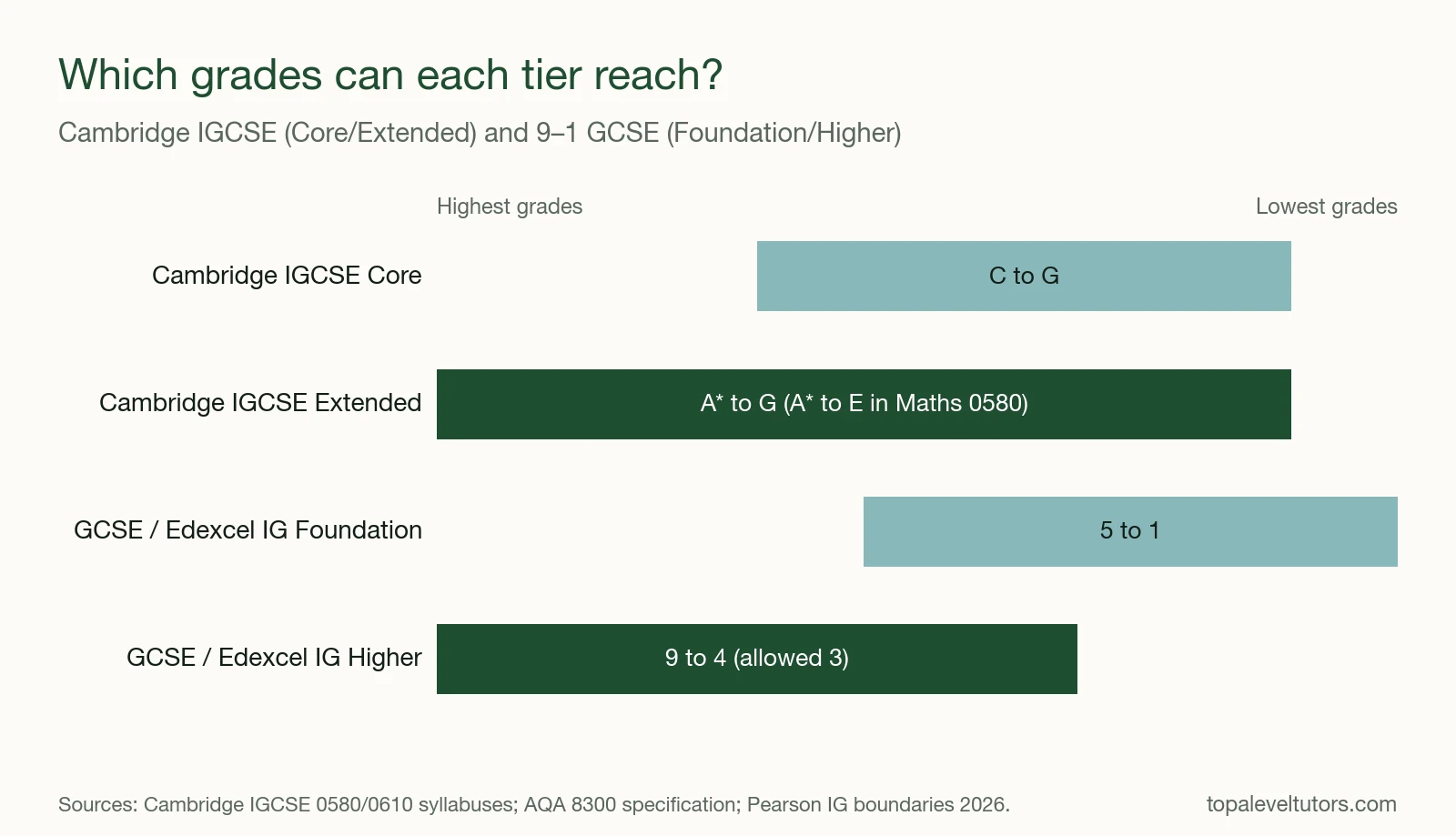
Higher tier has a safety net. A student who just misses grade 4 on Higher is "awarded an allowed grade 3"; below that, the result is U (AQA, 2026). Our guide to Core vs Extended explains how to choose.
How Are Edexcel International GCSE and UK GCSE Grades Calculated?
Pearson Edexcel International GCSEs and UK GCSEs use raw marks and boundaries for each series. In June 2026, International GCSE Mathematics A (Higher tier) needed 165 out of 200 for a 9, 111 for a 7 and 41 for a 4 (Pearson, 2026).
Pearson defines a boundary as "the minimum mark at which a numbered grade (between 9 and 1) can be achieved" (Pearson, 2026). UK boards (AQA, Pearson Edexcel, OCR) publish their GCSE boundaries on results day.
Why Do Boundaries Change Between Papers?
Boundaries are set after marking to keep standards steady, so a harder paper gets a lower boundary. Cambridge also sets different versions of each paper, called variants, for different time zones. In June 2026, an A\* in IGCSE Mathematics needed 162 out of 200 on variant 21/41 but 177 out of 200 on variant 22/42 (Cambridge International, 2026).
That 15-mark gap is bigger than most students expect. When you grade a past paper, use the threshold for that exact series and variant. Grading a variant 22 paper against variant 21 thresholds could make an A look like an A\*. Our IGCSE grade boundaries guide has the June 2026 figures.
The IGCSE students we tutor improve fastest when they track every past paper in a simple table: series, variant, marks and grade. After five or six papers, it's usually clear which paper and which topics are costing marks, and revision becomes far more targeted.
Want Help Turning Marks Into Grades?
Our tutors combine top recent graduates and qualified teachers and examiners, and know exactly how Cambridge, Edexcel International and UK boards award marks.
Submit an application and we'll match you with a tutor for your subjects.
Frequently Asked Questions
What percentage is an A* at IGCSE?
There's no fixed percentage, because boundaries change every series. In June 2026, a Cambridge IGCSE A\* needed about 81% in Mathematics, 82.5% in Biology and 86.5% in Chemistry on the first Extended paper combination (Cambridge International, 2026).
Can you get an A* on Core tier?
No. Core candidates in Cambridge IGCSE subjects such as Mathematics and Biology can achieve grades C to G only (Cambridge International, 2026). To aim for A or A\*, you need to be entered for Extended.
What is an allowed grade 3?
On UK GCSE Higher tier papers, a student who just misses grade 4 is awarded an "allowed grade 3" rather than a U (AQA, 2026). Below that, the result is ungraded.
The Bottom Line
- Your grade comes from your weighted total, compared with that series' boundaries.
- Tiers cap your grade: Core C–G, Extended up to A*; Foundation 1–5, Higher 4–9.
- Boundaries vary by series and paper variant, so grade practice papers carefully.
- An A* in Cambridge IGCSE Maths needed 162 out of 200 in June 2026.
Next, read our IGCSE grade boundaries June 2026 guide.
Find the right A-Level tutor this week
If you are not happy after your first session with your tutor, please let us know and we will give you a full refund and find you another tutor for free.