

IGCSE vs GCSE: What's the Difference and Which Is Harder?
How IGCSE and GCSE compare: who takes them, the exam boards, grading scales, exam series, coursework and difficulty, how universities view each, and which is right for you.


IGCSEs and GCSEs are at the same level: both are taken at 14 to 16, and both lead on to A Levels. The main differences are who takes them, how they're graded and when exams happen. An independent UK NARIC benchmarking study found Cambridge IGCSE "comparable to GCSE standards" (Cambridge International, 2026).
This guide compares the two side by side and explains which might suit you.
Key Takeaways
- IGCSE and GCSE are at the same level and both lead to A Levels.
- GCSEs are taken mainly in UK schools; IGCSEs mainly in international and many UK independent schools.
- GCSEs in England use 9 to 1; Cambridge IGCSE uses A* to G (or 9 to 1 in some regions).
- Universities treat the two equally, including for English and Maths requirements.
What's the Main Difference Between IGCSE and GCSE?
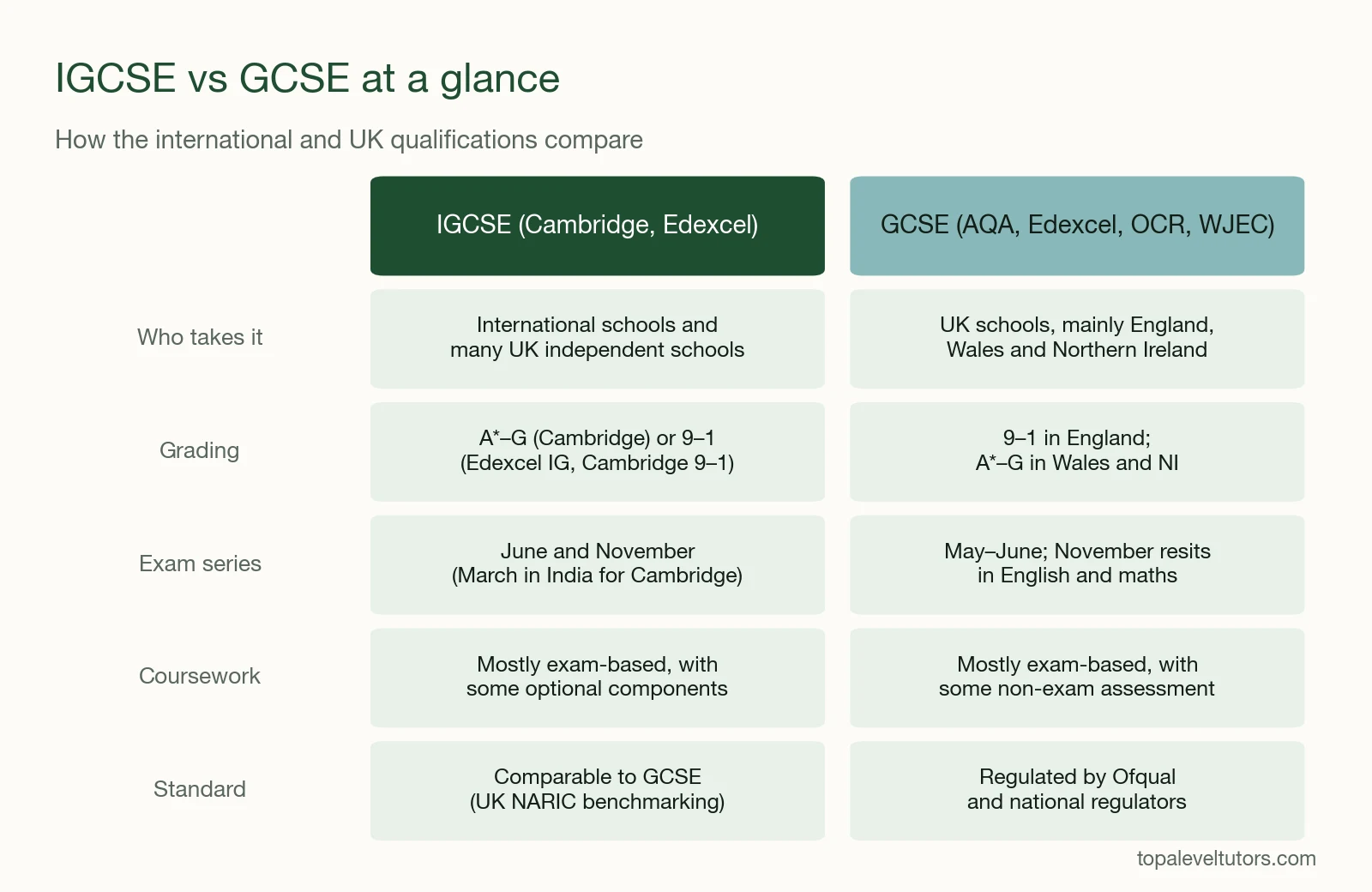
The main difference is the audience. GCSEs are set by UK boards (AQA, Pearson Edexcel, OCR and WJEC/Eduqas) for UK schools. IGCSEs are set by Cambridge International and Pearson Edexcel International for schools worldwide. In 2026, UK students sat 6,199,256 GCSE exams (JCQ, 2026).
IGCSE syllabuses are designed for international students. Cambridge says they were "created specifically for international students avoiding cultural bias" (Cambridge International, 2026). That shows in examples and contexts, and in options such as English as a Second Language.
How Do the Grading Scales Compare?
GCSEs in England are graded 9 to 1. Cambridge IGCSEs are graded A\* to G, although schools in Cambridge's zone 3 can choose 9 to 1 (Cambridge International, 2026). Edexcel International GCSEs use 9 to 1.
The scales line up at three points: 7 with A, 4 with C and 1 with G. The UK government describes grade 4 as a "standard pass" and grade 5 as a "strong pass" (AQA, 2026). Our guide to GCSE and IGCSE grades has the full comparison.
Are Exams and Coursework Different?
Both are mostly exam-based. GCSEs in the UK are sat in May and June, with November resits only for English Language and Maths. IGCSEs offer more flexibility: Pearson runs International GCSE exams "in May-June (Summer) and November each year" (Pearson, 2026), and Cambridge runs June and November series.
Pearson also now offers "a choice of linear or modular assessment for many of our International GCSEs" (Pearson, 2026). UK GCSEs are fully linear, with all exams at the end of the course.
Is IGCSE Harder Than GCSE?
Not in standard. Cambridge aligns IGCSE standards "with the GCSE qualification taken in England" (Cambridge International, 2026). Some subjects differ in content: IGCSE sciences, for example, include practical exam papers, and some IGCSE Maths content goes slightly beyond GCSE.
Results aren't a fair test of difficulty, because the students differ. In 2026, 22% of UK GCSE results were 7/A or above (JCQ, 2026), while 34.7% of Cambridge IGCSE Mathematics candidates achieved A or A\* (Cambridge International, 2026).
Many UK independent schools choose IGCSEs in some subjects, often Maths and the sciences, because they see them as better preparation for A Level. The more useful question isn't which is harder, but which tier and syllabus your school offers, because that decides the top grade you can reach.
Do Universities Prefer GCSE or IGCSE?
Neither. UK universities accept both on equal terms. UCL, for example, asks for English Language and Mathematics at grade 5 or above in "GCSE (or equivalent)" (UCL, 2026), and Cambridge reports that UK universities "will continue to welcome applications with A\*-G for Cambridge IGCSE" (Cambridge International, 2026).
What matters is your grades, especially in English and Maths, and in the subjects you'll take further. See what GCSE grades you need for A Level.
We regularly support families moving between the UK and international schools mid-course. Switching between GCSE and IGCSE in Year 10 is usually manageable, but switching boards in Year 11 is hard because the content and papers differ. If a move is likely, plan it before Year 11 starts.
Want Help With GCSEs or IGCSEs?
Our tutors combine top recent graduates and qualified teachers and examiners, and support students on UK GCSEs, Cambridge IGCSE and Edexcel International GCSE.
Submit an application and we'll match you with a tutor for your subjects.
Frequently Asked Questions
Is an IGCSE equivalent to a GCSE?
Yes, in level. UK NARIC benchmarking found Cambridge IGCSE (A\*–G and 9–1) "comparable to GCSE standards" (Cambridge International, 2026). Universities and sixth forms accept IGCSE grades in place of GCSE grades.
Can you take IGCSEs in the UK?
Yes. Many UK independent schools offer IGCSEs, and private candidates can sit them at approved centres. UK state schools mostly offer GCSEs, which count in government school performance measures.
Which is better for A Levels, GCSE or IGCSE?
Both prepare you well. Cambridge's A Level syllabuses recommend prior study "equivalent to Cambridge IGCSE" (Cambridge International, 2026), and UK A Levels build on GCSE. The tier and grade you achieve matter more than the qualification name.
The Bottom Line
- IGCSE and GCSE are at the same level and accepted equally by universities.
- GCSEs are mainly UK; IGCSEs mainly international and UK independent schools.
- Grading differs (A*–G or 9–1), but the scales are linked.
- IGCSE offers more exam series; GCSE is May–June only, apart from resits.
Next, read what an IGCSE is in more detail.
Find the right A-Level tutor this week
If you are not happy after your first session with your tutor, please let us know and we will give you a full refund and find you another tutor for free.