

IGCSE Core vs Extended (and Foundation vs Higher): Which Tier?
How exam tiers work: Cambridge IGCSE Core and Extended, GCSE and Edexcel International GCSE Foundation and Higher, which grades each allows, how schools decide and what it means for A Levels.




Core and Extended are the two tiers in many Cambridge IGCSE subjects. Core candidates can achieve grades C to G; Extended candidates can achieve up to A\* (Cambridge International, 2026). UK GCSEs and Edexcel International GCSEs use Foundation and Higher tiers instead: in GCSE Maths, Foundation covers grades 1 to 5 and Higher covers 4 to 9 (AQA, 2026).
This guide explains how each tier works, how schools decide and why it matters for A Levels.
Key Takeaways
- Cambridge IGCSE Core: grades C to G. Extended: up to A\*.
- GCSE and Edexcel International GCSE Foundation: grades 1 to 5. Higher: 4 to 9.
- Your tier caps your top grade, however well you do on the day.
- For A Level Maths or sciences, you'll almost always need the higher tier.
What's the Difference Between Core and Extended?
Extended covers the Core content plus extra "Supplement" content, and leads to higher grades. In Cambridge IGCSE Biology, Core candidates sit Papers 1 and 3 and "will be eligible for grades C to G"; Extended candidates sit Papers 2 and 4 and are eligible for "grades A\* to G" (Cambridge International, 2026). Both take the same practical paper.
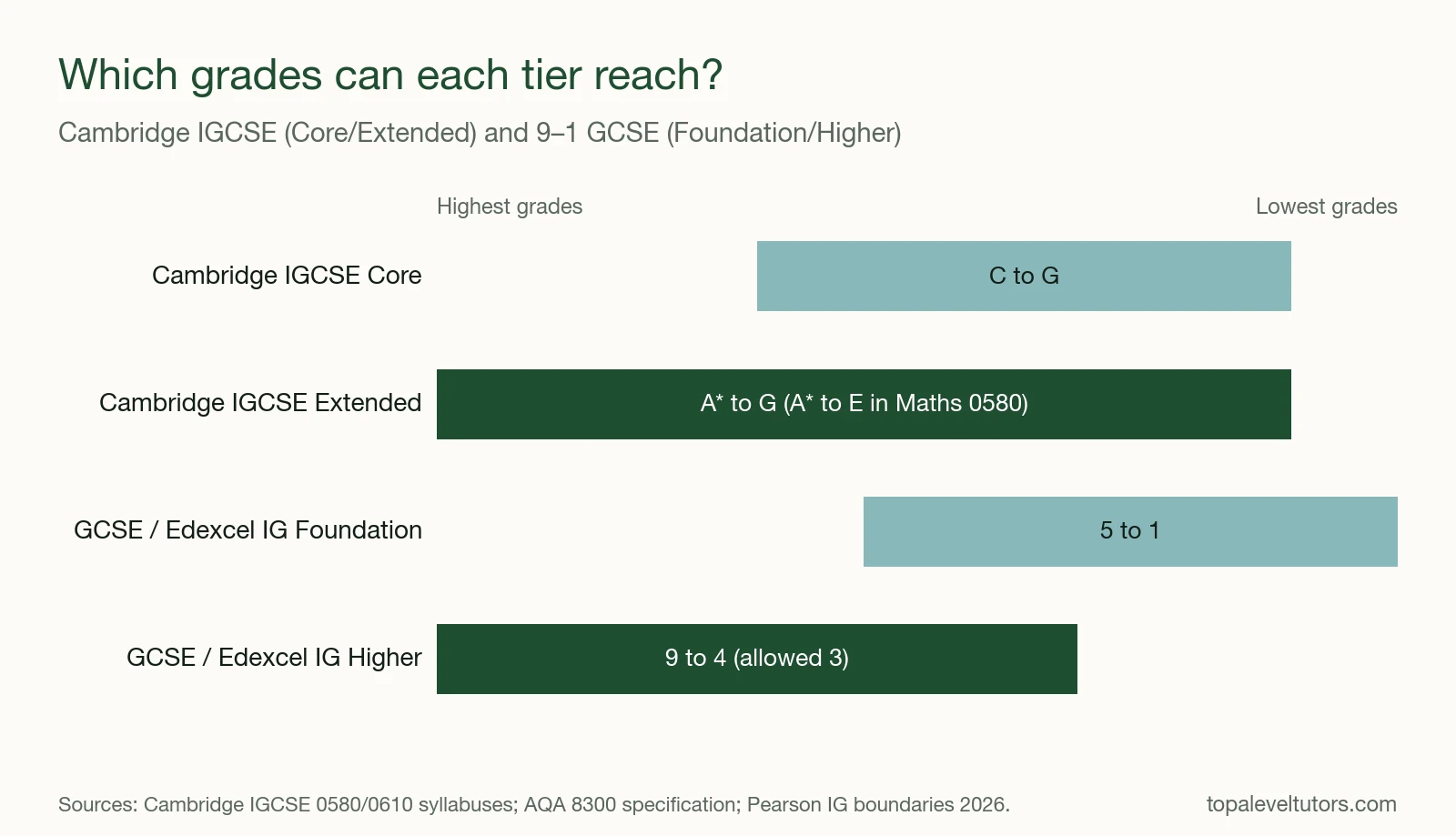
Mathematics is slightly different. In Cambridge IGCSE Mathematics, Extended candidates are eligible for grades A\* to E, not down to G (Cambridge International, 2026). A student who struggles on Extended Maths risks being ungraded rather than getting a low grade.
How Do Foundation and Higher Tiers Work?
UK GCSEs and Pearson Edexcel International GCSEs use Foundation and Higher. AQA's GCSE Maths has "a Foundation tier (grades 1 – 5) and a Higher tier (grades 4 – 9)" (AQA, 2026). In Edexcel International GCSE Mathematics A, the top Foundation grade in June 2026 was 5, which needed 148 out of 200 (Pearson, 2026).
Higher tier has a safety net. A student who just misses grade 4 on Higher "will be awarded an allowed grade 3"; below that, the result is U (AQA, 2026).
| Lower tier | Higher tier | |
|---|---|---|
| Cambridge IGCSE (most subjects) | Core: C to G | Extended: A\* to G |
| Cambridge IGCSE Mathematics | Core: C to G | Extended: A\* to E |
| GCSE (AQA, Edexcel, OCR) | Foundation: 5 to 1 | Higher: 9 to 4 (allowed 3) |
| Edexcel International GCSE | Foundation: up to 5 | Higher: 9 to 4 (allowed 3) |
Who Decides Your Tier?
Your school decides, based on your progress, usually in Year 10 or early Year 11. Cambridge's guidance is that candidates "expected to achieve a grade C or above" should take Extended (Cambridge International, 2026). Tier entries are fixed at the entry deadline, which for UK GCSEs in 2027 is 21 February (JCQ, 2026).
If you're on the border, ask what you'd need to show to move up, and by when.
The tier decision often matters more than the final mark. A student on Core Mathematics can't get above a C, and a C won't usually meet sixth form requirements for A Level Maths. A short, focused push in Year 10 to secure the Extended or Higher tier can keep A Level options open that would otherwise close.
Which Tier Do You Need for A Levels?
For A Level Maths and the sciences, the higher tier. Cambridge recommends that A Level Mathematics learners have "completed a course in mathematics equivalent to Cambridge IGCSE (Extended)" (Cambridge International, 2026), and it says the same for A Level Economics. Most sixth forms ask for grade 6 or 7 in Maths, which is only available on the higher tier.
See what GCSE grades you need for A Level for typical requirements.
We often work with students who've been placed on Core or Foundation and want to move up. With targeted work on the extra content and regular practice papers, many make the move within a term. Starting early is what makes the difference.
Want Help Reaching the Higher Tier?
Our tutors combine top recent graduates and qualified teachers and examiners, and support Cambridge IGCSE, Edexcel International GCSE and GCSE students aiming for Extended or Higher tier.
Submit an application and we'll match you with a tutor for your subjects.
Frequently Asked Questions
Can you get an A* on IGCSE Core?
No. Core candidates can achieve grades C to G only (Cambridge International, 2026). To aim for A or A\*, you need to be entered for Extended.
What is the highest grade on Foundation tier?
Grade 5. AQA's GCSE Maths Foundation tier covers grades 1 to 5 (AQA, 2026), and Edexcel International GCSE Mathematics A Foundation tops out at 5 as well.
Is it risky to take Extended or Higher?
There's some risk. Cambridge IGCSE Extended Mathematics only goes down to grade E, and Higher tier GCSEs only go down to an allowed grade 3 (AQA, 2026). For a student working at grade C/4 or above, the higher tier is usually the right choice.
The Bottom Line
- Core caps your grade at C; Extended allows A*.
- Foundation caps your grade at 5; Higher allows 9.
- Your school sets the tier, and entries are fixed early in the year.
- For A Level Maths or sciences, aim for the higher tier.
Next, read triple vs combined science.
Find the right A-Level tutor this week
If you are not happy after your first session with your tutor, please let us know and we will give you a full refund and find you another tutor for free.