

Is IGCSE Additional Maths Worth It?
Whether Cambridge IGCSE Additional Mathematics (0606) or Edexcel International GCSE Further Pure Maths is worth taking: what it covers, how it's assessed, results, how it helps with A Level Maths and who should skip it.



For students who enjoy maths and plan to take A Level Maths, IGCSE Additional Mathematics is usually worth it. It introduces A Level topics early, and Cambridge says candidates who achieve A\* to C "are well prepared to follow a wide range of courses including Cambridge International AS & A Level Mathematics" (Cambridge International, 2026). In June 2026, 51.7% of Additional Mathematics candidates achieved A or A\* (Cambridge International, 2026).
This guide explains what it involves, who it suits and who should skip it.
Key Takeaways
- Additional Maths (Cambridge 0606) is an extra IGCSE for strong mathematicians.
- It's assessed by two 2-hour papers and builds on IGCSE Maths.
- It gives a head start on A Level Maths topics such as calculus.
- It's not worth it if it would weaken your other grades.
What Is IGCSE Additional Maths?
Cambridge IGCSE Additional Mathematics (0606) is an extra maths qualification taken alongside IGCSE Mathematics. It covers topics such as functions, logarithms, trigonometry, calculus, vectors and series. Cambridge assumes knowledge of IGCSE Mathematics (0580), "including the use of indices and surds" (Cambridge International, 2026).
There are two papers, each 2 hours and 80 marks, and grades A\* to E are available; "grades F and G will not be available" (Cambridge International, 2026). Pearson Edexcel International offers a similar qualification, International GCSE Further Pure Mathematics (4PM1), with two 2-hour papers (Pearson, 2026).
How Do Students Do in Additional Maths?
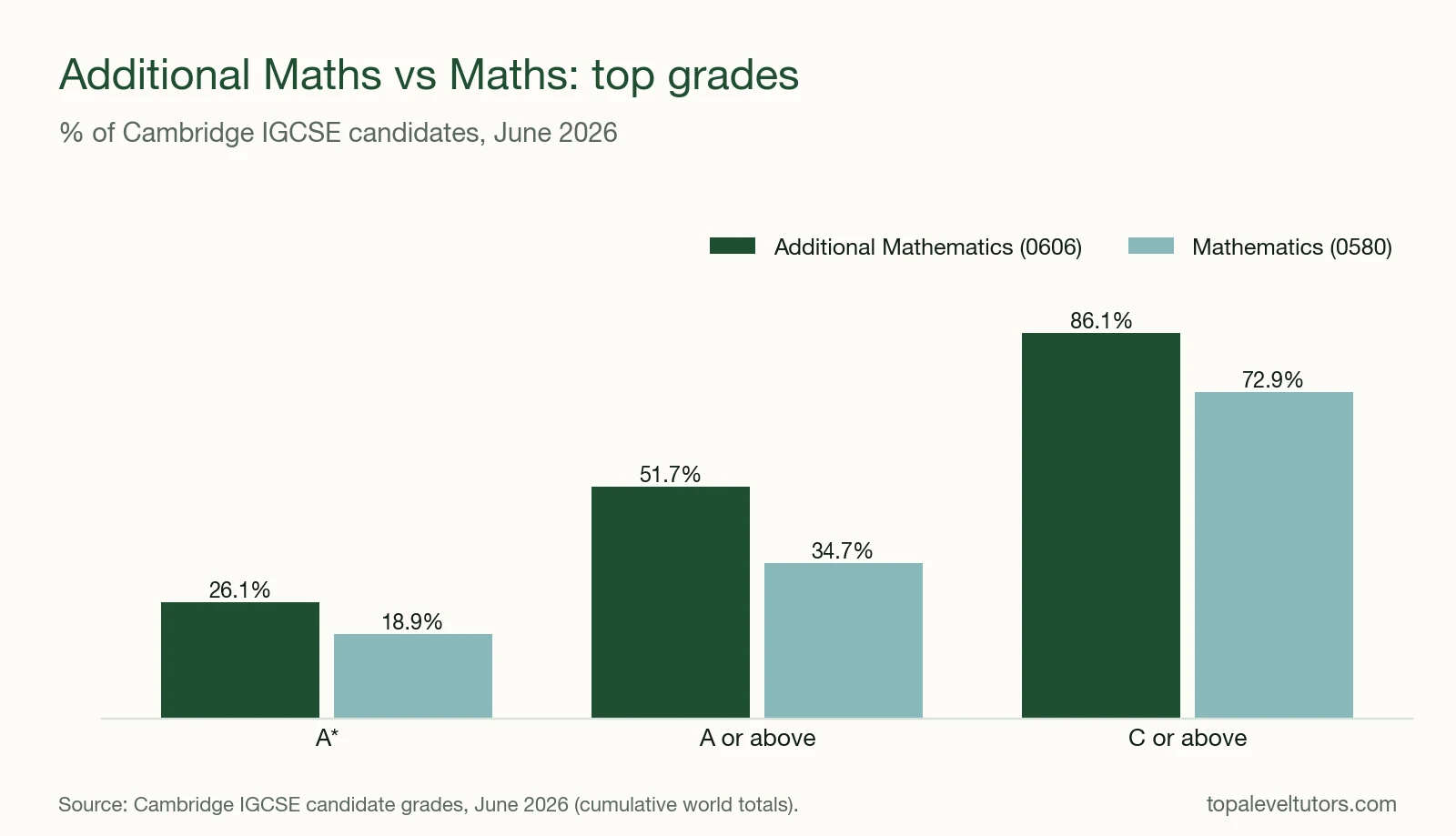
Very well, because those who take it are strong at maths. In June 2026, 26.1% of Cambridge International Additional Mathematics candidates achieved A\* and 51.7% A or A\*, against 18.9% and 34.7% in IGCSE Mathematics (Cambridge International, 2026).
The boundaries are high, though. In June 2026, an A\* needed 141 out of 160, about 88%, on papers 11 and 21 (Cambridge International, 2026). Accuracy matters as much as understanding.
How Does It Help With A Level Maths?
It gives you a head start. Much of the Additional Maths content, including differentiation, integration and logarithms, reappears in A Level Mathematics Pure papers. Cambridge recommends that A Level Mathematics learners have completed maths "equivalent to Cambridge IGCSE (Extended)" (Cambridge International, 2026); Additional Maths goes further than that.
Students planning A Level Mathematics and especially Further Mathematics benefit most. See is Further Maths worth it? for the next step.
The biggest benefit isn't the extra grade; it's the first term of Year 12. A Level Maths moves quickly through algebra and calculus, and students who've met those ideas in Additional Maths spend the first months consolidating rather than catching up. That buffer often shows up in AS or mock grades.
Who Should Skip Additional Maths?
Skip it if it would weaken your other grades. UCL notes that students presenting "Additional" subjects, such as Additional Mathematics, "should have also taken GCSE Mathematics" (UCL, 2026): it adds to your profile, it doesn't replace the core. If you're working below an A in IGCSE Mathematics, focus there first.
It's also less useful if you don't plan to take maths, sciences, economics or computer science at A Level.
The students we tutor who get the most from Additional Maths take it because they enjoy maths, not for the extra certificate. For them, it's often their favourite subject. For students who find maths a struggle, the time is better spent securing a strong IGCSE Mathematics grade.
Want Help With Additional Maths?
Our tutors combine top recent graduates and qualified teachers and examiners, with specialists in Cambridge IGCSE Additional Mathematics and Edexcel International GCSE Further Pure Mathematics.
Submit an application and we'll match you with a maths tutor.
Frequently Asked Questions
Is IGCSE Additional Maths hard?
It's more demanding than IGCSE Mathematics, with A Level-style topics. But results are strong because able students take it: 51.7% got A or A\* in June 2026 (Cambridge International, 2026). An A\* needed about 88% of the marks.
Do universities care about Additional Maths?
It shows strong mathematical ability, but universities don't usually require it. They focus on English and Maths grades and your A Levels. UCL expects students with Additional Maths to have GCSE (or IGCSE) Maths as well (UCL, 2026).
Is Additional Maths the same as Further Pure Maths?
They're similar. Cambridge offers Additional Mathematics (0606), and Pearson offers International GCSE Further Pure Mathematics (4PM1). Both extend IGCSE Maths into early A Level topics, and both are assessed by two 2-hour papers.
The Bottom Line
- Additional Maths suits strong mathematicians heading for A Level Maths.
- It's two 2-hour papers, building on IGCSE Mathematics.
- 51.7% of Cambridge candidates got A or A* in 2026, but boundaries are high.
- Skip it if it would cost you grades in your core subjects.
Next, read what GCSE grades you need for A Level.
Find the right A-Level tutor this week
If you are not happy after your first session with your tutor, please let us know and we will give you a full refund and find you another tutor for free.