

How to Choose Your GCSE or IGCSE Subjects
A step-by-step guide to choosing GCSE or IGCSE subjects: compulsory subjects in England, how Cambridge IGCSE choice works, keeping options open for A Levels and university, and mistakes to avoid.


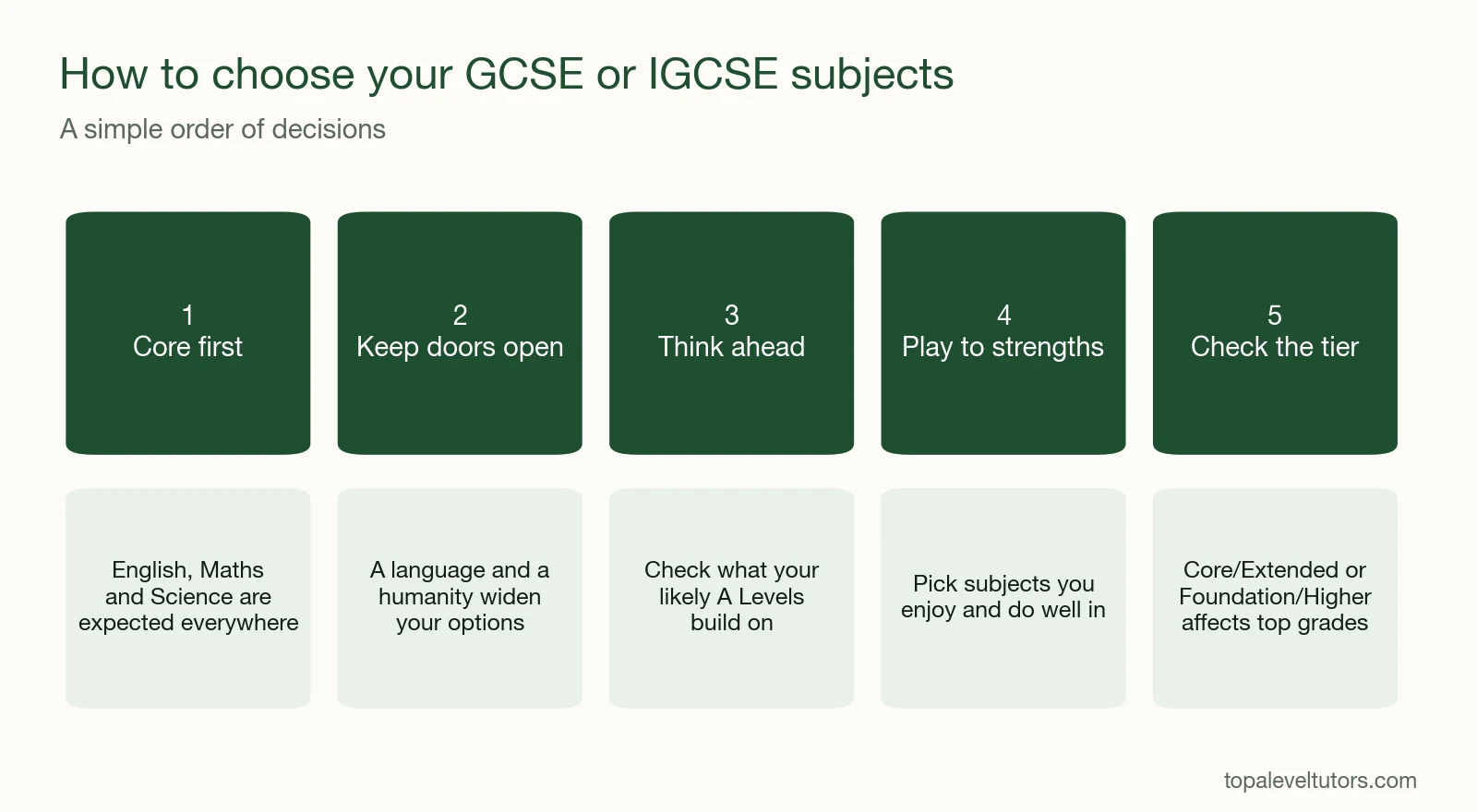
Choose GCSE or IGCSE subjects in three steps: secure the core (English, Maths and science), keep doors open with a language and a humanity, then pick subjects you enjoy and do well in. In England, English, maths and science are compulsory at key stage 4 (Department for Education, 2026). Cambridge IGCSE, by contrast, has "no compulsory subjects" (Cambridge International, 2026), so international schools set their own rules.
This guide walks through each decision, with what to check before you commit.
Key Takeaways
- English, Maths and science are the foundation everywhere.
- A language and a humanity keep the widest range of A Levels and degrees open.
- Check what your likely A Level subjects build on.
- The tier you're entered for can cap your grade, so ask early.
Which GCSE Subjects Are Compulsory?
In England, English, maths and science are "core subjects" at key stage 4. Schools must also teach computing, physical education and citizenship, and offer at least one subject from each of the arts, design and technology, the humanities and modern foreign languages (Department for Education, 2026).
International schools usually follow similar rules. Cambridge IGCSE lets schools choose freely from "over 70 subjects in any combination" (Cambridge International, 2026), but most schools still require English, Maths and at least one science.
How Do You Keep Your Options Open?
Take a broad mix. A language and a humanity (History or Geography) keep the widest range of A Levels and degrees open. Cambridge's ICE award is built on the same idea: it recognises students who pass seven IGCSEs from five curriculum areas, "including two different languages" (Cambridge International, 2026).
In England, the government's EBacc combination (English, maths, sciences, history or geography and a language) followed the same logic. Its guidance was withdrawn in October 2026, but those subjects still fill key slots in school performance measures (Department for Education, 2026).
How Do GCSE Choices Affect A Levels?
Most A Levels build on the same GCSE or IGCSE subject. Cambridge recommends that A Level Chemistry students "have completed a course in Chemistry or Co-ordinated Science equivalent to Cambridge IGCSE" (Cambridge International, 2026). For A Level Economics, it recommends Extended-level IGCSE Mathematics rather than Economics itself (Cambridge International, 2026).
Some A Levels, such as Psychology or Sociology, can be started fresh. Our guide on how to choose A Level subjects looks two steps ahead, and what GCSE grades you need for A Level covers entry requirements.
The subject that most often limits options later is Maths, not a niche option. Economics, sciences, Computer Science and Psychology at A Level all need confident maths, and many sixth forms ask for a 6 or 7 in GCSE Maths for A Level Maths. Choosing the Extended or Higher tier matters more than any single option choice.
How Do You Choose Between Similar Options?
When two options look equal, choose the one you enjoy more and do better in. Interest drives effort over two years, and grades matter more than subject names for most next steps. UCL, for example, sets the same GCSE requirement for every course: English Language and Mathematics at grade 5 or above (UCL, 2026).
Then check the practical details: coursework load, the tier you'd be entered for, and whether triple or combined science is offered. See triple vs combined science and IGCSE Core vs Extended.
When we help families with option choices, the most common regret we hear later is dropping a language or separate sciences too early, then wanting them for medicine or a languages degree. A few minutes checking future requirements in Year 9 saves a lot of stress in Year 12.
Want Help With Option Choices?
Our tutors combine top recent graduates and qualified teachers and examiners, and support students across GCSE, Cambridge IGCSE and Edexcel International GCSE subjects.
Submit an application and we'll match you with a tutor for your subjects.
Frequently Asked Questions
What GCSEs should I take for medicine?
Strong grades in English, Maths and the sciences, ideally separate Biology, Chemistry and Physics. Medical schools also look closely at Maths and English grades; UCL asks every applicant for grade 5 or above in both (UCL, 2026). See our best A Levels for medicine guide.
Is it bad to drop a language at GCSE?
Not always, but it narrows options. A language keeps language degrees open and was part of England's EBacc combination (Department for Education, 2026). If you're unsure, a language is usually the safer choice.
How many options do you choose at GCSE?
Usually three or four, on top of the compulsory core. Most students finish with seven to ten GCSEs or IGCSEs. See how many GCSEs to take.
The Bottom Line
- Secure English, Maths and science first.
- Keep doors open with a language and a humanity.
- Check what your likely A Levels build on, especially Maths.
- Choose subjects you enjoy, and check your tier.
Next, read IGCSE Core vs Extended.
Find the right A-Level tutor this week
If you are not happy after your first session with your tutor, please let us know and we will give you a full refund and find you another tutor for free.