

A Level Results 2026: Key Statistics, Trends and Analysis
The key statistics from A Level results 2026: UK headline grades, England's results by region, school type and subject, how many students got straight A*s, and how Cambridge International results compare worldwide.



In summer 2026, 9.6% of UK A Level results were A*, 28.5% were A or A* and 97.5% were a pass, across 906,425 entries from 349,917 students (JCQ, 2026). Top grades edged up from 2025, when 9.4% of results were A* and 28.3% were A or A*.
Internationally, almost 368,000 students at 3,492 schools received Cambridge International AS & A Level results in June 2026 (Cambridge International, 2026). This post pulls together the most useful figures from both.
Key Takeaways
- UK 2026: 9.6% A*, 28.5% A or A*, 97.5% A*–E, with entries up 2.7%.
- Economics had the largest rise in entries and is now the fifth most popular A Level.
- Just 2.2% of 18-year-olds in England taking three A Levels got straight A*s.
- Independent schools in England: 48.6% A or A*; all state-funded schools: 25.4%.
What Were the Headline A Level Results in 2026?
UK A Level grades were stable, with a small rise at the top. JCQ reported 9.6% A* (up from 9.4%), 28.5% A or A* (up from 28.3%) and 97.5% A*–E (unchanged). Entries rose 2.7% to 906,425, partly because the 18-year-old population grew by 3.9% (JCQ, 2026).
| UK A Level results | 2025 | 2026 |
|---|---|---|
| Students | 341,577 | 349,917 |
| Entries | 882,653 | 906,425 |
| A* | 9.4% | 9.6% |
| A or A* | 28.3% | 28.5% |
| A*–E (pass) | 97.5% | 97.5% |
In England alone, 835,950 A Level results went to 320,505 students, and 28.3% were A or A*, up from 28.2% in 2025 (Ofqual, 2026). AS results continued to shrink, with 48,835 issued in England.
Which Subjects Were Most Popular?
Mathematics remained the most popular A Level, with 107,300 students in England, followed by Psychology (76,100), Biology (68,005), Chemistry (61,050) and Economics (45,915) (Ofqual, 2026). Economics had the largest rise in entries across the UK (JCQ, 2026).
| Subject (England, 2026) | Students | % female |
|---|---|---|
| Mathematics | 107,300 | 36.8% |
| Psychology | 76,100 | 75.4% |
| Biology | 68,005 | 64.9% |
| Chemistry | 61,050 | 56.5% |
| Economics | 45,915 | 30.4% |
The gender split is striking. Three in four Psychology students were female, while seven in ten Economics students were male.
How Many Students Got Straight A*s?
Very few. In England, 7,245 18-year-olds achieved an A* in every A Level they took (Ofqual, 2026). Among 18-year-olds taking three A Levels, 4,195 got three A*s, just 2.2%. Among those taking four, 12.7% got four A*s (Ofqual, 2026).
The higher straight-A* rate among four-subject students isn't evidence that a fourth A Level helps. Students who take four are usually exceptionally strong already, often with Further Maths. For most students, three subjects with more time for each is still the better route to top grades.
How Did Results Vary by Region?
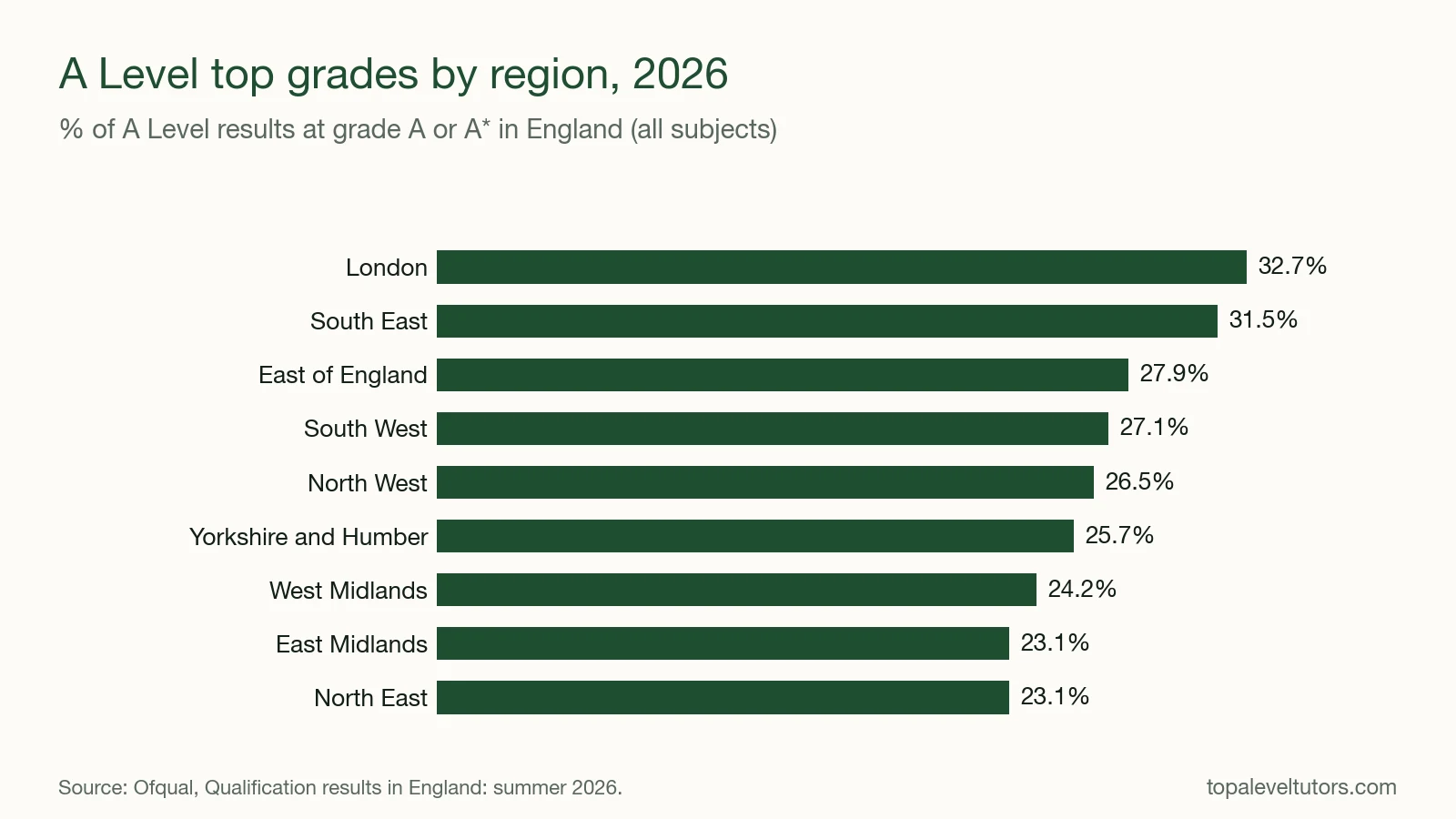
London led England, with 32.7% of A Level results at A or A*, followed by the South East (31.5%). The North East and East Midlands had the lowest share, both at 23.1% (Ofqual, 2026). That's a gap of nearly 10 percentage points.
How Did Results Vary by Type of School?
The gap between school types was much larger. In England, 48.6% of results at independent schools were A or A*, against 43.4% at grammar schools, 25.4% across all state-funded schools and 12.8% at further education colleges (Ofqual, 2026).
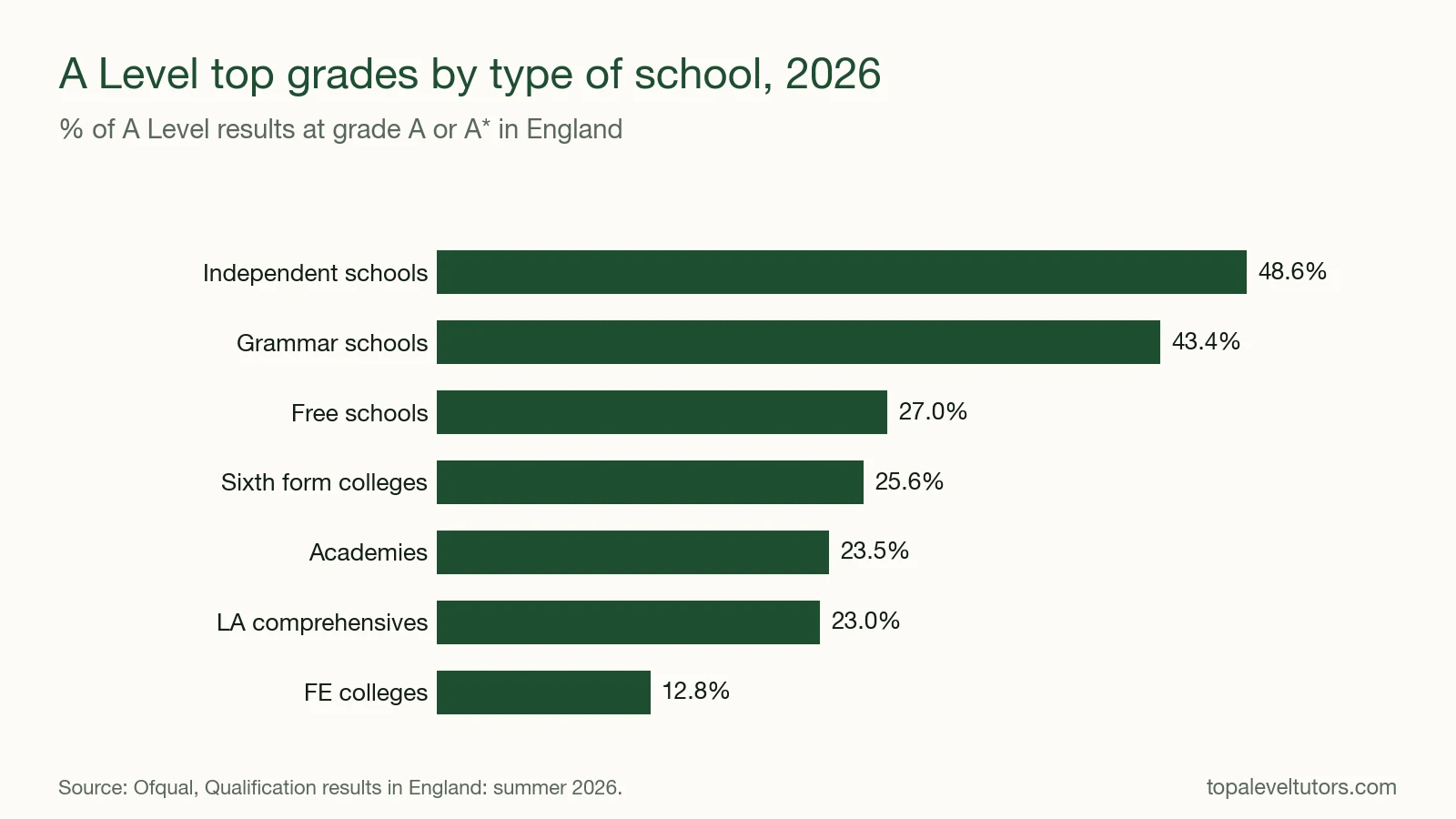
These figures reflect differences in student intake as well as teaching, so they don't show that one type of school "adds" more. They do show how competitive top grades are for students outside selective schools.
How Did Cambridge International Results Compare?
Cambridge International publishes world results by subject. In June 2026, 24.2% of Further Mathematics candidates and 16.9% of Mathematics candidates achieved A*, while just 1.3% of English Language candidates achieved A or A* (Cambridge International, 2026). Our guides to the hardest A Levels and easiest A Levels analyse these in detail.
Cambridge AS & A Level entries grew about 5%, with strong growth across Southeast Asia, including 12% rises in Indonesia and Thailand (Cambridge International, 2026).
For the international families we work with, these figures put targets in context. A predicted A* in Cambridge Mathematics means finishing in roughly the top sixth of candidates worldwide. Setting realistic but ambitious targets, subject by subject, makes planning revision and university choices much easier.
What Do the 2026 Results Mean for 2027 Students?
Expect a similar standard in 2027. Ofqual and Cambridge both aim to keep grading steady from year to year, and Cambridge has applied its pre-Covid standard since June 2023 (Cambridge International, 2026). UK results day 2027 is Thursday 12 August. See our A Level results day 2027 guide.
Aiming for Top Grades in 2027?
Top grades are rare, but they're achievable with the right preparation. Our tutors combine top recent A Level graduates and qualified teachers and examiners, supporting UK, Cambridge International and Edexcel International students towards the grades their university offers need.
Submit an application and we'll match you with a tutor for your subjects.
Frequently Asked Questions
What percentage of A Level results were A* in 2026?
Across the UK, 9.6% of A Level results were A* in 2026, up from 9.4% in 2025 (JCQ, 2026). In Cambridge International A Levels, A* rates in major subjects ranged from 0.9% in History to 24.2% in Further Mathematics.
What was the A Level pass rate in 2026?
97.5% of UK A Level results were A*–E, unchanged from 2025 (JCQ, 2026). In England, 78.1% of results were grade C or above (Ofqual, 2026).
What was the most popular A Level in 2026?
Mathematics, with 107,300 students in England, about one in eight A Level results (Ofqual, 2026). Psychology, Biology, Chemistry and Economics followed.
How many students got all A*s in 2026?
In England, 7,245 18-year-olds achieved A* in every A Level they took (Ofqual, 2026). Among 18-year-olds taking three A Levels, just 2.2% got three A*s.
The Bottom Line
- UK 2026: 9.6% A*, 28.5% A or A*, 97.5% pass, with entries up 2.7%.
- Maths remains the most popular A Level; Economics grew fastest.
- Only 2.2% of 18-year-olds taking three A Levels got straight A*s.
- Results vary widely by region and school type, and by subject internationally.
Planning for 2027? See our A Level exam timetable 2027.
Find the right A-Level tutor this week
If you are not happy after your first session with your tutor, please let us know and we will give you a full refund and find you another tutor for free.