

The 10 Hardest A Levels in 2026 (Ranked With Real Data)
Which A Levels are hardest? We rank 10 subjects using 2026 Cambridge International and UK results, separating hard content from scarce top grades, and explain how to decide if a hard subject suits you.



The hardest A Levels are usually Further Mathematics, Physics, Chemistry, Mathematics and Biology for content, and History, English Literature and English Language for winning top grades. In Cambridge International A Levels in June 2026, only 7.9% of History candidates achieved A or A*, compared with 60.8% in Further Mathematics (Cambridge International, 2026).
That gap shows why "hardest" needs careful thought. There's no official league table of A Level difficulty. So this guide combines two measures, how demanding the content is and how scarce top grades are, using the latest UK and international data.
Key Takeaways
- Further Maths, Physics and Chemistry have the most demanding content, but strong students choose them, so top-grade rates are high.
- Essay subjects such as History and English Literature award the fewest A and A* grades on Cambridge International data.
- Only 1.3% of Cambridge English Language candidates achieved A or A* in 2026.
- "Hard" depends on your strengths: choose subjects you can sustain for two years.
How Did We Rank the Hardest A Levels?
We used two measures. The first is content difficulty: how abstract, cumulative and fast-paced the course is. The second is outcomes: the share of candidates achieving A or A*, and the share left ungraded, from Cambridge International's June 2026 world results (Cambridge International, 2026) and England's 2026 results (Tes, 2026).
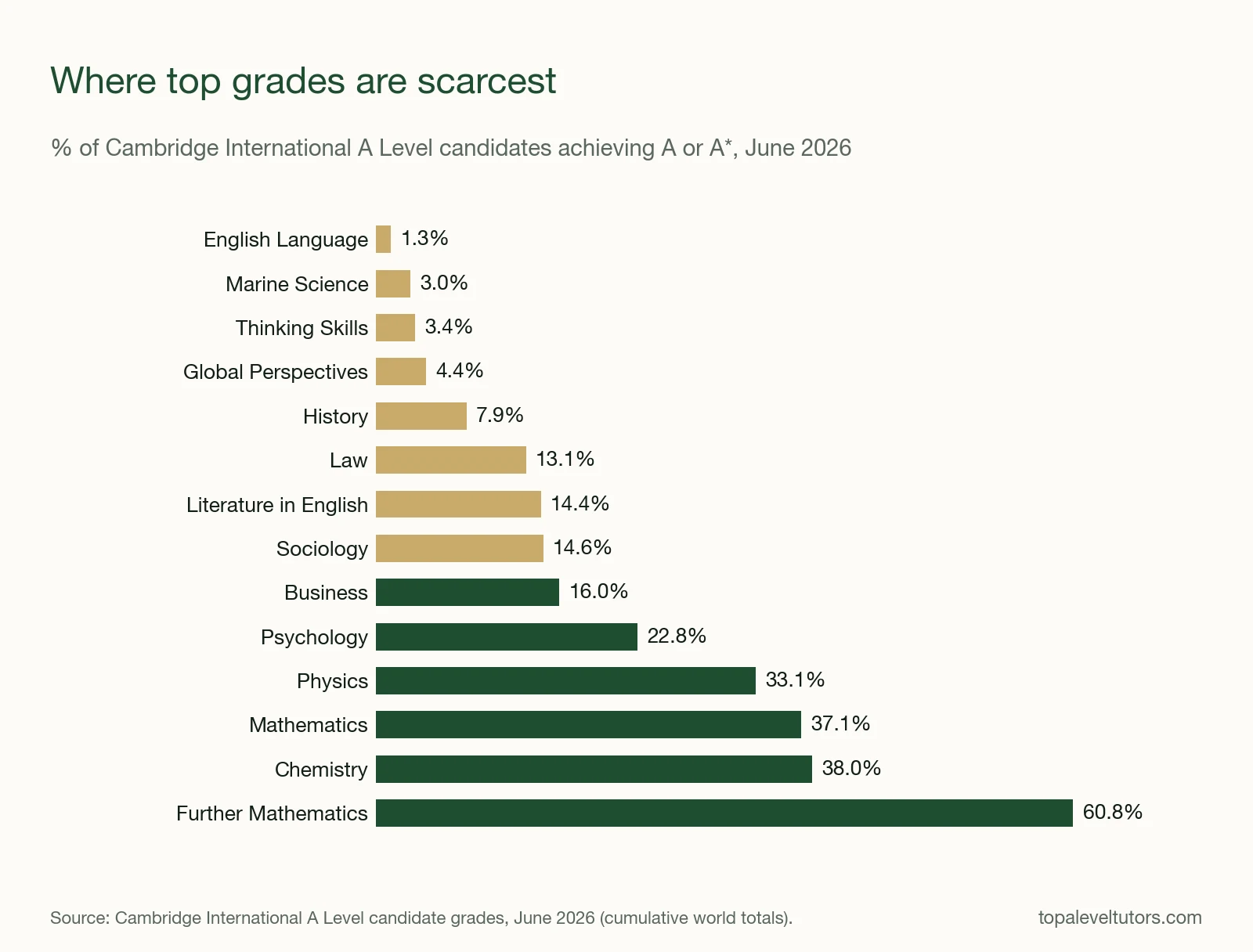
The two measures often disagree, and that's the most useful thing to understand. Further Maths has the hardest content of any A Level, yet 60.8% of Cambridge candidates got A or A*. That's because almost everyone who takes it is already a very strong mathematician. Meanwhile, History has more accessible content but awards far fewer top grades, because writing a sustained, top-band argument is genuinely hard to do under exam conditions.
1. Further Mathematics
Further Mathematics is the hardest A Level for content. It goes well beyond A Level Maths into complex numbers, matrices, further calculus and differential equations. Cambridge says it's "essential" for Mathematics and Computer Science at Cambridge (University of Cambridge, 2026). Its high top-grade rate (24.2% A* on Cambridge data) reflects a very strong group of students, not easy papers.
Take it if you love maths and want a maths-heavy degree. See our Further Mathematics page for more.
2. Physics
Physics combines abstract concepts with heavy mathematical problem-solving. Only 33.1% of Cambridge International Physics candidates achieved A or A* in June 2026 (Cambridge International, 2026). In England it was 32.2% (Tes, 2026).
The step up from GCSE or IGCSE is large, especially in mechanics, fields and quantum physics. Students who also take Maths have a clear advantage. Read more on our Physics page.
3. Chemistry
Chemistry is famous for its jump in difficulty from GCSE. Organic mechanisms, physical chemistry calculations and precise mark scheme language all need mastering. In 2026, 38.0% of Cambridge International Chemistry candidates achieved A or A*, and 31.8% did in England (Tes, 2026).
It's required for medicine and many science degrees, so it's often non-negotiable. See our Chemistry page.
4. Mathematics
A Level Maths is the most popular A Level in England, about one in eight results (Ofqual, 2026), but it's still demanding. Pure maths, statistics and mechanics all test multi-step reasoning. On Cambridge data, 37.1% of candidates got A or A* in 2026, while 4.9% were ungraded.
Maths rewards steady, consistent practice more than almost any other subject. See our Mathematics page.
5. Biology
Biology's difficulty is volume plus precision. There's a large amount of content, and mark schemes demand exact terminology. In 2026, 34.6% of Cambridge International Biology candidates achieved A or A* (Cambridge International, 2026), and just 27.4% did in England (Tes, 2026).
Data analysis and practical skills questions also catch many students out. See our Biology page.
6. History
History is among the hardest A Levels for top grades. Only 7.9% of Cambridge International History candidates achieved A or A* in June 2026, and 17.3% were ungraded (Cambridge International, 2026). In England, 24.8% got A or A* (Tes, 2026).
The challenge is writing balanced, well-supported arguments under strict time limits, plus analysing sources. See our History page.
7. English Literature
English Literature asks you to write sophisticated, original analysis of texts you've studied, often in timed, closed-book exams. In Cambridge International Literature in English, only 14.4% of candidates achieved A or A* in 2026, and 19.5% were ungraded (Cambridge International, 2026). In England, 25.0% achieved A or A*.
It's a strong subject for law, humanities and many other degrees. See our English Literature page.
8. English Language (Cambridge International)
Cambridge International English Language had the scarcest top grades of any major subject in June 2026. Only 1.3% of candidates achieved A or A*, and 30.6% were ungraded (Cambridge International, 2026).
Many international students take this subject expecting it to be straightforward because they speak English fluently. It isn't a language test. It's an analysis and writing course with precise assessment criteria. The students we see improve fastest are the ones who learn exactly what each question type is asking for.
9. Law
Law demands precise application of legal rules to scenarios, plus evaluation of how well the law works. In Cambridge International Law, 13.1% of candidates achieved A or A* in June 2026 and 16.5% were ungraded (Cambridge International, 2026).
Note that you don't need A Level Law to study law at university. Many top law schools prefer subjects such as History or English Literature.
10. Computer Science
Computer Science combines theory, algorithms and programming, and its difficulty depends heavily on your coding experience. In 2026, 30.1% of Cambridge International Computer Science candidates achieved A or A*, and 8.1% were ungraded (Cambridge International, 2026).
Students who start with no programming background often find the first year steep. See our Computer Science page.
Which "Easy" A Levels Are Actually Hard?
Some subjects have a reputation for being easier but award few top grades. In Cambridge International A Levels in 2026, only 14.6% of Sociology candidates, 16.0% of Business candidates and 22.8% of Psychology candidates achieved A or A* (Cambridge International, 2026). In England, Psychology was 20.0% and Business 15.6%.
These subjects have accessible content but demanding essay and evaluation questions. Our guide to the easiest A Levels looks at this in more detail.
Should You Take a Hard A Level?
Take a hard A Level if your degree needs it, or if you're strong in it and enjoy it. A demanding subject you love is easier to sustain for two years than an "easy" one you find dull. Competitive courses often require hard subjects anyway: Cambridge strongly recommends three sciences or maths for science applicants (University of Cambridge, 2026).
The key is to go in prepared. Keep up from Year 12, practise past papers early and get feedback on your weakest topics. Our guides on how to choose A Level subjects and how to get an A* at A Level cover both steps.
Taking On a Hard Subject?
The hardest A Levels reward expert support. Our tutors combine top recent A Level graduates, who've recently aced these subjects, with qualified teachers and examiners who know exactly how they're marked. We support UK, Cambridge International and Edexcel International A Level students worldwide.
Submit an application and we'll match you with a specialist tutor.
Frequently Asked Questions
What is the hardest A Level?
Further Mathematics has the most demanding content. On grades, essay subjects are toughest: in Cambridge International A Levels in June 2026, only 7.9% of History candidates and 1.3% of English Language candidates achieved A or A* (Cambridge International, 2026).
Is A Level Chemistry harder than Biology?
Most students find Chemistry harder conceptually, while Biology has more content to learn. In England in 2026, 31.8% of Chemistry results and 27.4% of Biology results were A or A* (Tes, 2026). Many students take both, especially for medicine.
What is the hardest A Level combination?
Further Maths, Physics and Chemistry is often seen as the hardest combination, because all three are cumulative and maths-heavy. It's also one of the most valued, especially for engineering and physical sciences. Cambridge strongly recommends three sciences or maths for science applicants (University of Cambridge, 2026).
Why does Further Maths have so many A* grades if it's so hard?
Because the students who take it are usually exceptional mathematicians. On Cambridge data, 24.2% of Further Maths candidates achieved A* in June 2026, the highest rate of any major subject (Cambridge International, 2026). High grade rates reflect the group, not easy exams.
Are international A Levels harder than UK A Levels?
They cover similar content at the same level and earn the same UCAS points. Results differ by subject: in 2026, 37.1% of Cambridge International Mathematics candidates got A or A*, against 42.2% in England (Tes, 2026). Differences in who takes each exam explain much of this.
The Bottom Line
- Further Maths, Physics, Chemistry, Maths and Biology have the hardest content.
- History, English Literature and English Language award the fewest top grades on Cambridge data.
- High grade rates in hard subjects reflect strong students, not easy exams.
- Choose hard subjects when your degree needs them and you can sustain them.
Next, compare these with the easiest A Levels.
Find the right A-Level tutor this week
If you are not happy after your first session with your tutor, please let us know and we will give you a full refund and find you another tutor for free.