

A Level Grades Explained: A* to E, Boundaries and Results
Everything you need to know about A Level grades: the A* to U scale, what counts as a pass, how grade boundaries are set, how the A* is awarded, how grades are spread by subject and what to do on results day.



A Level grades run from A* (the highest) down to E (the lowest pass), with U meaning unclassified. In 2026, 9.6% of UK A Level results were A*, 28.5% were A or A*, and 97.5% were a pass at A*–E (JCQ, 2026).
Those headline numbers hide a lot, though. Grades aren't fixed percentages, the A* works differently on different boards, and some subjects award top grades far more often than others. This guide explains it all, for UK and international A Level students.
Key Takeaways
- A Level grades are A*, A, B, C, D and E (all passes), plus U (fail).
- Grade boundaries are set after each exam series, so the marks needed change every year.
- 28.5% of UK A Level results were A or A* in 2026 (JCQ).
- AS Levels are graded A to E, with no A*.
What Are the A Level Grades?
There are six passing A Level grades: A*, A, B, C, D and E. Anything below E is a U (unclassified), which means no qualification is awarded. Each grade converts into UCAS Tariff points, from 56 for an A* to 16 for an E (University of Roehampton, 2026).
| Grade | Meaning | UCAS points |
|---|---|---|
| A* | Outstanding | 56 |
| A | Excellent | 48 |
| B | Very good | 40 |
| C | Good | 32 |
| D | Satisfactory pass | 24 |
| E | Minimum pass | 16 |
| U | Unclassified (fail) | 0 |
The same letters are used by UK boards (AQA, OCR, Pearson Edexcel, WJEC/Eduqas) and international boards (Cambridge International, Pearson Edexcel International and OxfordAQA). For how points add up across subjects, see our guide to A Level points.
What Counts as a Pass at A Level?
Technically, any grade from A* to E is a pass. In 2026, 97.5% of UK A Level results were A*–E (JCQ, 2026). In practice, though, a "pass" and a "useful grade" are different things.
Most universities set offers well above E. Competitive courses typically ask for AAA to A*A*A, and mid-ranking courses often ask for BBB to ABB. So the grade you need depends on where you want to go, not on the pass mark.
International results show more spread. In Cambridge International English Language in June 2026, only 66.7% of candidates achieved E or above, and 30.6% were ungraded (Cambridge International, 2026).
How Are A Level Grade Boundaries Set?
Grade boundaries are the minimum marks needed for each grade, and exam boards set them after marking, not before. For example, AQA A Level Mathematics in June 2024 needed 259 out of 300 for an A* and 73 for an E (Open Study College, 2026). That's about 86% for an A* and 24% for a pass.
Boundaries move because papers vary in difficulty. If a paper is harder than usual, boundaries drop so that students aren't penalised for the tougher questions. In England, Ofqual oversees this process so that a grade represents a similar standard from one year to the next.
The practical lesson is to track your performance in grades, not raw percentages. Score each past paper against that year's published boundaries. A 78% on a hard paper might be an A, while 78% on an easy one might be a B. Students who only track percentages often misjudge where they stand by a whole grade.
How Is the A* Grade Awarded?
For UK A Levels, the A* is simply the top grade boundary on your total marks, because AS results no longer count towards the A Level (Pearson, 2026). For Pearson Edexcel International A Levels, you need an A overall plus at least 90% of the uniform marks on your A2 units (Pearson, 2026).
For Cambridge International, the A* is only available on the full A Level, and AS grades stop at A. Our guide on how to get an A* at A Level covers the strategies that top students use.
How Are Grades Spread Across Students?
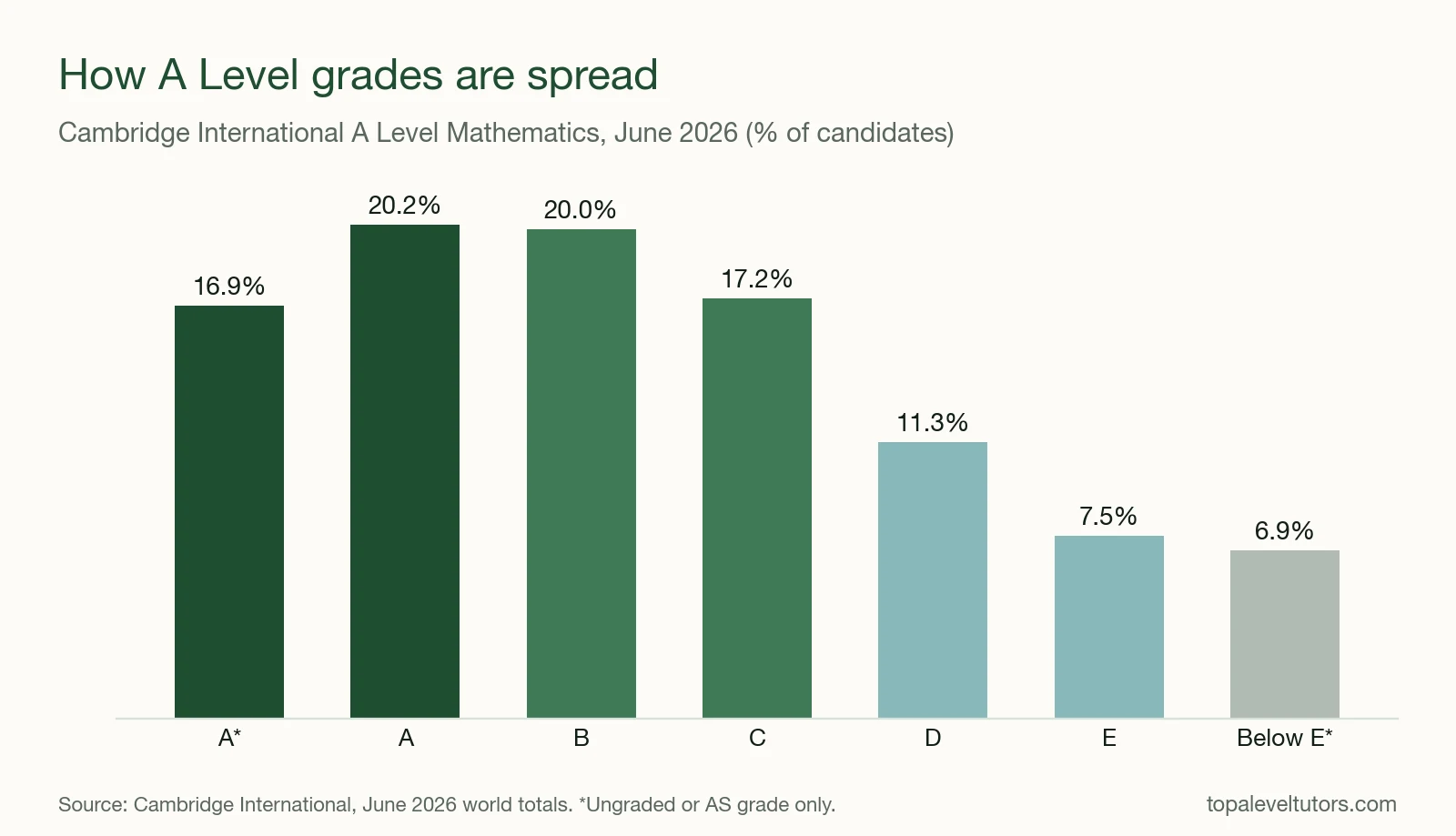
Grades follow a broad spread rather than clustering at the top. In Cambridge International A Level Mathematics in June 2026, 16.9% of candidates got A*, 37.1% got A or above and 74.3% got C or above (Cambridge International, 2026).
UK subjects vary too. In England in 2026, 42.2% of Maths results were A or A*, compared with 25.0% in English Literature, 20.0% in Psychology and 15.6% in Business (Tes, 2026).
| Subject (England, 2026) | A or A* |
|---|---|
| German | 45.4% |
| Mathematics | 42.2% |
| Physics | 32.2% |
| Chemistry | 31.8% |
| Economics | 30.1% |
| Biology | 27.4% |
| English Literature | 25.0% |
| History | 24.8% |
| Psychology | 20.0% |
| Business | 15.6% |
These differences partly reflect who takes each subject. A subject chosen mostly by strong mathematicians will award more top grades. Our guides to the hardest A Levels and easiest A Levels look at this in more detail.
How Are AS Level Grades Different?
AS Levels are graded A, B, C, D and E, with no A*. An AS grade is worth 40% of the UCAS points of the same A Level grade, so an AS A is 20 points (University of Roehampton, 2026).
How AS grades feed into the full A Level depends on your board. In the UK, AS is a separate qualification and doesn't count. With Cambridge International, an AS can count as half of the A Level if you take the staged route. With Edexcel International, AS units are half of the full qualification.
What Happens on Results Day?
UK A Level results were released on 13 August 2026, when 835,950 A Level results were issued in England (Ofqual, 2026). Cambridge International June results are also released in mid-August, in time for university confirmation.
If you miss your offer, contact the university straight away, as some will still accept you. If you think a script was marked wrongly, your school can request a review of marking (UK) or an enquiry about results (Cambridge). Grades can go up or down after a review.
Each year, some students we work with miss an offer by a single grade. The ones who do best act on the day: they call admissions, ask their school to check borderline papers and look at alternatives through Clearing. A calm, quick response matters more than the grade gap itself.
Want to Move Up a Grade?
The gap between grades is often a handful of marks, and the right support can close it. Our tutors combine top recent A Level graduates with qualified teachers and examiners, who know what earns marks at each grade. We support UK, Cambridge International and Edexcel International A Level students.
Submit an application to be matched with a tutor for your subjects.
Frequently Asked Questions
Is a D or E a pass at A Level?
Yes. Any grade from A* to E is a pass, and 97.5% of UK A Level results were A*–E in 2026 (JCQ, 2026). But most university offers ask for C or above, and competitive courses ask for A grades.
What percentage is an A* at A Level?
There's no set percentage, because boundaries change each year. In AQA A Level Maths in June 2024, an A* needed 259 out of 300, about 86% (Open Study College, 2026). Essay subjects often have lower percentage boundaries.
What is a U grade at A Level?
A U means unclassified: the result was below the E boundary and no qualification is awarded. In Cambridge International A Level Mathematics in June 2026, 4.9% of candidates were ungraded (Cambridge International, 2026). You can resit the subject in a later series.
Is an A* better than an A for university?
Yes, for courses that ask for it. Many top courses make offers such as A*AA or A*A*A, and an A* is worth 56 UCAS points against 48 for an A (University of Roehampton, 2026). For other courses, an A meets the requirement just as well.
Are international A Level grades the same as UK A Level grades?
Yes. Cambridge International and Edexcel International A Levels use the same A*–E scale and earn the same UCAS points. Grade patterns differ by board: in June 2026, 16.9% of Cambridge Mathematics candidates achieved A* (Cambridge International, 2026).
The Bottom Line
- A Level grades run from A* to E, all passes, with U as unclassified.
- Boundaries are set after marking and change each year.
- 28.5% of UK A Level results were A or A* in 2026, with big differences between subjects.
- The A* rule differs by board, and AS grades stop at A.
New to A Levels? Start with our guide to what an A Level is.
Find the right A-Level tutor this week
If you are not happy after your first session with your tutor, please let us know and we will give you a full refund and find you another tutor for free.