

The Easiest A Levels in 2026: What the Data Really Shows
Which A Levels are easiest to do well in? We use 2026 Cambridge International and UK results to show where most students score well, why some 'easy' subjects award few top grades and how to choose.



No A Level is truly easy, but some subjects see far more students do well. In Cambridge International A Levels in June 2026, 84.6% of Music candidates and 77.3% of Geography candidates achieved grade C or above, compared with just 26.8% in Travel and Tourism (Cambridge International, 2026).
That last figure surprises most people, because Travel and Tourism has a reputation as an easy option. This guide uses 2026 results from the UK and Cambridge International to show where students actually score well, and why reputation is a poor guide.
Key Takeaways
- Subjects where most students do well include Music, Geography, Art and Design, Drama and modern languages.
- Some "easy" subjects award few top grades: only 14.6% of Cambridge Sociology candidates got A or A* in 2026.
- Home-language A Levels have very high top-grade rates because many candidates are native speakers.
- The easiest A Level for you is one you're strong in and enjoy.
How Do You Measure an "Easy" A Level?
We looked at two things: the share of students reaching grade C or above, and the share reaching A or A*. We used Cambridge International's June 2026 world results (Cambridge International, 2026) and England's 2026 subject results (Tes, 2026).
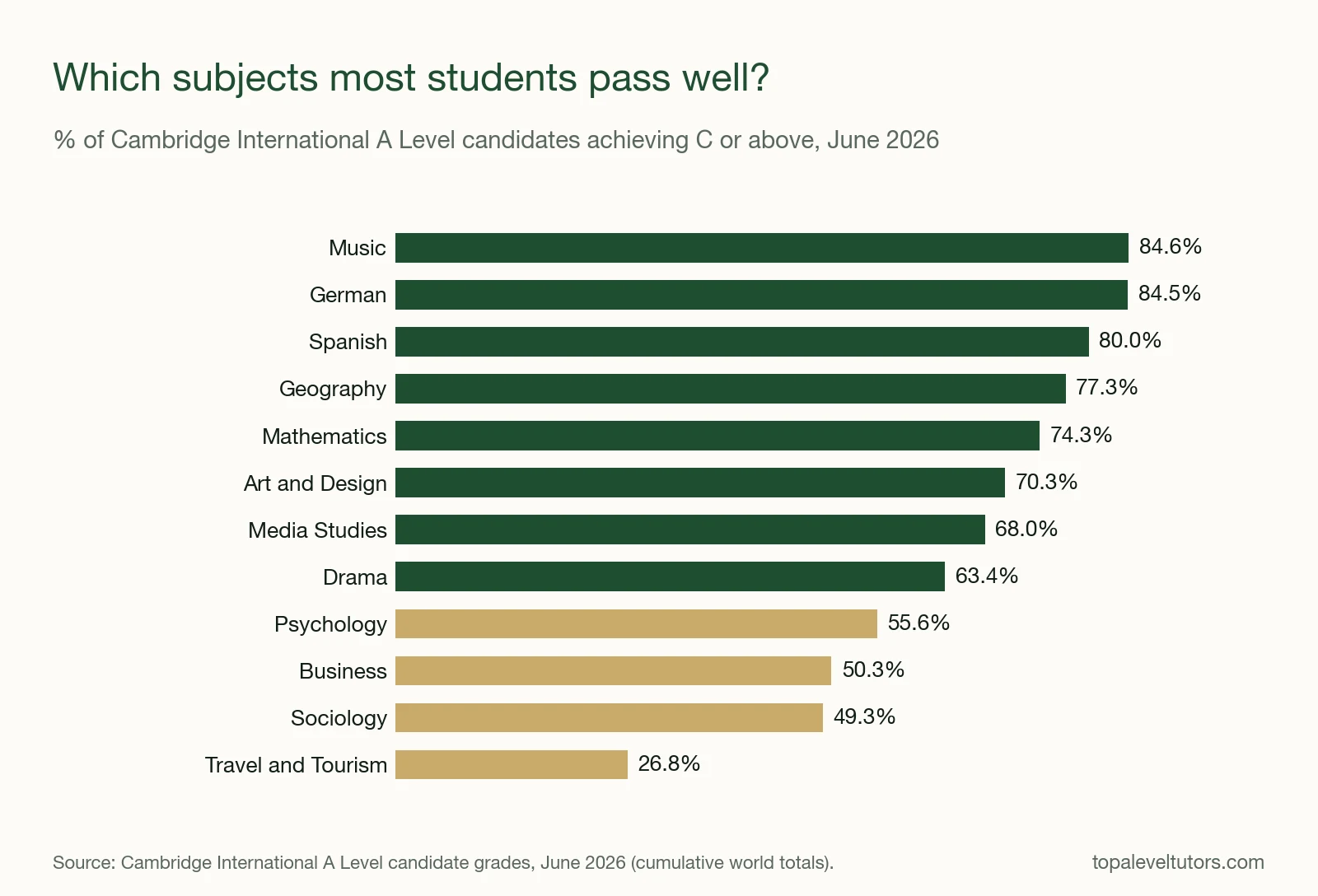
There's an important catch. Results depend on who takes a subject as well as how hard it is. Music and languages attract students who already have years of skill, so high grades partly reflect the students, not easy exams. Keep that in mind as you read the list.
1. Your Home Language
For international students, an A Level in a language you already speak fluently is often the most accessible top grade. In Cambridge International A Levels in June 2026, 86.2% of Chinese Language and Literature candidates and 70.9% of Arabic candidates achieved A or A* (Cambridge International, 2026).
This is one of the clearest advantages international students have over UK students, and many don't use it. A home-language A Level can be a strong fourth subject or AS Level. Check two things first, though: that the universities you want accept it, and that it doesn't replace a subject your degree requires.
2. Geography
Geography combines physical and human topics, data skills and fieldwork, and many students find it more approachable than the sciences. In 2026, 77.3% of Cambridge International Geography candidates achieved C or above and 40.6% got A or A* (Cambridge International, 2026). In England, 80.7% got C or above (Tes, 2026).
It's also well regarded by universities, which makes it one of the best "accessible" choices. See our Geography page.
3. Art and Design
Art and Design is largely assessed through portfolio work rather than written exams, which suits creative students. In England in 2026, 89.0% of Art and Design results were C or above and 35.2% were A or A* (Tes, 2026). In Cambridge International, 70.3% achieved C or above.
Don't underestimate the workload, though. Portfolio subjects need many hours of practical work outside lessons.
4. Drama and Theatre
Drama combines practical performance with written analysis. In England in 2026, 89.1% of Drama results were C or above (Tes, 2026), and in Cambridge International, 97.2% of Drama candidates achieved E or above (Cambridge International, 2026).
Top grades are harder: only 14.4% of Cambridge Drama candidates got A or A*. It suits confident performers who also write well.
5. Music
Music had one of the highest pass rates of any Cambridge International subject in June 2026: 84.6% achieved C or above and every candidate achieved at least an E (Cambridge International, 2026). In England, 77.9% achieved C or above.
But Music assumes years of instrumental skill and music theory. It's only "easy" if you already have that background.
6. Media Studies
Media Studies is accessible for many students, with 68.0% of Cambridge International candidates reaching C or above and 95.9% passing in June 2026 (Cambridge International, 2026). Top grades are rarer, at 17.6% A or A*.
Be aware that Cambridge University lists Media Studies among subjects that are "less useful" for its courses (University of Cambridge, 2026). Pair it with traditional academic subjects if you're aiming high.
7. Modern Foreign Languages (If You're Already Strong)
Languages award top grades often, partly because many students taking them are confident or bilingual. In England in 2026, 45.4% of German results, 38.9% of French and 34.5% of Spanish were A or A* (Tes, 2026). In Cambridge International Spanish, 80.0% achieved C or above.
If you're starting from a basic GCSE level, a language A Level is a big jump. If you're strong already, it can be one of your best grades.
Which "Easy" A Levels Aren't Easy at All?
Several subjects with a reputation for being easy award relatively few top grades. In Cambridge International A Levels in June 2026, only 14.6% of Sociology candidates, 16.0% of Business candidates and 22.8% of Psychology candidates achieved A or A*. In Travel and Tourism, just 1.4% did (Cambridge International, 2026).
| Subject (Cambridge International, 2026) | A or A* | C or above |
|---|---|---|
| Psychology | 22.8% | 55.6% |
| Business | 16.0% | 50.3% |
| Sociology | 14.6% | 49.3% |
| Travel and Tourism | 1.4% | 26.8% |
England shows the same pattern: 20.0% of Psychology results and 15.6% of Business results were A or A* in 2026 (Tes, 2026).
We see this every year. Students pick Psychology or Business expecting a lighter load, then find the essays and evaluation questions harder than they thought. Familiar topics make these subjects feel easy in lessons. The exams, though, reward precise use of studies, theory and evaluation, and that takes real practice.
Should You Choose an A Level Because It's Easy?
Choose subjects for fit, not for a reputation. A subject that matches your strengths and your degree plans will usually be your "easiest" route to a strong grade. Cambridge University warns that some vocational subjects are "less useful" for its courses (University of Cambridge, 2026), and that view is shared by many selective universities.
A good approach is to pair subjects you're confident in with the ones your degree requires. Our guide on how to choose A Level subjects walks through that process, and our guide to the hardest A Levels shows the other side of the picture.
Want Top Grades in Every Subject?
Whichever subjects you choose, top grades take good technique. Our tutors are a combination of top recent A Level graduates and qualified teachers and examiners, so you get support from people who've done well in the exams and people who mark them. We support UK, Cambridge International and Edexcel International A Level students.
Submit an application and we'll match you with a tutor for your subjects.
Frequently Asked Questions
What is the easiest A Level to get an A* in?
Among major subjects, home-language A Levels and Further Maths have the highest A* rates, but both reflect strong candidates rather than easy exams. In Cambridge International A Levels in June 2026, 24.2% of Further Maths candidates achieved A* (Cambridge International, 2026).
Is Psychology an easy A Level?
Not for top grades. Only 20.0% of Psychology results in England were A or A* in 2026, below the all-subject average of 28.3% (Tes, 2026). The content is approachable, but exams demand detailed knowledge of studies and strong evaluation.
Is Sociology an easy A Level?
Sociology is approachable but not easy to score highly in. In Cambridge International A Levels in June 2026, only 14.6% of Sociology candidates achieved A or A*, and fewer than half (49.3%) achieved C or above (Cambridge International, 2026).
Do universities accept easy A Levels?
Most universities accept most A Levels, but selective ones prefer traditional academic subjects. Cambridge calls subjects such as Business, Media Studies and Travel and Tourism "less useful" for its courses (University of Cambridge, 2026). One such subject alongside two academic ones is usually fine.
Which A Level has the highest pass rate?
On Cambridge International data, Music had a 100% pass rate (E or above) in June 2026, and Chinese Language and Literature was 99.9% (Cambridge International, 2026). Across all UK subjects, 97.5% of A Level results were a pass in 2026.
The Bottom Line
- Music, Geography, Art and Design, Drama and languages see the most students do well.
- Home-language A Levels are a real advantage for many international students.
- Sociology, Business, Psychology and Travel and Tourism award fewer top grades than their reputation suggests.
- The easiest A Level for you is one that fits your strengths and your degree.
Start from the beginning with our guide to what an A Level is.
Find the right A-Level tutor this week
If you are not happy after your first session with your tutor, please let us know and we will give you a full refund and find you another tutor for free.