

A Level Economics Past Papers: Where to Find Them and How to Use Them
Where to find official A Level Economics past papers for AQA, Edexcel, OCR, Cambridge International and Edexcel International, how each board's papers are structured, and how to write essays that earn evaluation marks.

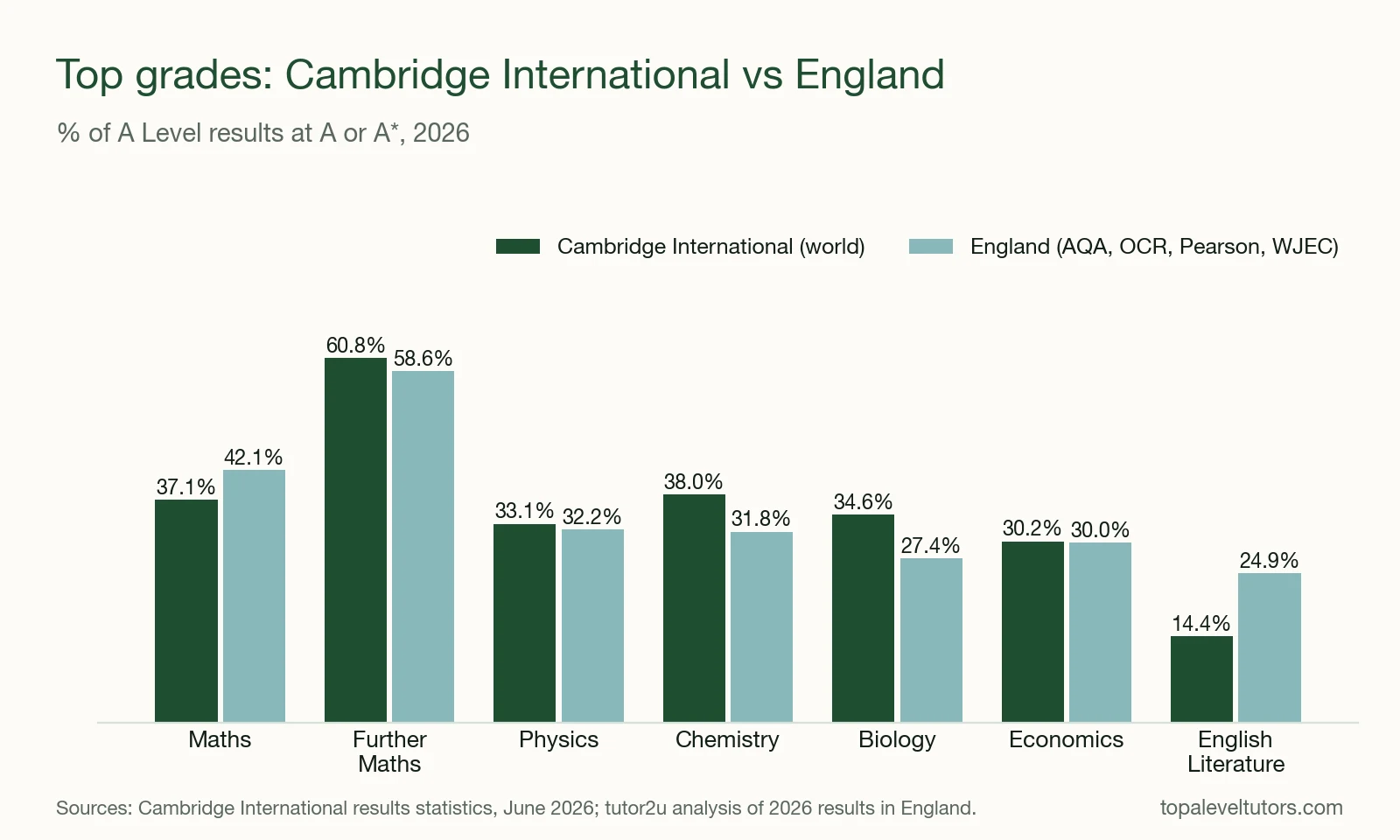
Official A Level Economics past papers come from your exam board: AQA, Pearson Edexcel or OCR in the UK, and Cambridge International or Pearson Edexcel International at most international schools. Past papers matter more in Economics than in many subjects, because essays need practice. In 2026, 30.0% of Economics results in England were A or A\* (tutor2u, 2026), almost the same as the 30.2% for Cambridge International candidates (Cambridge International, 2026).
This guide shows where to find official papers for each board, how the exams are structured and how to use past papers to improve both short questions and essays.
Key Takeaways
- Use official papers and mark schemes from your own board and specification.
- Every board combines data questions with extended essays that need evaluation.
- Essays are marked with levels, so compare your score with the boundary, not with 100%.
- About 30% of Economics students get A or A\*, in the UK and internationally.
Where Can You Find Official Economics Past Papers?
Every board publishes papers free, with different rules. Pearson keeps the most recent 12 months of papers for teachers only (Pearson, 2026). AQA's summer 2026 papers go public on 9 July 2027 (AQA, 2026).
| Board | Specification | Where to find papers | Access |
|---|---|---|---|
| AQA | Economics 7136 | AQA past papers | Public about a year after the exam |
| Pearson Edexcel (UK) | Economics A 9EC0 | Pearson past papers | Free, except papers from the last 12 months |
| OCR | Economics H460 | OCR past paper finder | Public The newest papers may be restricted |
| Cambridge International | Economics 9708 | Cambridge 9708 past papers | Public selection Full archive for schools |
| Pearson Edexcel International | Economics YEC11 | Pearson past papers | Free, except papers from the last 12 months |
Cambridge's public 9708 page offers a selection of recent papers, mark schemes and examiner reports, with the full archive on the School Support Hub (Cambridge International, 2026). Schools often save the newest papers for mocks, so ask your teacher.
How Are AQA, Edexcel and OCR Economics Papers Structured?
UK A Level Economics is linear, with three 2-hour papers at the end of Year 13. AQA's three papers are each worth 80 marks and a third of the A Level: markets and market failure, the national and international economy, and economic principles and issues (AQA, 2026).
| Board | Papers | What they cover |
|---|---|---|
| AQA (7136) | Three 2-hour papers, 80 marks each | Microeconomics, macroeconomics, and a synoptic paper with multiple choice and an investigation |
| Pearson Edexcel (9EC0) | Three 2-hour papers, 100 marks each | Markets and business behaviour, the national and global economy, and a synoptic paper |
| OCR (H460) | Three 2-hour papers | Microeconomics, macroeconomics, and themes in economics |
Every UK board ends with a synoptic paper that draws on the whole course, so save full practice of that paper until you've covered everything.
How Are the Cambridge 9708 Economics Papers Structured?
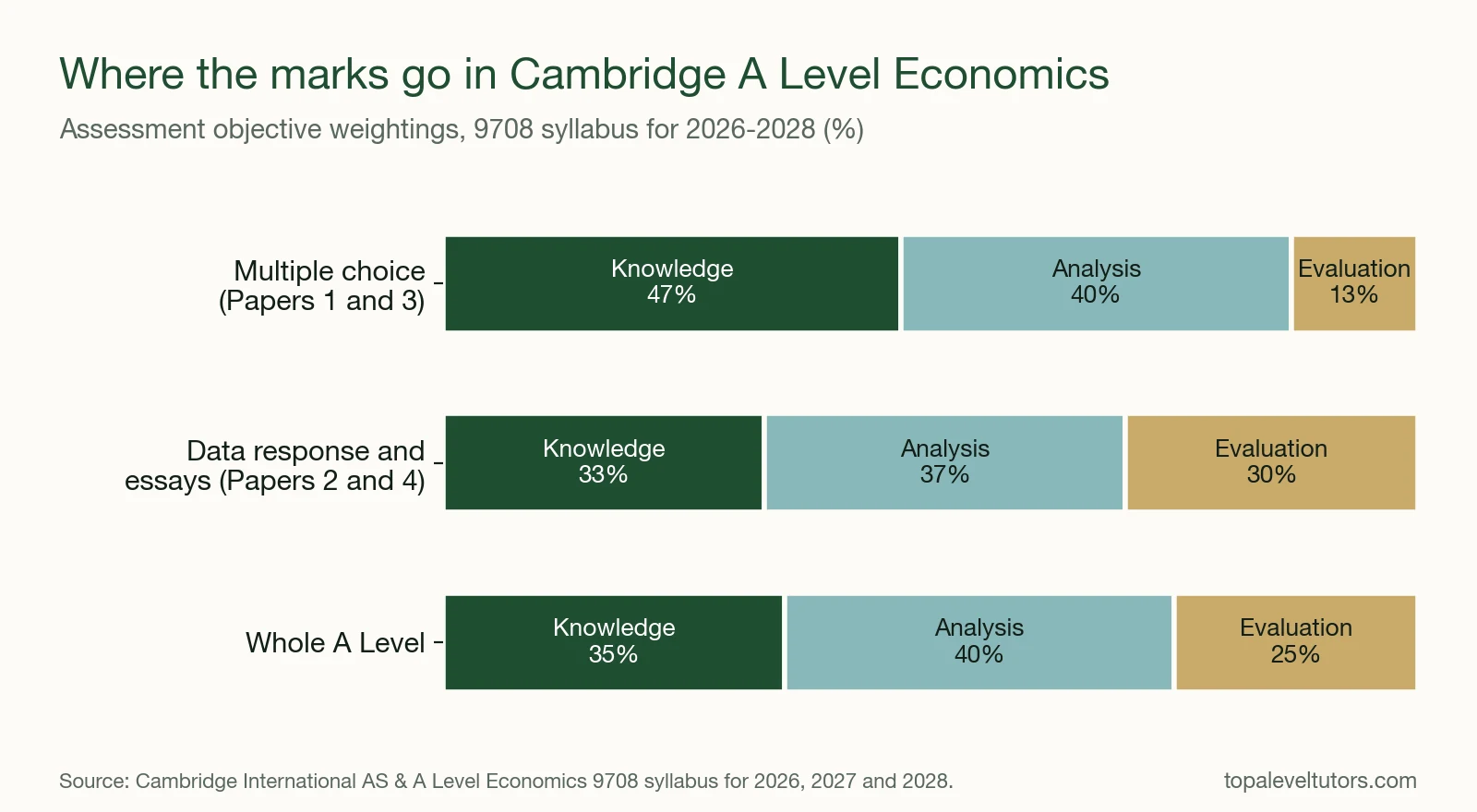
Cambridge A Level Economics has four papers. The two multiple choice papers are each worth 17% of the A Level, and the two data response and essay papers 33% each (Cambridge International, 2026).
| Paper | Time | Marks | Weighting |
|---|---|---|---|
| 1: AS Level Multiple Choice | 1 hr | 30 | 33% of AS / 17% of A Level |
| 2: AS Level Data Response and Essays | 2 hr | 60 | 67% of AS / 33% of A Level |
| 3: A Level Multiple Choice | 1 hr 15 min | 30 | 17% of A Level |
| 4: A Level Data Response and Essays | 2 hr | 60 | 33% of A Level |
Each data response and essay paper has three 20-mark sections. On Paper 4, the essays are unstructured, with no parts, so you need to plan the whole argument yourself. Evaluation makes up 30% of these papers.
How Are Edexcel International Economics Papers Structured?
Pearson Edexcel International A Level Economics (YEC11) has four units, each worth 80 marks. Units 1 and 2 are 1 hour 45 minute exams; Units 3 and 4 are 2 hours (Pearson, 2018).
For four-unit subjects, the A\* needs at least 320 uniform marks overall and 180 on the A2 units (Pearson, 2026). See how A Level grades are calculated for how each board totals marks.
How Should You Use Economics Past Papers?
Use short and multiple choice questions for fast, frequent testing, and essay questions for timed writing practice. Practice testing was rated one of only two "high utility" learning methods in a major review (Dunlosky et al., 2013). Both question types benefit.
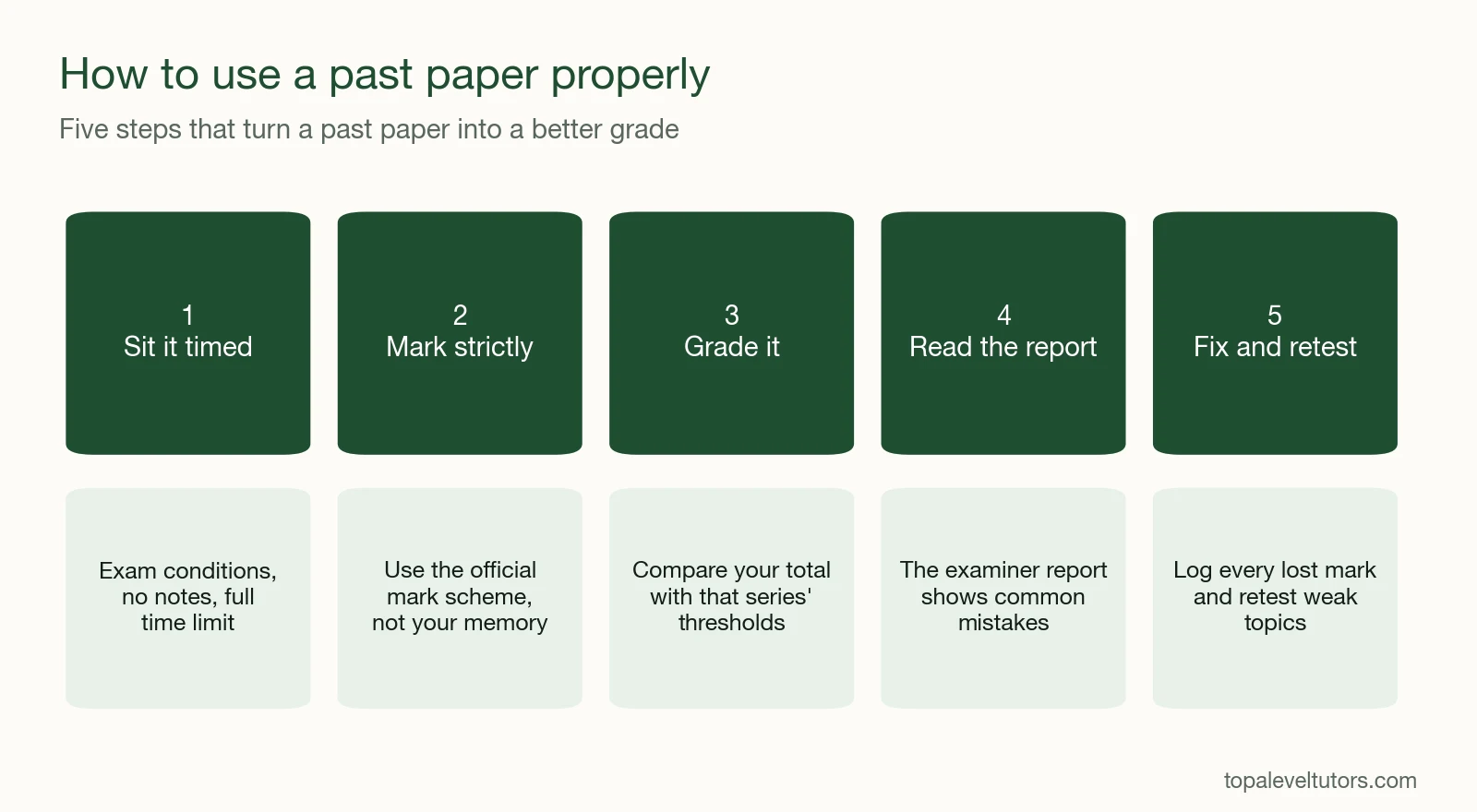
For essays, mark with the mark scheme's levels descriptors, not just its indicative content. On every board, the top levels need accurate knowledge, developed analysis with diagrams and a supported judgement. If you can, have a teacher or tutor mark your essays too, because judging your own evaluation is hard.
Boundaries show how differently the question types are marked. In Cambridge's June 2026 series, an A on the multiple choice Paper 1 needed 25 out of 30, about 83%, while an A on the essay Paper 2 needed just 24 out of 60, 40% (Cambridge International, 2026). Essays on every board work like this: full marks are rare. Don't be discouraged by essay scores that look low; compare them with the boundary.
When Should You Start Economics Past Papers?
Start short questions on each topic as soon as it's taught, and write timed essays from the middle of Year 12. Full papers can wait until you've covered the course. Spacing practice over months beats cramming (Dunlosky et al., 2013).
Write at least one timed essay a week in Year 13. Speed matters on every board. Our guide on how to revise for A Levels includes a full revision plan.
What Grade Can You Expect in A Level Economics?
Economics top grades are competitive. In England in 2026, 7.6% of Economics results were A\* and 30.0% were A or A\* (tutor2u, 2026). Among Cambridge International candidates, 12.9% got A\* and 30.2% got A or A\* (Cambridge International, 2026).
The Economics students we tutor usually do well on short questions and lose marks on evaluation. A typical essay explains both sides well but ends with "it depends" and no real judgement. Practising conclusions that say what it depends on, and which way the balance falls, is often what moves a B to an A. Our A Level command words guide explains how to answer "evaluate" and "assess".
Want Help With A Level Economics?
Essay feedback from an expert is the fastest way to improve in Economics. Our tutors combine top recent A Level graduates and qualified teachers and examiners, with specialists in AQA, Edexcel, OCR, Cambridge and Edexcel International Economics. See our A Level Economics tutoring.
Submit an application and we'll match you with an Economics tutor.
Frequently Asked Questions
Where can I find AQA and Edexcel A Level Economics past papers?
On each board's website. AQA publishes papers about a year after the exam, and Pearson makes them free once they're more than 12 months old (AQA, 2026; Pearson, 2026). Ask your teacher for anything newer.
Where can I find Cambridge 9708 Economics past papers?
Cambridge publishes a selection of recent 9708 papers, mark schemes and examiner reports on its public syllabus page. The full archive is on the School Support Hub for registered schools (Cambridge International, 2026).
How do you get evaluation marks in Economics essays?
Weigh up the arguments, say what the outcome depends on and reach a clear, justified judgement. On Cambridge, evaluation is worth 30% of the data response and essay papers and 25% of the whole A Level (Cambridge International, 2026). UK boards reward the same skill.
Are older Economics past papers still useful?
Yes, for most topics, but check them against your current specification. Cambridge's current 9708 syllabus has applied since 2023 (Cambridge International, 2026), and UK papers from before 2017 follow the old modular courses. Use older papers for topic practice rather than full mocks.
The Bottom Line
- Use official papers and mark schemes from your own board.
- Use short questions for frequent testing and essays for timed writing.
- Compare essay scores with boundaries, not with 100%.
- Evaluation decides the top grades on every board, so practise clear judgements.
Choosing subjects? See the best A Levels for economics.
Find the right A-Level tutor this week
If you are not happy after your first session with your tutor, please let us know and we will give you a full refund and find you another tutor for free.