

Best A Levels for Medicine: Required Subjects and Grades (2027)
Which A Levels you need for medicine: required and recommended subjects, typical grades, the UCAT, how competitive places are for international students, and how to choose your third subject.





The best A Levels for medicine are Chemistry and Biology, plus a third subject such as Mathematics or Physics. Almost every UK medical school requires Chemistry, and most also want Biology. Cambridge, for example, requires A Level Chemistry plus one or two of Biology, Physics, Mathematics or Further Mathematics, with a minimum offer of A*A*A (University of Cambridge, 2026).
Grades matter as much as subjects. This guide explains what medical schools ask for, how competitive places are for international students and how to choose your third subject.
Key Takeaways
- Chemistry is essential for almost every UK medical school; Biology is required or strongly preferred by most.
- Typical offers range from AAA to A*A*A.
- Most UK medical schools require the UCAT admissions test.
- At Cambridge, 82% of A Level entrants achieved at least A*A*A*.
Which A Levels Do You Need for Medicine?
Chemistry is the one subject nearly every UK medical school requires. Most also want Biology, and many accept Mathematics, Physics or Further Mathematics as the second or third science. Cambridge asks for Chemistry plus one or two of these, depending on the College (University of Cambridge, 2026).
| Subject | How medical schools see it |
|---|---|
| Chemistry | Required by almost all |
| Biology | Required or strongly preferred by most |
| Mathematics | Useful second or third science |
| Physics | Useful, especially for some courses |
| A non-science | Accepted as a third subject by many, not all |
Some schools exclude General Studies and Critical Thinking, and many won't count overlapping subjects, such as Biology and Human Biology, separately. Always check each medical school's 2027 requirements.
What Grades Do You Need for Medicine?
Typical offers range from AAA to A*A*A. At Cambridge, the minimum offer is A*A*A, Colleges usually require an A* in Chemistry, and 82% of entrants who took A Levels achieved at least A*A*A* (University of Cambridge, 2026).
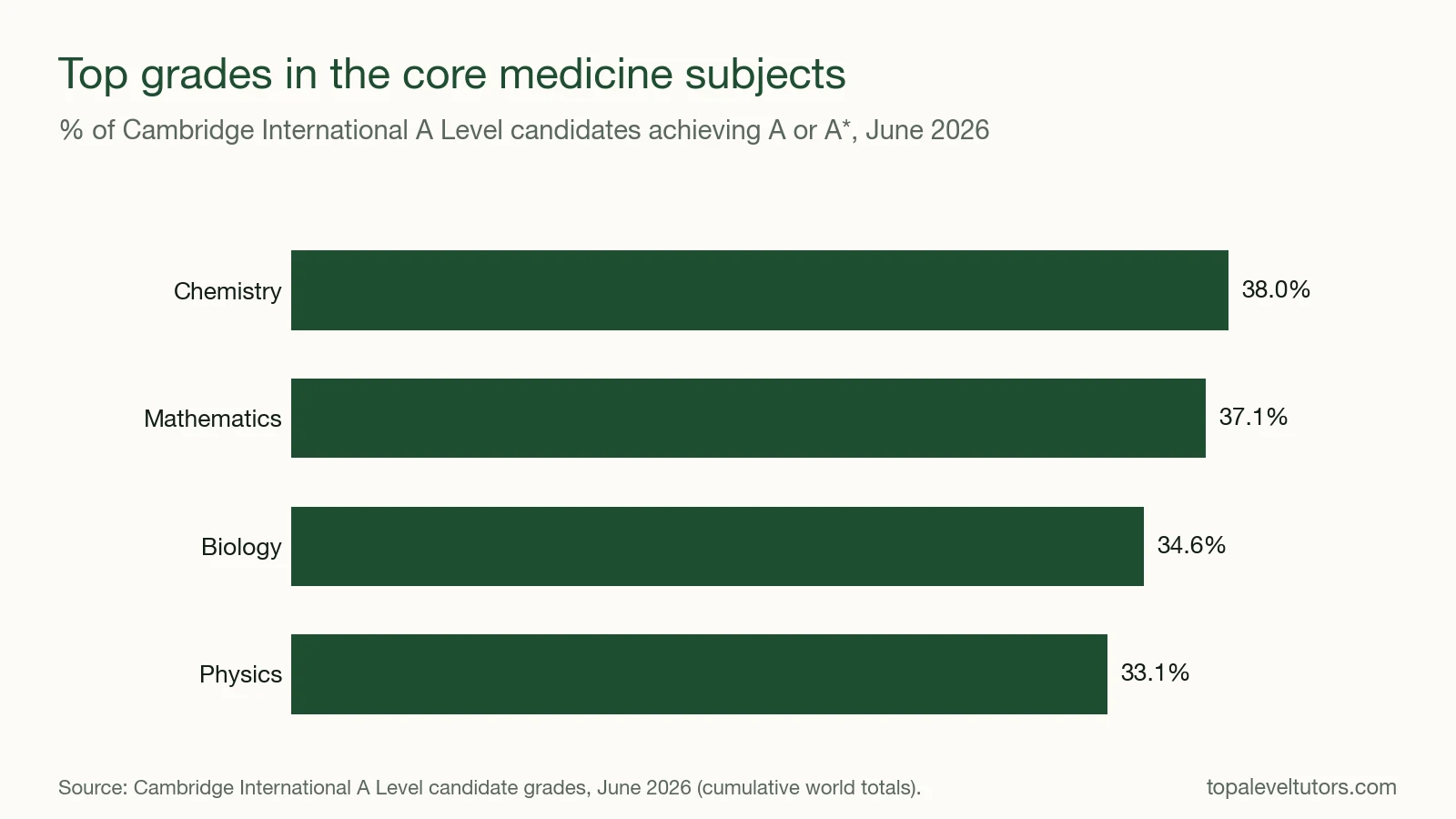
Those grades are rare. In June 2026, only 38.0% of Cambridge International A Level Chemistry candidates and 34.6% of Biology candidates achieved A or A* (Cambridge International, 2026).
How Competitive Is Medicine for International Students?
Very. Medical schools have strict limits on places for international students. Cambridge, for example, had 6 applications per place in the 2025 cycle and has 22 places for overseas fee status students (University of Cambridge, 2026). Other medical schools also cap international places.
For international applicants, this changes the strategy. You're competing for a much smaller pool of places, so excellent grades are a starting point, not a differentiator. Your UCAT score, interview performance and evidence of genuine interest in medicine carry even more weight. Apply broadly, including to medical schools with more international places.
Do You Need the UCAT?
Most UK medical schools require the UCAT (University Clinical Aptitude Test), taken in the summer before you apply. Cambridge uses it too, and for 2027 entry only the overall cognitive subtest score is used (University of Cambridge, 2026). Medical schools use UCAT scores differently, some as a cut-off and some as one factor among several.
The UCAT is taken on computer at test centres around the world, which makes it accessible for international students. Book early and prepare over several weeks, alongside your A Level work.
Which Third Subject Should You Choose?
Choose a third subject you can get an A or A* in, ideally one that strengthens your application. Mathematics is the most popular choice and helps with Chemistry calculations; Physics suits students interested in medical technology. A humanities subject such as Psychology or English can work if your medical schools accept it, and it shows breadth.
In England in 2026, 42.2% of Mathematics results were A or A*, against 31.8% for Chemistry and 27.4% for Biology (Tes, 2026). Choose where you're strongest, as long as it meets your schools' rules.
Medicine applicants we support often focus so hard on Chemistry and Biology that their third subject slips. That's a risk, because most offers include it. We encourage students to protect their weakest subject early in Year 12, because an A in all three is non-negotiable for most medical schools.
When Should You Apply?
Medicine applications through UCAS are due by 15 October 2026 for 2027 entry (University of Exeter, 2026), much earlier than most courses. That means your UCAT, personal statement and work experience need to be in place by the start of Year 13. Our guide to applying to UK universities as an international student covers the full process.
Aiming for Medicine?
Medicine needs top grades in demanding subjects. Our tutors combine top recent A Level graduates with qualified teachers and examiners. We support Chemistry, Biology, Mathematics and Physics across UK, Cambridge International and Edexcel International boards.
Submit an application and we'll match you with a specialist tutor.
Frequently Asked Questions
Can you study medicine without A Level Biology?
At some medical schools, yes, if you take Chemistry and another science. Cambridge requires Chemistry plus one or two of Biology, Physics, Mathematics or Further Mathematics, depending on the College (University of Cambridge, 2026). Many other schools do require Biology.
Can you study medicine without A Level Chemistry?
Very rarely. Chemistry is required by almost every UK medical school. In June 2026, 38.0% of Cambridge International A Level Chemistry candidates achieved A or A* (Cambridge International, 2026), so it's essential to start strongly.
Is Further Maths useful for medicine?
It's accepted as a science by some schools, including Cambridge (University of Cambridge, 2026), but it isn't needed. Most applicants are better served by Chemistry, Biology and one other subject they can achieve an A* in.
How many A Levels do you need for medicine?
Three is standard. Most medical schools make offers on three A Levels, typically AAA to A*A*A. A fourth subject rarely helps your application. Focus on three top grades and a strong UCAT.
The Bottom Line
- Chemistry is essential; Biology is required or preferred by most schools.
- Typical offers range from AAA to A*A*A, and top schools see much higher grades.
- Most schools require the UCAT, and international places are limited.
- Choose a third subject you can achieve an A or A* in.
See how competitive other courses are in our guide to the best A Levels for engineering.
Find the right A-Level tutor this week
If you are not happy after your first session with your tutor, please let us know and we will give you a full refund and find you another tutor for free.