

A Level Chemistry Past Papers: Where to Find Them and How to Use Them
Where to find official A Level Chemistry past papers for AQA, Edexcel, OCR, Cambridge International and Edexcel International, how each board's exams are structured, and how to grade your practice and pick up missed marks.



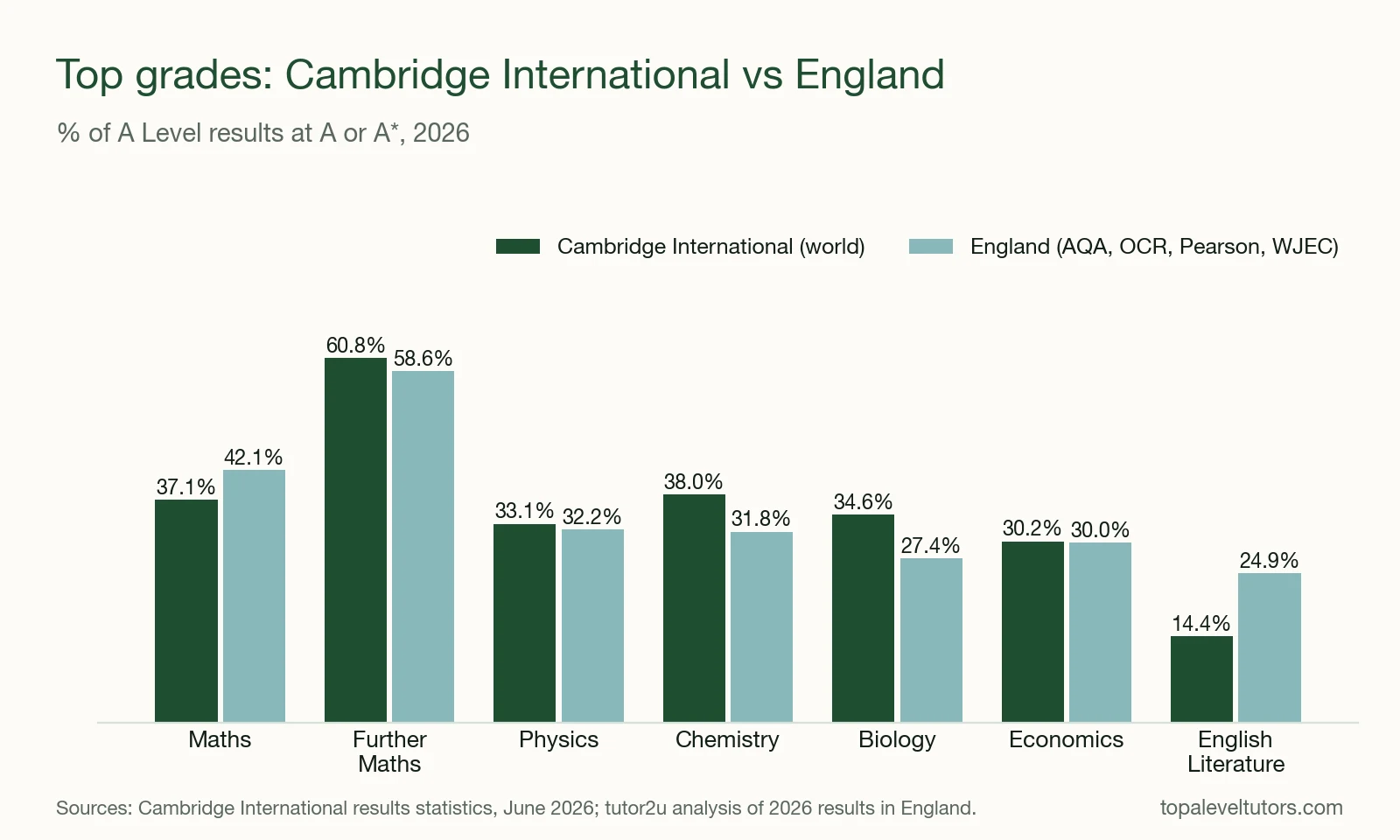
Official A Level Chemistry past papers come from your exam board: AQA, Pearson Edexcel or OCR in the UK, and Cambridge International or Pearson Edexcel International at most international schools. They're essential for top grades on every board. In 2026, just 31.8% of Chemistry results in England were A or A\* (tutor2u, 2026), and a Cambridge A\* needed 209 out of 260 weighted marks, about 80% (Cambridge International, 2026).
This guide shows where to find official papers for each board, how the exams are structured and how to use past papers to close the gap to an A or A\*.
Key Takeaways
- Use official papers and mark schemes from your own board and specification.
- UK boards set three papers; Cambridge sets five; Edexcel International sets six units.
- Mark schemes are exact about mechanisms, units and significant figures.
- Boundaries vary between series and paper versions, so grade each paper with its own.
Where Can You Find Official Chemistry Past Papers?
Every board publishes papers free, with different rules. Pearson keeps the most recent 12 months of papers for teachers only (Pearson, 2026). AQA's summer 2026 papers go public on 9 July 2027 and stay online for three years (AQA, 2026).
| Board | Specification | Where to find papers | Access |
|---|---|---|---|
| AQA | Chemistry 7405 | AQA past papers | Public about a year after the exam |
| Pearson Edexcel (UK) | Chemistry 9CH0 | Pearson past papers | Free, except papers from the last 12 months |
| OCR | Chemistry A H432 | OCR past paper finder | Public The newest papers may be restricted |
| Cambridge International | Chemistry 9701 | Cambridge 9701 past papers | Public selection Full archive for schools |
| Pearson Edexcel International | Chemistry YCH11 | Pearson past papers | Free, except papers from the last 12 months |
Cambridge's public 9701 page offers a selection of recent papers, mark schemes and examiner reports, and registered schools get the full archive through the School Support Hub (Cambridge International, 2026). Ask your teacher for anything newer.
How Are AQA, Edexcel and OCR Chemistry Papers Structured?
UK A Level Chemistry is linear, with three papers at the end of Year 13. AQA's papers are 2 hours each, worth 105, 105 and 90 marks (AQA, 2026). OCR's Chemistry A uses two 2 hour 15 minute papers and a 1 hour 30 minute unified paper (OCR, 2026).
| Board | Paper 1 | Paper 2 | Paper 3 |
|---|---|---|---|
| AQA (7405) | 2 hr, 105 marks (35%) | 2 hr, 105 marks (35%) | 2 hr, 90 marks (30%), including practical skills |
| Pearson Edexcel (9CH0) | 1 hr 45 min, 90 marks | 1 hr 45 min, 90 marks | 2 hr 30 min, 120 marks: general and practical principles |
| OCR (H432) | 2 hr 15 min, 100 marks | 2 hr 15 min, 100 marks | 1 hr 30 min, 70 marks: unified chemistry |
Practical skills are assessed in these written papers, and in England a separate practical endorsement is reported alongside your grade. The final paper on each board usually draws on the whole course, so leave it until you've covered everything.
How Are the Cambridge 9701 Chemistry Papers Structured?
Cambridge A Level Chemistry has five papers. Paper 4, the A Level structured paper, is worth 38.5% of the A Level, and the two practical skills papers together are worth 23% (Cambridge International, 2026).
| Paper | Time | Marks | Weighting |
|---|---|---|---|
| 1: Multiple Choice | 1 hr 15 min | 40 | 31% of AS / 15.5% of A Level |
| 2: AS Level Structured Questions | 1 hr 15 min | 60 | 46% of AS / 23% of A Level |
| 3: Advanced Practical Skills | 2 hr | 40 | 23% of AS / 11.5% of A Level |
| 4: A Level Structured Questions | 2 hr | 100 | 38.5% of A Level |
| 5: Planning, Analysis and Evaluation | 1 hr 15 min | 30 | 11.5% of A Level |
Paper 3 is a lab practical covering techniques such as titrations and qualitative analysis. You can practise its written parts at home: processing results, calculating values and drawing conclusions.
How Are Edexcel International Chemistry Papers Structured?
Pearson Edexcel International A Level Chemistry (YCH11) has six units. Units 1 and 2 are 1 hour 30 minute papers worth 80 marks; Units 4 and 5 are 1 hour 45 minutes and 90 marks; Units 3 and 6 are 50-mark written papers on practical skills.
For the A\*, you need an A overall and at least 270 uniform marks on the A2 units (Pearson, 2026). See how A Level grades are calculated for how each board totals your marks.
How Should You Use Chemistry Past Papers?
Use them to test yourself. Practice testing was rated one of only two "high utility" learning methods in a major review (Dunlosky et al., 2013). In Chemistry, past papers also train you to recognise how examiners phrase questions on mechanisms, calculations and data.
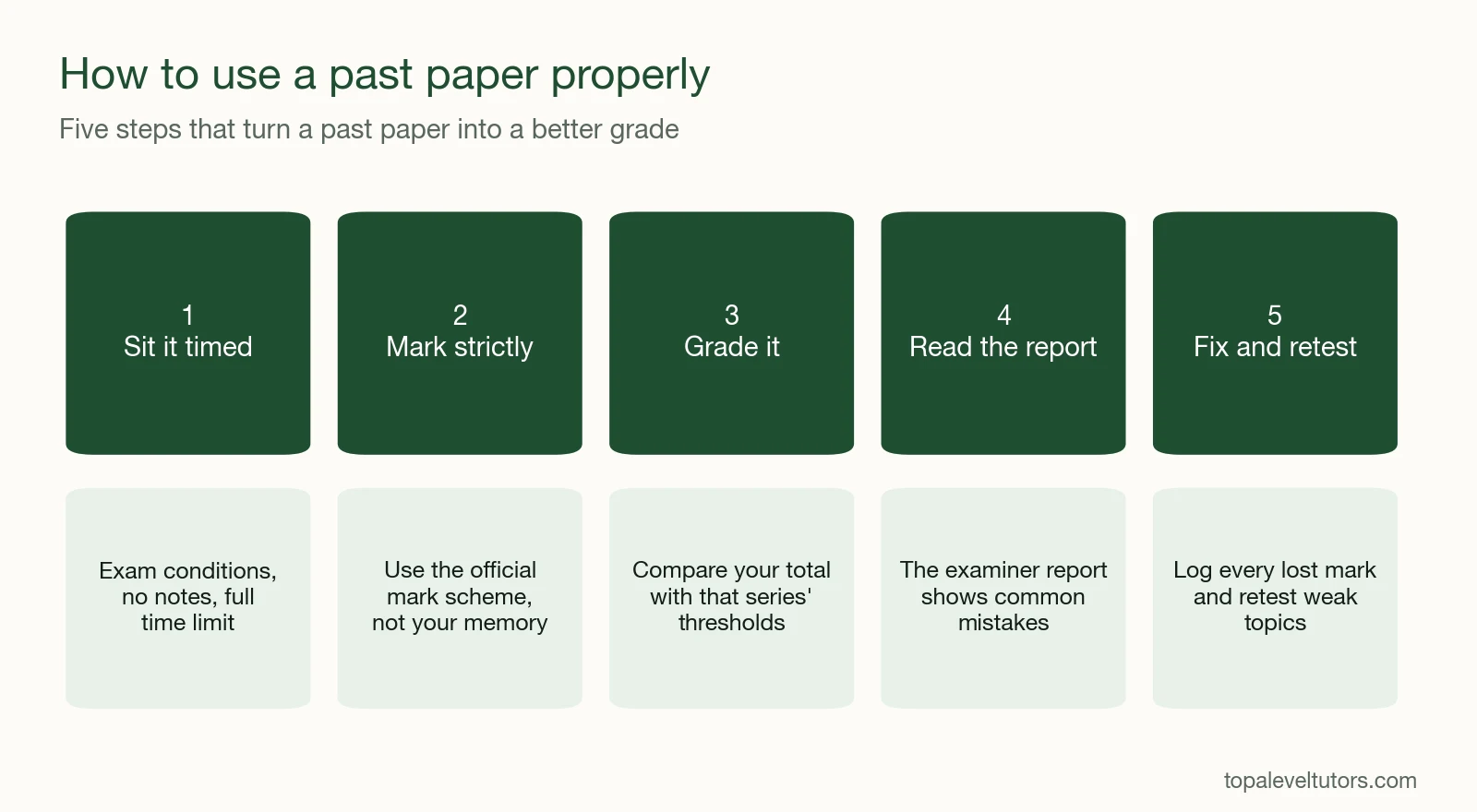
Mark strictly. Chemistry mark schemes on every board are exact about curly arrows in mechanisms, state symbols, units and significant figures. A mechanism with one arrow starting from the wrong place can lose the mark. Note each slip in an error log; the same ones tend to repeat.
Grade each paper with its own boundary. In Cambridge's June 2026 series, an A on Paper 2 needed 44 out of 60 on variant 21 but only 37 out of 60 on variant 22 (Cambridge International, 2026). A 40 would be a B on one and an A on the other. UK boundaries shift from year to year in the same way, so always use the boundaries for the series you're practising.
When Should You Start Chemistry Past Papers?
Start with topic questions as soon as each topic is taught in Year 12, especially for calculations and organic mechanisms. Move to full papers once you've covered the course, usually early in Year 13. Spacing practice over months beats cramming (Dunlosky et al., 2013).
Keep the most recent series for timed mocks in the final month. Our guide on how to revise for A Levels includes a full revision plan.
What Grade Can You Expect in A Level Chemistry?
Chemistry top grades are hard won. In England in 2026, 9.2% of Chemistry results were A\* and 31.8% were A or A\* (tutor2u, 2026). Among Cambridge International candidates, 16.5% got A\* and 38.0% got A or A\* (Cambridge International, 2026).
Many of the Chemistry students we support are aiming for medicine, where an A or A\* is often essential. The pattern we see is strong recall but lost marks on unfamiliar contexts, especially in organic chemistry and practical planning questions. Working through past paper questions with feedback on reasoning, not just answers, is what moves them up a grade. Our guide to the best A Levels for medicine explains why Chemistry matters so much.
Want Help With A Level Chemistry?
Past papers show you where marks slip; an expert shows you how to get them back. Our tutors combine top recent A Level graduates and qualified teachers and examiners, with specialists in AQA, Edexcel, OCR, Cambridge and Edexcel International Chemistry. See our A Level Chemistry tutoring.
Submit an application and we'll match you with a Chemistry tutor.
Frequently Asked Questions
Where can I find AQA and OCR A Level Chemistry past papers?
On each board's website. AQA publishes papers about a year after the exam and keeps them online for three years (AQA, 2026). OCR's past paper finder lists its papers, and your teacher can access the newest ones.
Where can I find Cambridge 9701 Chemistry past papers?
Cambridge publishes a selection of recent 9701 papers, mark schemes and examiner reports on its public syllabus page. The full archive is on the School Support Hub for registered schools (Cambridge International, 2026).
Which Chemistry paper is worth the most?
It depends on the board. On Cambridge, Paper 4 is worth 38.5% of the A Level (Cambridge International, 2026). On AQA, Papers 1 and 2 are 35% each and Paper 3 is 30% (AQA, 2026). Weight your practice to match.
How many Chemistry past papers should I do?
Aim for several full timed papers of each type, marked strictly and reviewed. One carefully reviewed paper is worth more than three rushed ones. Practice testing is one of the most effective revision methods (Dunlosky et al., 2013), but only if you learn from each mistake.
The Bottom Line
- Use official papers and mark schemes from your own board.
- UK boards: three papers; Cambridge: five; Edexcel International: six units.
- Mark strictly for mechanisms, units and significant figures.
- Grade each paper with the boundaries for that series.
Studying Biology too? See our A Level Biology past papers guide.
Find the right A-Level tutor this week
If you are not happy after your first session with your tutor, please let us know and we will give you a full refund and find you another tutor for free.