

How to Revise for A Levels: An Evidence-Based Plan
A practical, evidence-based guide to A Level revision: which methods research shows work best, how to build a revision timetable, how to use past papers and mark schemes, and a month-by-month plan for Year 13.


The most effective way to revise for A Levels is to test yourself and space your revision out over time. A major review of ten learning techniques rated practice testing and distributed practice as the only two "high utility" methods, while re-reading and highlighting, which most students rely on, were rated "low utility" (Dunlosky et al., Psychological Science in the Public Interest, 2013).
Good revision isn't about more hours. It's about using the methods that work. This guide shows you how, with a timetable approach and a month-by-month plan for Year 13.
Key Takeaways
- Self-testing and spaced practice are the most effective revision methods.
- Re-reading, highlighting and summarising feel productive but work poorly.
- Past papers, mark schemes and examiner reports should be the core of your revision.
- Start in Year 12 and revise in phases, not one last-minute push.
Which Revision Methods Actually Work?
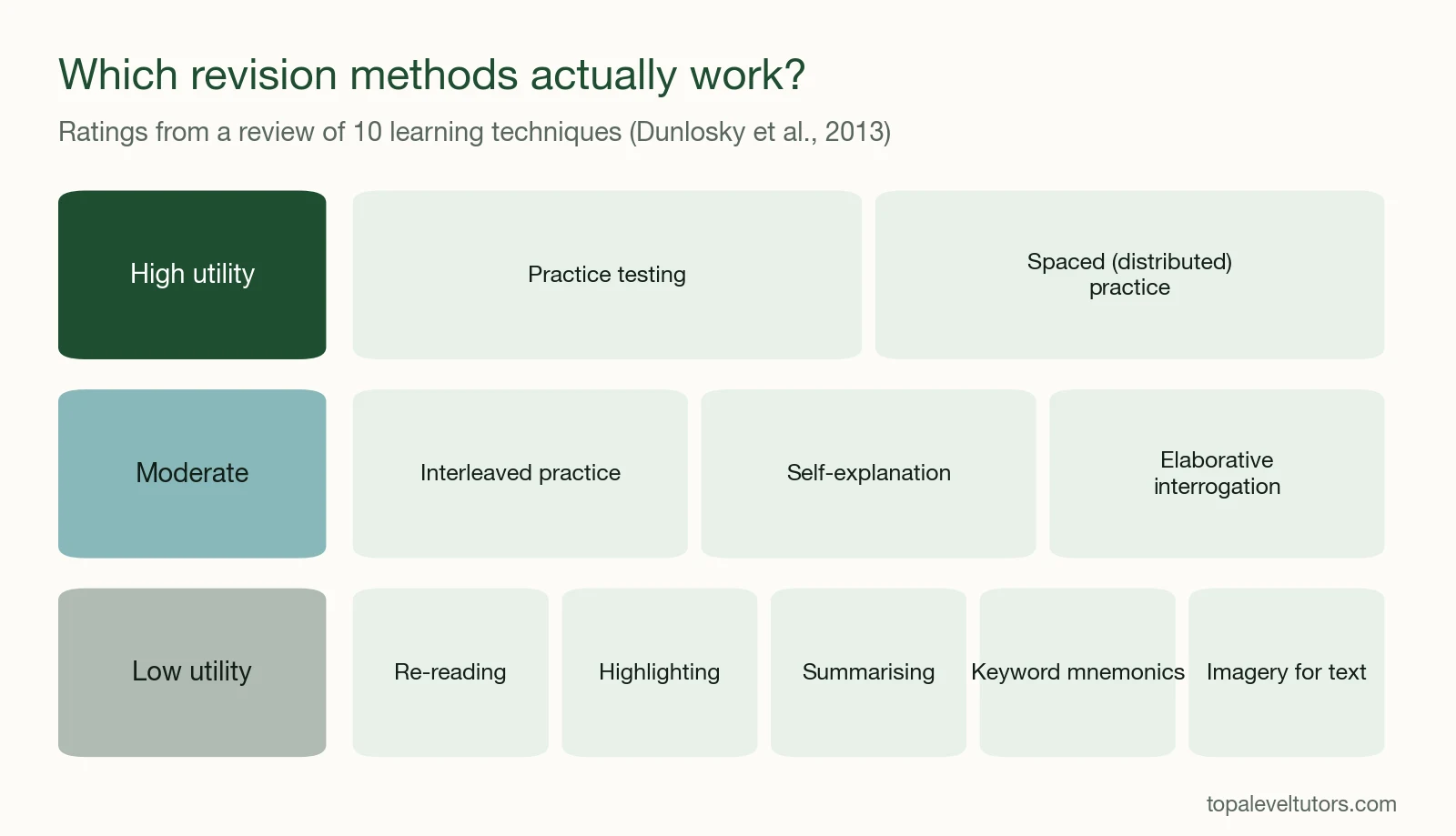
Research is clear on this. Dunlosky and colleagues reviewed hundreds of studies and rated ten techniques. Practice testing and distributed (spaced) practice were "high utility"; interleaved practice, self-explanation and elaborative interrogation were "moderate"; re-reading, highlighting, summarising, keyword mnemonics and imagery were "low" (Dunlosky et al., 2013).
| Method | What it looks like for A Levels |
|---|---|
| Practice testing | Past paper questions, flashcards, blank-page recall |
| Spaced practice | Returning to each topic several times over weeks |
| Interleaved practice | Mixing topics in one session, as exams do |
| Self-explanation | Explaining each step of a worked solution |
| Elaborative interrogation | Asking "why does this happen?" |
The methods that work best feel harder, and that's exactly why students avoid them. Re-reading notes feels smooth and familiar, so it feels like learning. Testing yourself feels uncomfortable because you notice what you've forgotten. That discomfort is the learning happening.
How Do You Build a Revision Timetable?
Start with your exam dates. UK A Level exams run from 10 May to 18 June 2027 (AQA, 2026); international dates vary by board. Work backwards to plan three phases: learning gaps, practising questions and final timed papers.
Then break each subject into topics, not chapters. Rate each topic red, amber or green based on recent test scores, and schedule more sessions for reds. Revisit every topic several times, spaced out, rather than "finishing" topics one by one. Our A Level exam timetable 2027 has the dates you need.
How Should You Use Past Papers?
Past papers are the most useful single revision tool, because they test you in the exact format of your exam. Use them in three stages: first with notes and no time limit, then without notes, then fully timed. Mark strictly with the mark scheme and compare your score with the grade boundaries for that paper.
Boundaries vary by paper: in June 2026, the Cambridge Mathematics A* threshold was 223 out of 250 on one variant and 231 on another (Cambridge International, 2026). Use the right one. Our guide to Cambridge A Level grade boundaries explains how.
Why Do Mark Schemes and Examiner Reports Matter?
Mark schemes tell you exactly what earns marks, and examiner reports explain where students lost them. Reading them teaches you the precise language examiners reward, such as "more frequent successful collisions" rather than "the reaction speeds up" in Chemistry. Every major board publishes both after each series.
When we review students' past papers, lost marks rarely come from not knowing the content. They come from vague wording, missing steps in calculations or essays that describe instead of evaluate. Twenty minutes with an examiner report often fixes errors that hours of re-reading never would.
What Should a Year 13 Revision Plan Look Like?
Spread the work across the year so you're consolidating, not cramming, in the spring. Students in England take an average of 2.67 A Levels at age 18 (Ofqual, 2026), so every subject needs its own regular slot.
| When | Focus |
|---|---|
| September – December | Keep up with new content Weekly self-testing on Year 12 topics |
| January – February | Mock exams Fix red topics Start full past papers |
| March – April | Timed papers Examiner reports Spaced review of every topic |
| May – June | Final timed papers Targeted review between exams |
How Many Hours Should You Revise?
There's no magic number. During term, one to two hours of independent study per subject each week, beyond lessons, works well for most students. In the final months, three to five focused hours a day is plenty. Short, spaced sessions beat long ones (Dunlosky et al., 2013).
Protect sleep and breaks. Memory is consolidated during sleep, so late-night cramming works against you, especially in the weeks before exams.
Want Help Revising Smarter?
The right method makes every hour of revision count. Our tutors combine top recent A Level graduates and qualified teachers and examiners, and they help UK, Cambridge International and Edexcel International students build revision plans around evidence-based methods and their own exam dates.
Submit an application and we'll match you with a tutor for your subjects.
Frequently Asked Questions
What is the best way to revise for A Levels?
Test yourself and space your revision. Practice testing and distributed practice were the only two methods rated "high utility" in a major review of learning techniques (Dunlosky et al., 2013). Use past papers, flashcards and blank-page recall.
When should I start revising for A Levels?
Start in Year 12 with light, regular review, then build up through Year 13. With UK exams starting on 10 May 2027 (AQA, 2026), aim to finish first-pass revision of every topic by the Easter holidays.
Is highlighting a good revision technique?
Not on its own. Highlighting was rated "low utility" in the Dunlosky review, along with re-reading and summarising (Dunlosky et al., 2013). Turn highlighted notes into questions and test yourself instead.
How do I revise for essay subjects?
Practise planning and writing timed essays, then compare them with mark schemes and examiner reports. Build banks of evidence and arguments for each topic, and test yourself on them. Essay subjects award few top grades: only 7.9% of Cambridge History candidates got A or A* in 2026 (Cambridge International, 2026).
The Bottom Line
- Test yourself and space your revision; avoid relying on re-reading and highlighting.
- Plan revision backwards from your exam dates, in phases.
- Make past papers, mark schemes and examiner reports the core of your revision.
- Start early, keep it regular and protect your sleep.
For more on top grades, read how to get an A* at A Level.
Find the right A-Level tutor this week
If you are not happy after your first session with your tutor, please let us know and we will give you a full refund and find you another tutor for free.