

How to Get an A* at A Level: 9 Strategies That Work
How to get an A or A* at A Level: how the A* is awarded on UK, Cambridge and Edexcel International A Levels, how many students achieve it, and nine evidence-based strategies used by top students and examiners.





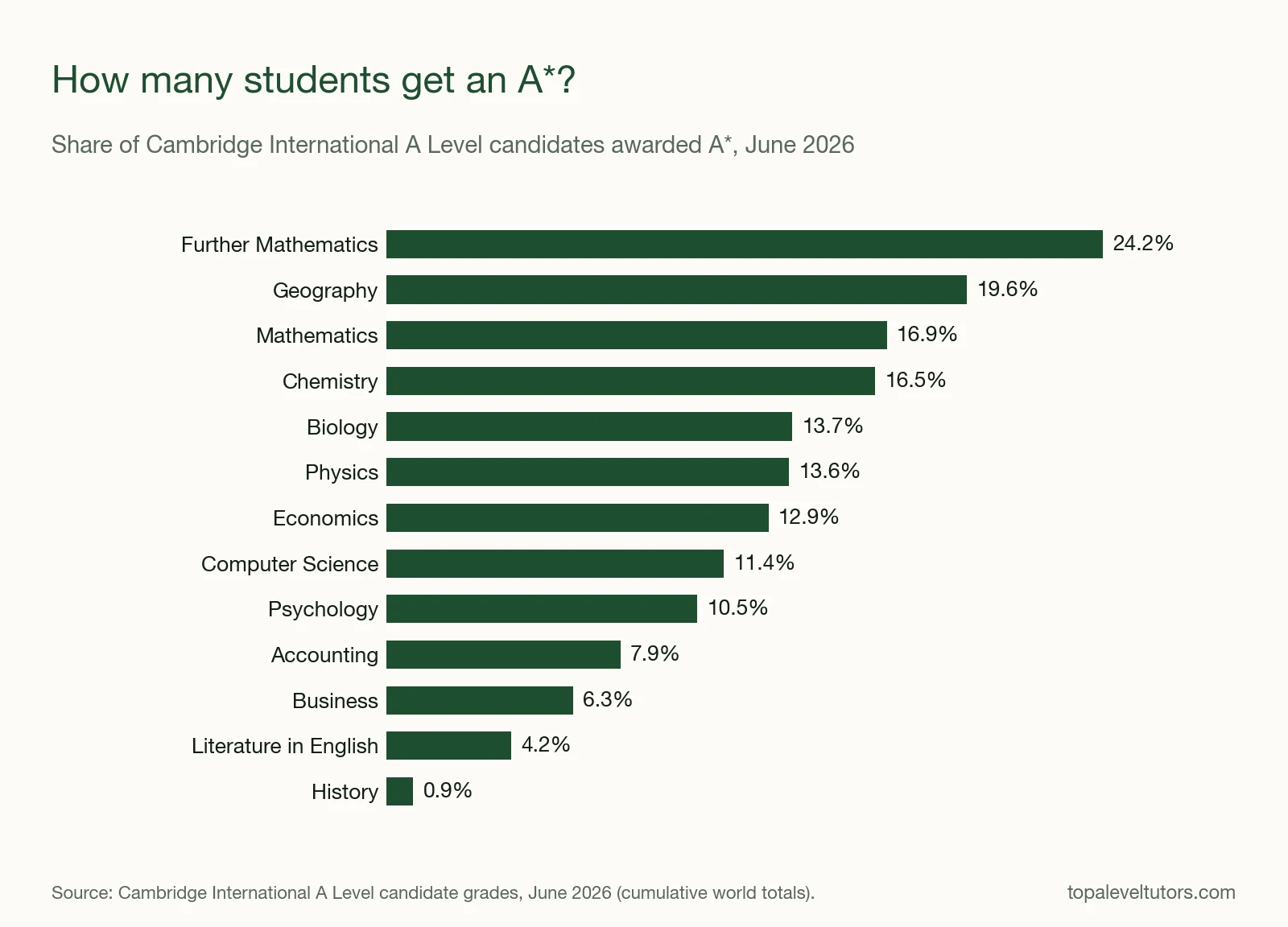
Getting an A* at A Level means finishing in roughly the top tenth of candidates. In 2026, 9.6% of UK A Level results were A* (JCQ, 2026). Internationally the rate varies hugely by subject, from 24.2% in Cambridge International Further Mathematics to under 1% in History (Cambridge International, 2026).
The good news is that A* students aren't simply "naturally clever". They study in particular ways that research and examiners agree on. This guide explains how the A* is awarded, then gives nine strategies you can start using this week.
Key Takeaways
- About 1 in 10 UK A Level results is an A*, but rates differ widely by subject and board.
- Practice testing and spaced study are the two highest-rated revision methods in learning research.
- Past papers, mark schemes and examiner reports show exactly what earns top marks.
- Start in Year 12: the A* is decided by two years of work, not two months.
How Is the A* Grade Awarded?
How you earn an A* depends on your exam board. For UK A Levels, the A* is set by a grade boundary on your total marks across all papers, because AS results no longer count towards the A Level (Pearson, 2026). For Pearson Edexcel International A Levels, you need an A overall and at least 90% of the uniform marks on your A2 units (Pearson, 2026).
That IAL rule matters. You can't coast into an A* on strong AS units; your second-year units must be excellent too. For Cambridge International, the A* only exists for the full A Level, so AS results are capped at grade A.
On all boards, boundaries move each year. A* might need 85% of the marks one year and 80% the next, depending on how hard the papers were. Our guide to A Level grades explains boundaries in detail.
How Many Students Get an A*?
A* rates depend heavily on the subject. In Cambridge International A Levels in June 2026, 24.2% of Further Mathematics candidates and 16.9% of Mathematics candidates got A*, compared with 4.2% in Literature in English and 0.9% in History (Cambridge International, 2026).
Top all-round results are rarer still. In England in 2026, 7,245 18-year-olds achieved an A* in every subject they took (Ofqual, 2026). That's a small fraction of the 320,505 students who received results.
Don't read low A* rates as "impossible". In essay subjects such as History and Literature, the A* depends on a skill examiners can describe precisely: a sustained, well-supported argument. In maths and sciences, it depends on accuracy under time pressure. Both can be trained. The strategies below work for either kind of subject.
Strategy 1: Start Properly in Year 12
The A* is built across two years, not in the final term. Year 12 content underpins Year 13, so gaps compound. A Levels are designed so that later topics build on earlier ones, especially in Mathematics, Physics and Chemistry. With only 37.1% of Cambridge International Mathematics candidates reaching A or A* in 2026 (Cambridge International, 2026), there's little room for gaps left over from Year 12.
In practice, that means doing a little extra every week from September of Year 12. Two focused hours per subject each week, spent on practice questions and tidying notes, adds up to hundreds of hours by your exams. It's far less stressful than cramming.
Strategy 2: Test Yourself Instead of Re-reading
Practice testing is one of only two revision methods rated "high utility" in a major review of ten learning techniques (Dunlosky et al., Psychological Science in the Public Interest, 2013). Re-reading and highlighting, which most students rely on, were rated "low utility".
So close the textbook and answer questions from memory. Use flashcards, blank-page recall ("write everything you know about enzymes") or past paper questions. It feels harder than re-reading, and that difficulty is exactly why it works.
Strategy 3: Space Out Your Revision
Distributed practice, spreading study of a topic over time, was the other technique rated "high utility" in the same review (Dunlosky et al., 2013). Studying a topic for one hour on three separate days beats three hours in one sitting.
Build a timetable that cycles back to older topics. Flashcard apps with spaced repetition do this automatically. Mixing different topics in one session, known as interleaving, also helps you choose the right method in the exam.
Strategy 4: Make Past Papers Your Main Tool
Past papers show you the exact style, wording and difficulty of your exam. Every major board publishes them: AQA, OCR and Pearson in the UK, and Cambridge International and Pearson for international A Levels. With grade boundaries shifting each year (Pearson, 2026), timed papers are also the best way to know where you stand.
Do papers in three stages. First, untimed with notes, to learn the style. Then untimed without notes. Finally, timed and under exam conditions. Record your score and every topic where you lost marks.
Strategy 5: Learn the Mark Scheme Language
Mark schemes tell you exactly what examiners credit, and examiner reports tell you where students lose marks. Cambridge, AQA, OCR and Pearson all publish examiner reports after each series. Reading them is one of the fastest ways to raise your grade.
Students often lose A* grades on precision rather than knowledge. A chemistry answer that says "the reaction speeds up" instead of "more frequent successful collisions" loses the mark. An economics essay that describes but never evaluates is capped in the lower bands. Our examiner tutors spend a lot of time on exactly this kind of mark scheme language, because it's where quick gains are.
Strategy 6: Fix Weak Topics First
Your grade is limited by your weakest topics, not your strongest. Rate every topic red, amber or green based on past paper scores, then spend most of your time on the reds. In subjects where only about a third of students reach A or A*, such as Cambridge Physics at 33.1% (Cambridge International, 2026), one weak topic can cost you the grade.
Keep green topics alive with short, spaced reviews. Don't drop them entirely.
Strategy 7: Write Essays Under Time Pressure
In essay subjects, an A* answer is a clear, sustained argument, not a list of everything you know. Cambridge's 2026 results show how hard this is: just 7.9% of History candidates and 14.4% of Literature in English candidates achieved A or A* (Cambridge International, 2026).
Practise writing plans in five minutes, then full essays in timed conditions. Ask a teacher or tutor to mark them against the mark scheme. Then rewrite the weakest paragraph. That cycle of feedback and rewriting is what moves essay grades.
Strategy 8: Look After Sleep and Routine
Memory consolidation happens during sleep, so late-night cramming works against you. A steady routine, regular exercise and proper breaks protect your concentration over two long years. With 835,950 A Level results issued in England in 2026 (Ofqual, 2026), the students who stand out are rarely the most exhausted ones.
Plan your revision around fixed sleep times. Keep phones out of the room while you study and while you sleep.
Strategy 9: Get Expert Feedback Early
Feedback tells you what you can't see in your own work. Teachers do this in class, but with large groups they can't mark every practice answer in detail. One-to-one support speeds up the feedback loop, especially for students aiming at competitive courses that ask for A*AA or above.
The most useful feedback comes from people who know the mark scheme from the inside. That's why our tutors combine top recent A Level graduates with qualified teachers and examiners. For the subjects where top grades are scarcest, see our guide to the hardest A Levels.
Ready to Aim for the A*?
If you're aiming for an A* in one or more subjects, the right support can make the difference. Our tutors are top recent A Level graduates and qualified teachers and examiners. They help students on UK, Cambridge International and Edexcel International A Levels build the exam technique that top grades need.
Submit an application and we'll match you with a tutor for your subject and board.
Frequently Asked Questions
What percentage do you need for an A* at A Level?
There's no fixed percentage. Boundaries are set after each exam series, and often fall somewhere around 80–90% of the total marks for subjects like maths. Only 9.6% of UK A Level results were A* in 2026 (JCQ, 2026). Check your board's published boundaries from previous years.
Is it possible to get an A* if you're behind in Year 12?
Yes, if you act early. Spaced practice and self-testing are the most effective ways to catch up, according to a major review of learning techniques (Dunlosky et al., 2013). Identify the Year 12 topics that Year 13 builds on and secure those first.
How many hours a day should I revise for A Levels?
Quality matters more than hours. During term, a steady one to two hours of independent study per subject each week, beyond lessons, works well. Before exams, three to five focused hours a day is plenty for most students. Spacing it out beats long sessions (Dunlosky et al., 2013).
Which A Level is easiest to get an A* in?
On Cambridge International data, Further Mathematics had the highest A* rate among major subjects in June 2026, at 24.2%. But that reflects a very strong, self-selected group of students (Cambridge International, 2026). See our guide to the easiest A Levels.
How does the A* work for Edexcel International A Levels?
You need an A overall plus at least 90% of the uniform marks across your A2 units. For example, in four-unit subjects that means at least 320 uniform marks overall and 180 across the A2 units (Pearson, 2026). Strong A2 units are essential.
The Bottom Line
- About 1 in 10 UK A Level results is an A*, with big differences between subjects.
- Self-testing and spaced revision beat re-reading and highlighting.
- Past papers, mark schemes and examiner reports are the core of A* preparation.
- Start in Year 12, fix weak topics first and get expert feedback early.
Want to see how your target grades convert to university offers? Read our guide to A Level points.
Find the right A-Level tutor this week
If you are not happy after your first session with your tutor, please let us know and we will give you a full refund and find you another tutor for free.