

Cambridge A Level Grade Boundaries: June 2026 Explained
How Cambridge International A Level grade thresholds work, with June 2026 boundaries for Mathematics, Chemistry, Physics, Biology and Economics, why they differ by paper variant, and how to use them to track your grade.



Cambridge International calls its grade boundaries "grade thresholds": the minimum marks needed for each grade. In June 2026, an A* in Cambridge A Level Mathematics (9709) needed 223 out of 250 weighted marks on the most common paper combination, about 89%, while an A needed 197 (Cambridge International, 2026).
Thresholds change every series and vary between subjects and even between paper variants. This guide explains how they work, gives the June 2026 figures for five popular subjects and shows you how to use them.
Key Takeaways
- Thresholds are set after marking, so they change every series.
- June 2026 A* thresholds ranged from about 69% (Economics) to 89% (Mathematics) on the first paper variant.
- Different paper variants (such as 11 vs 13) have different thresholds.
- There's no A* on individual papers, only on the overall A Level.
What Are Cambridge Grade Thresholds?
Grade thresholds are the minimum raw or weighted marks needed for each grade. Cambridge publishes two kinds: component thresholds for each paper (A to E only) and syllabus thresholds for the overall qualification. As Cambridge notes, "Grade A* does not exist at the level of an individual component" (Cambridge International, 2026).
Your overall grade comes from your weighted total across all papers. Cambridge publishes a separate table for each combination of components, because different routes and variants can lead to slightly different thresholds.
Thresholds are set after marking, by senior examiners who compare scripts with previous years. If a paper turns out harder than expected, the threshold falls; if it's easier, it rises. That's why one fixed percentage never guarantees a grade. Our guide to A Level grades explains this for all boards.
What Were the June 2026 Thresholds?
On the first paper variant, the June 2026 A* threshold was 89% of weighted marks in Mathematics, 80% in Chemistry, 76% in Physics, 74% in Biology and 69% in Economics. The A threshold ranged from 79% in Mathematics to 61% in Economics (Cambridge International, 2026).
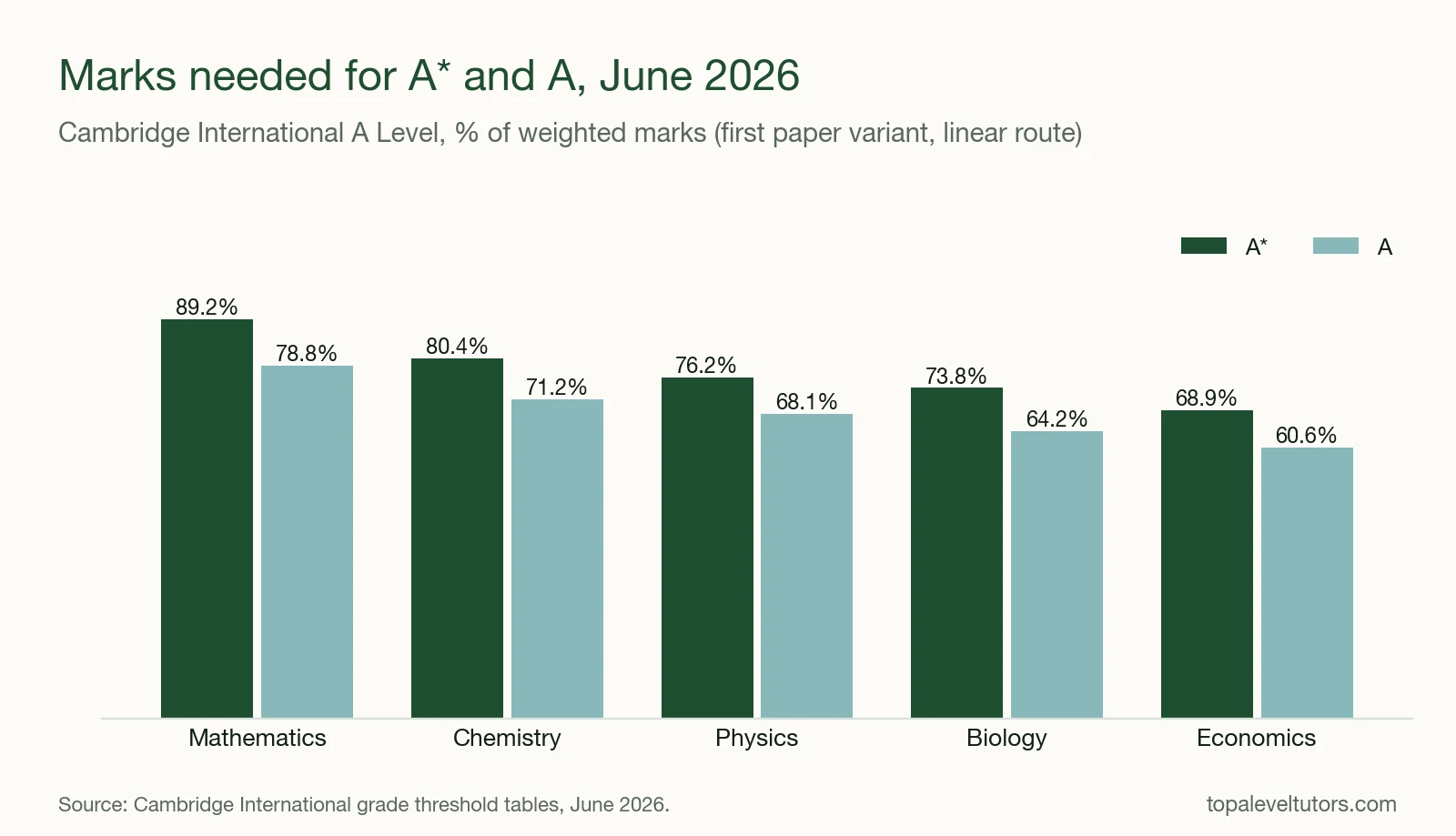
| Subject (linear route, variant 1) | Max mark | A* | A | B | C | E |
|---|---|---|---|---|---|---|
| Mathematics 9709 | 250 | 223 | 197 | 163 | 128 | 60 |
| Chemistry 9701 | 260 | 209 | 185 | 161 | 133 | 79 |
| Physics 9702 | 260 | 198 | 177 | 156 | 132 | 84 |
| Biology 9700 | 260 | 192 | 167 | 142 | 121 | 80 |
| Economics 9708 | 180 | 124 | 109 | 94 | 82 | 59 |
Sources: Cambridge International June 2026 threshold tables for Mathematics, Chemistry, Physics, Biology and Economics.
Why Do Thresholds Differ Between Paper Variants?
Cambridge sets different versions of each paper, called variants, for different time zones. Each variant is a different paper, so each gets its own threshold. In June 2026 Mathematics, the A* threshold was 223/250 on variant 11-31-41-51 but 231/250 on variant 13-33-43-53 (Cambridge International, 2026).
That's a 3-percentage-point gap for the same grade. It doesn't mean one group had it easier: a higher threshold usually reflects a slightly easier paper. Thresholds exist precisely to even out those differences.
This has a practical consequence for international students. When you mark a past paper, use the threshold for that exact variant, not a nearby one. Using variant 11 thresholds on a variant 13 paper can make you look a grade higher, or lower, than you really are.
How Do Component Thresholds Work?
Each paper has its own threshold for grades A to E. In June 2026 Mathematics Paper 11, the A threshold was 59 out of 75 and the E threshold was 15 (Cambridge International, 2026). Component grades help you see which paper pulled your overall grade up or down.
Your component marks appear in Cambridge International Direct and on the component mark report your school receives. Some regions also see "percentage uniform marks" on statements of results. These aren't raw marks and can't be compared directly with thresholds.
How Should You Use Grade Thresholds?
Use thresholds to turn past paper scores into realistic grades. Mark each paper strictly against the mark scheme, then compare your total with the threshold for that paper's series and variant. Because only 37.1% of Cambridge Mathematics candidates got A or A* in June 2026 (Cambridge International, 2026), honest marking matters.
Track your results in a table over several months. Look for trends rather than single scores. If you're consistently a few marks below a threshold, focus on the paper and topics that cost you the most marks. Our guide on how to get an A* at A Level covers how to close that gap.
The students we work with who improve fastest keep a simple log: date, paper, variant, score and grade. After six to eight papers, the pattern is usually obvious, for example strong on pure maths but losing marks on statistics. That's when targeted tutoring makes the biggest difference.
Do Thresholds Get Easier or Harder Over Time?
Cambridge aims to keep standards steady from year to year. Its results statistics note that the awarding standard returned to the pre-Covid standard in June 2023 (Cambridge International, 2026). So thresholds move with paper difficulty, not because grades are becoming easier.
That means older thresholds are still useful practice guides, but treat 2020–2022 thresholds with caution, because standards were adjusted in those years.
Need Help Hitting Your Threshold?
Grade thresholds show you exactly how many marks stand between you and your target grade. Our tutors combine top recent A Level graduates and qualified teachers and examiners who know Cambridge mark schemes in detail. We help students pick up the marks that move them over the line.
Submit an application and we'll match you with a Cambridge specialist tutor.
Frequently Asked Questions
What is the A* grade boundary for Cambridge A Level Maths?
In June 2026, the A* threshold for Cambridge A Level Mathematics (9709) was 223 out of 250 on the most common linear combination, about 89%. On another variant it was 231 (Cambridge International, 2026). It changes every series.
When are Cambridge grade thresholds published?
Cambridge publishes grade threshold tables once results for a series are released. June 2026 results came out on 11 August 2026 (Cambridge International, 2026). November series thresholds follow in January.
Is there an A* for individual Cambridge papers?
No. Cambridge states that "Grade A* does not exist at the level of an individual component" (Cambridge International, 2026). The A* is only awarded on your overall A Level total.
Why are Cambridge Chemistry boundaries lower than Maths?
Thresholds reflect how hard each paper is, not how important the subject is. In June 2026, the Chemistry A* threshold was 209/260, about 80%, against 89% for Mathematics (Cambridge International, 2026). Science papers include longer, harder questions.
Can I use thresholds from past years?
Yes, as a guide. Cambridge has applied the pre-Covid standard since June 2023, so recent thresholds are comparable (Cambridge International, 2026). Always match the threshold to the exact series and variant of the paper you sat.
The Bottom Line
- Grade thresholds are set after marking and change every series.
- June 2026 A* thresholds ranged from about 69% to 89% across major subjects.
- Paper variants have different thresholds, so always use the right one.
- Use thresholds to turn past paper scores into realistic grade predictions.
Next, see how grades turn into university offers in our guide to A Level points.
Find the right A-Level tutor this week
If you are not happy after your first session with your tutor, please let us know and we will give you a full refund and find you another tutor for free.