

A Level Command Words: Meanings, Examples and How to Answer
What A Level command words like explain, analyse, evaluate and assess mean, with official Cambridge definitions, commonly confused pairs, maths and science words, and how to answer each.



A Level command words are the instruction words at the start of exam questions, such as "explain", "analyse" or "evaluate". They tell you exactly what the examiner wants. Cambridge International publishes a list of them because, in its words, they "help candidates know what is expected from them in the exams" (Cambridge International, 2026).
Misreading one is among the most common ways strong students lose marks. This guide gives the official meanings, explains the pairs students mix up most often and shows how to answer each type.
Key Takeaways
- Command words tell you what kind of answer earns the marks, not just the topic.
- "Explain" asks why or how; "evaluate" and "assess" ask for a judgement.
- Evaluation is 25% of Cambridge A Level Economics, so judgement questions matter.
- Some words mean different things in different subjects, so check your syllabus.
What Are A Level Command Words?
Command words are the verbs that set the task in a question. Each exam board publishes a list with definitions, and many lists are tailored to the subject. AQA, for instance, notes that its lists are not exhaustive and that "similar words may be used from time to time" (AQA, 2026).
They also signal how marks are shared out. A "state" question usually earns one mark for a correct fact. An "evaluate" question needs knowledge, analysis and a supported judgement, and earns far more. Reading the command word first tells you how much to write and what kind of thinking to show.
What Do the Main Command Words Mean?
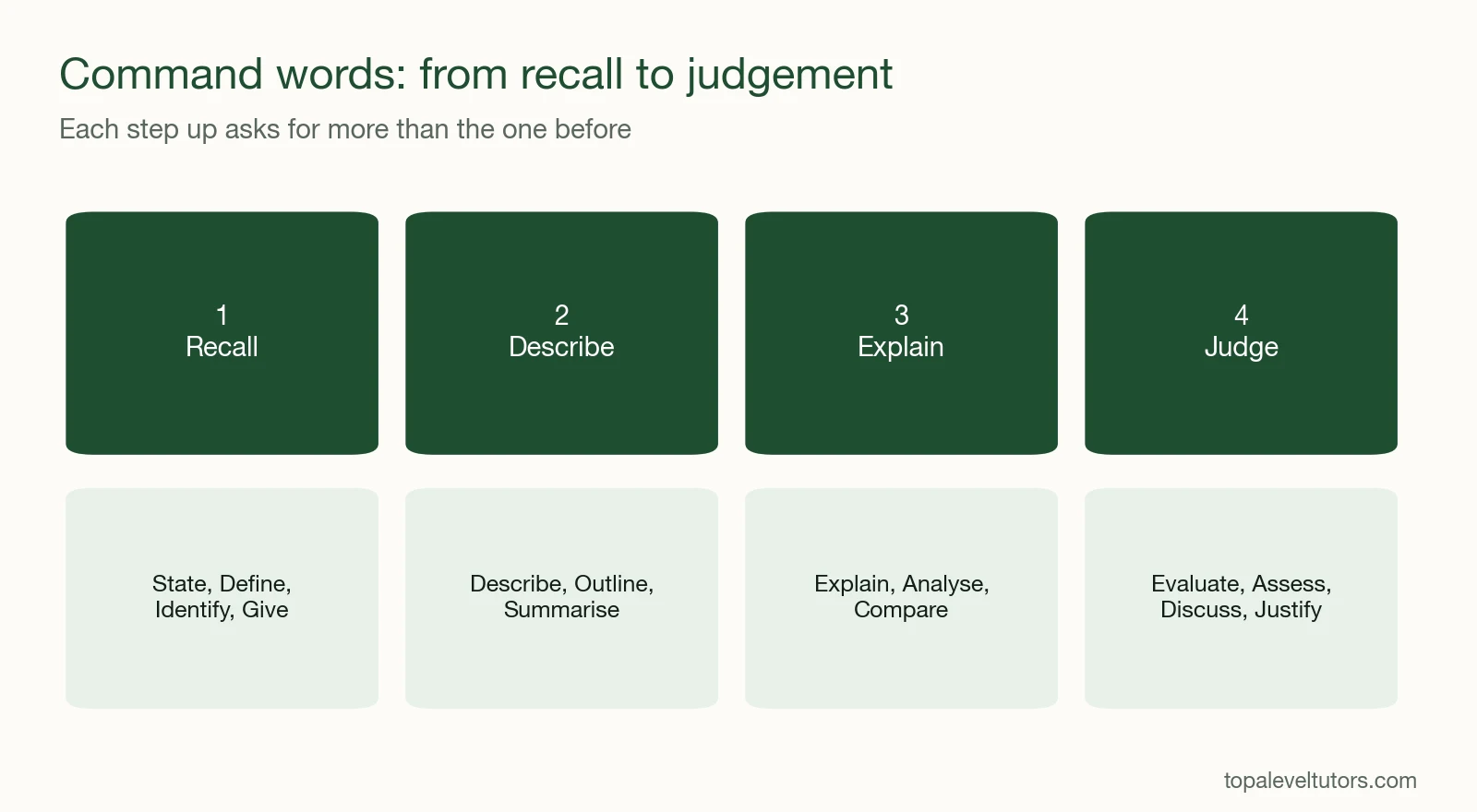
Cambridge International uses the same core definitions across its syllabuses. These are the official meanings from the Cambridge International AS & A Level Economics syllabus for 2026 to 2028, the most common words you'll meet in any subject (Cambridge International, 2026).
| Command word | What it means (Cambridge) |
|---|---|
| Analyse | Examine in detail to show meaning, identify elements and the relationship between them |
| Assess | Make an informed judgement |
| Calculate | Work out from given facts, figures or information |
| Comment | Give an informed opinion |
| Compare | Identify/comment on similarities and/or differences |
| Consider | Review and respond to given information |
| Define | Give precise meaning |
| Describe | State the points of a topic / give characteristics and main features |
| Discuss | Write about issue(s) or topic(s) in depth in a structured way |
| Evaluate | Judge or calculate the quality, importance, amount, or value of something |
| Explain | Set out purposes or reasons / make the relationships between things clear / say why and/or how and support with relevant evidence |
| Identify | Name/select/recognise |
| Justify | Support a case with evidence/argument |
| Outline | Set out the main points |
| State | Express in clear terms |
Pearson Edexcel International, AQA and OCR use very similar meanings, though wording varies. Always check the command word list in your own specification.
What's the Difference Between Describe and Explain?
"Describe" asks what happens; "explain" asks why or how. Cambridge defines "describe" as giving "characteristics and main features", while "explain" means saying "why and/or how" and supporting it "with relevant evidence" (Cambridge International, 2026).
Take a graph showing prices rising. A description says what the graph shows: prices rose steadily from 2022 and then levelled off. An explanation gives the reason: higher energy costs raised firms' production costs, so they passed them on to consumers. Many students describe when the question asks them to explain, and lose most of the marks.
A quick test: if your answer has no "because", "so" or "therefore", it's probably a description.
What's the Difference Between Explain and Analyse?
"Analyse" goes further than "explain". It asks you to break an issue into its parts and show how they connect. Cambridge defines it as examining "in detail to show meaning, identify elements and the relationship between them" (Cambridge International, 2026).
In practice, analysis means a chain of reasoning: A leads to B, which causes C, which affects D. In economics, that often includes a diagram. In the sciences, it often means using data to identify a pattern and explain the relationship behind it. One linked chain, fully developed, usually beats three points that each stop after one step.
What's the Difference Between Evaluate, Assess and Discuss?
All three need a judgement. "Evaluate" means to "judge or calculate the quality, importance, amount, or value of something", and "assess" means to "make an informed judgement" (Cambridge International, 2026). "Discuss" asks for an in-depth, structured look at an issue, and in most mark schemes that includes a conclusion.
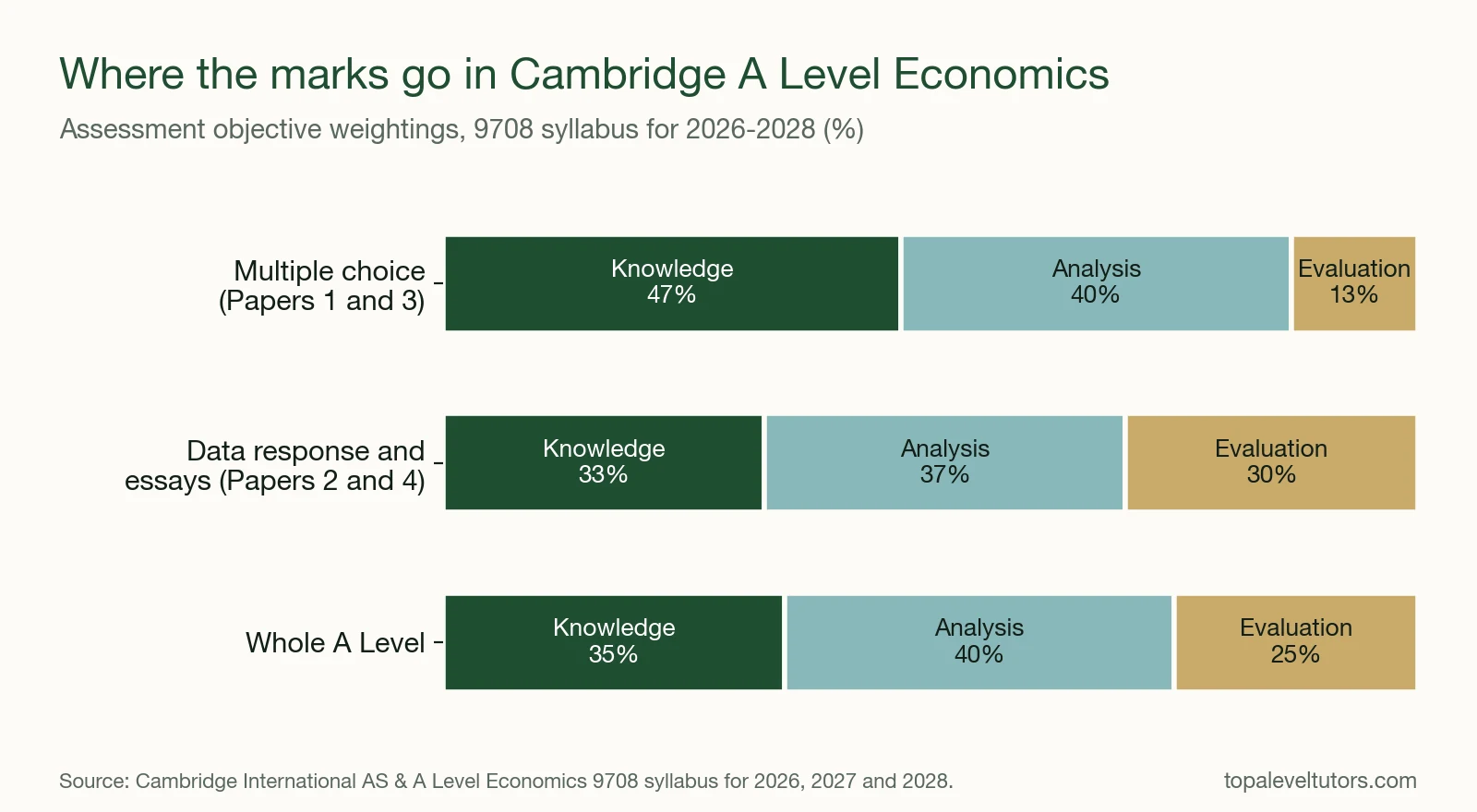
These words carry a lot of marks. In Cambridge A Level Economics, evaluation makes up 25% of the whole qualification and 30% of the data response and essay papers (Cambridge International, 2026).
A strong evaluation does three things:
1. Weighs both sides, with analysis on each. 2. Says what the answer depends on, such as time period, size of the change or the type of economy. 3. Reaches a clear, justified conclusion that answers the question.
"To what extent" isn't on Cambridge's list, but it appears often in essay papers and works the same way as "evaluate". Students often treat it as "explain both sides" and stop there. The phrase "to what extent" is asking for a degree: largely, partly or hardly at all. Your conclusion should state that degree clearly and say why.
Do Command Words Differ Between Subjects?
Yes. Each Cambridge syllabus has its own list, and some words change meaning. In Cambridge Mathematics, "determine" means "establish with certainty", but in Cambridge Physics it means "establish an answer using the information available" (Cambridge International, 2026; Cambridge International, 2026).
Maths and science papers also use words you won't see in essay subjects:
| Command word | Meaning | Where you'll see it |
|---|---|---|
| Show (that) | Provide structured evidence that leads to a given result | Maths, sciences |
| Verify | Confirm a given statement/result is true | Maths |
| Prove | Confirm the truth of the given statement using a chain of logical mathematical reasoning | Further Maths |
| Sketch | Make a simple freehand drawing showing the key features | Maths, sciences |
| Suggest | Apply knowledge and understanding to situations where there are a range of valid responses in order to make proposals | Sciences |
| Predict | Suggest what may happen based on available information | Sciences |
Sources: Cambridge International syllabuses for Mathematics 9709, Further Mathematics 9231 and Physics 9702.
"Show that" questions give you the answer, so the marks are for the working. Write every step clearly, even ones that seem obvious. "Suggest" means there isn't one correct answer: examiners want a sensible idea that uses your scientific knowledge, often in an unfamiliar context.
When our tutors review past papers with students, command word errors show up again and again, especially in Economics and Biology. A student writes a fluent page on an "assess" question but never gives a judgement, or explains a mechanism when the question only asked them to "state". Highlighting the command word before writing anything fixes a surprising number of lost marks.
How Should You Practise Command Words?
Practise them with past papers and mark schemes. For each question, underline the command word, note the marks available, then plan an answer that matches. When you mark it, compare your answer with what the mark scheme rewards. Our guide on how to revise for A Levels explains why testing yourself like this works better than re-reading notes.
Keep a list of command words that cost you marks. After a few papers, you'll see patterns, such as running out of time on evaluation or giving too little detail on "explain". Fix those first.
Want Help With Exam Technique?
Command words are one of the quickest areas to improve with expert feedback. Our tutors combine top recent A Level graduates and qualified teachers and examiners, who know exactly what mark schemes reward for each command word.
Submit an application and we'll match you with a tutor for your subjects.
Frequently Asked Questions
What is the difference between evaluate and assess?
They're very close. Cambridge defines "assess" as "make an informed judgement" and "evaluate" as "judge or calculate the quality, importance, amount, or value of something" (Cambridge International, 2026). Both need balanced analysis and a supported conclusion.
How do you answer a "to what extent" question?
Treat it as an evaluation. Analyse the arguments for and against, then give a clear judgement on the degree, such as "largely" or "only partly", and explain why. In Cambridge A Level Economics, evaluation is worth 30% of the essay papers (Cambridge International, 2026).
What does "show that" mean in A Level Maths?
It means "provide structured evidence that leads to a given result" (Cambridge International, 2026). The answer is given, so the marks come from clear, complete working. Skipping steps is the most common way to lose marks.
Are command words the same for every exam board?
The core meanings are similar, but each board publishes its own lists, often by subject. Even within Cambridge, "determine" means something slightly different in Mathematics and Physics (Cambridge International, 2026). Use the list in your own specification.
The Bottom Line
- Read the command word first: it tells you what kind of answer scores.
- Describe says what; explain says why; analyse builds a chain of reasoning.
- Evaluate, assess and discuss all need a supported judgement.
- Check subject-specific words such as "show that", "suggest" and "determine".
Next, see how A Level grades are calculated.
Find the right A-Level tutor this week
If you are not happy after your first session with your tutor, please let us know and we will give you a full refund and find you another tutor for free.