

IGCSE to A Level: How Big Is the Jump and How to Prepare
What changes when you move from IGCSE to A Level, how much harder top grades get (with Cambridge 2026 data), which IGCSE grades you need for each subject, and a practical plan to make the transition smoothly.



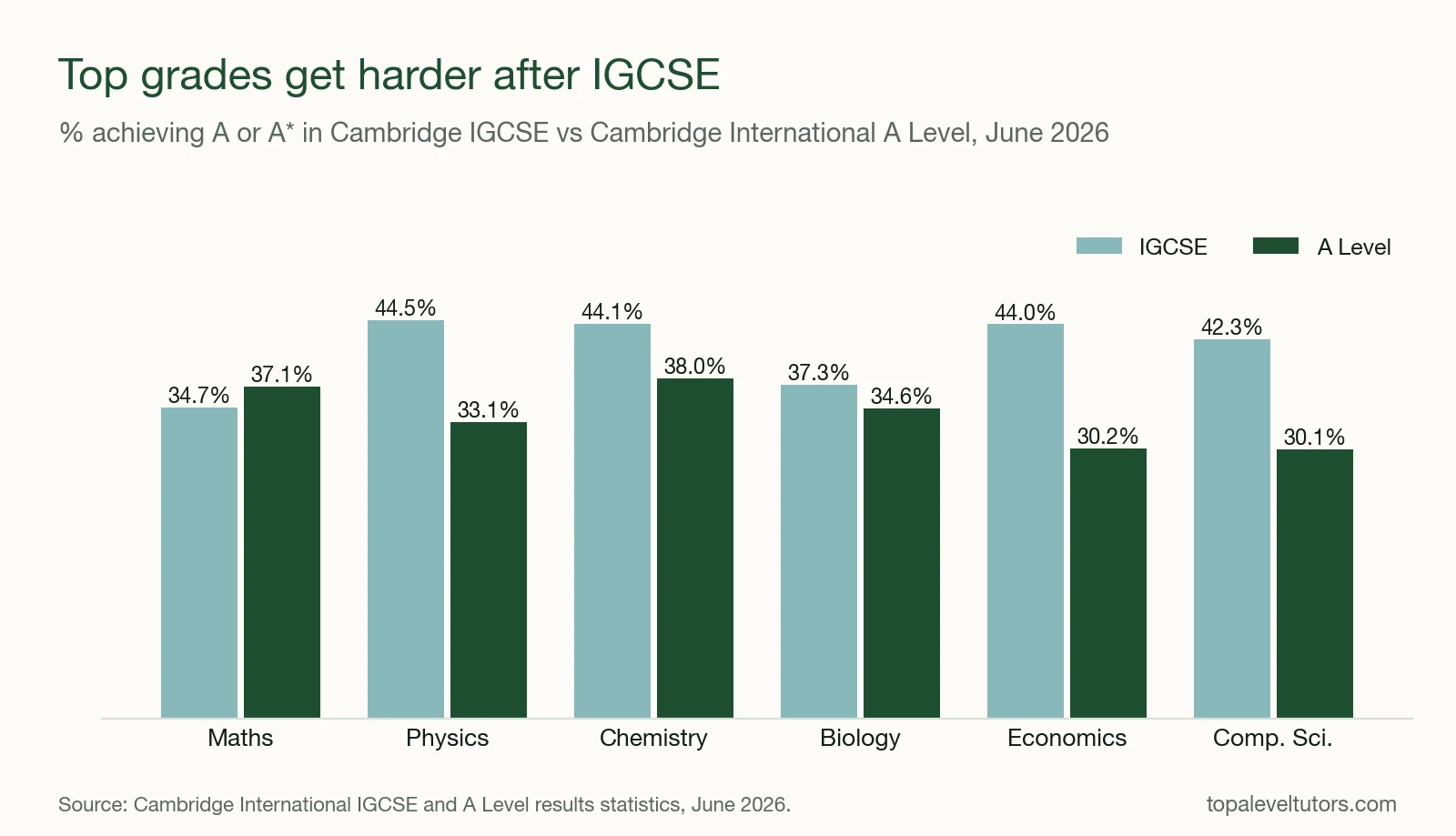
The jump from IGCSE to A Level is the biggest academic step most students take at school. Cambridge's June 2026 results show it clearly: 44.5% of Cambridge IGCSE Physics candidates achieved A or A*, but only 33.1% of Cambridge International A Level Physics candidates did (Cambridge International, 2026; Cambridge International, 2026).
That's despite A Level students being a more selective group. This guide explains what changes, what grades you need to start, and how to prepare so the jump doesn't catch you out.
Key Takeaways
- Top grades are harder to reach at A Level than at IGCSE in most subjects.
- IGCSE is Level 2; A Level is Level 3, one full step up (GOV.UK).
- Most schools ask for a 6/B to 7/A at IGCSE in subjects you continue.
- The biggest change is the shift from memorising to reasoning and independent study.
How Big Is the Jump From IGCSE to A Level?
It's a full qualification level. IGCSE and GCSE at grades 9–4 are Level 2, while A Levels are Level 3 (GOV.UK, 2026). In Cambridge's June 2026 results, the share of A and A* grades fell from IGCSE to A Level in Physics, Chemistry, Biology, Economics and Computer Science.
| Subject (Cambridge, June 2026) | IGCSE A or A* | A Level A or A* |
|---|---|---|
| Physics | 44.5% | 33.1% |
| Economics | 44.0% | 30.2% |
| Chemistry | 44.1% | 38.0% |
| Computer Science | 42.3% | 30.1% |
| Biology | 37.3% | 34.6% |
| Mathematics | 34.7% | 37.1% |
Mathematics is the interesting exception: the A Level top-grade rate is slightly higher than at IGCSE. That's because only confident mathematicians usually continue to A Level, so the group is stronger. Even so, many of those students still find the first term of A Level Maths a shock. A higher success rate doesn't mean an easier course.
What Actually Changes at A Level?
Three things change. First, depth: you study each topic in far more detail. Second, reasoning: exam questions test whether you can apply ideas to unfamiliar problems, not just recall them. Third, independence: you're expected to study on your own between lessons. In England, students take an average of 2.67 A Levels at 18 (Ofqual, 2026), against eight to ten IGCSEs, so each subject gets much more time.
Writing also changes. In subjects like History, Economics and English, you move from short answers to sustained, evaluative essays. In the sciences, you need precise technical language and multi-step calculations.
What IGCSE Grades Do You Need for A Level?
Requirements are set by schools, not exam boards, but most ask for a 6 or B to a 7 or A in any subject you want to continue, and often a 7 or A for Mathematics, Further Mathematics and the sciences. Some subjects you can start fresh at A Level, such as Psychology, Sociology, Economics or Law.
For Mathematics in particular, strong IGCSE grades matter. In June 2026, 18.9% of Cambridge IGCSE Mathematics candidates achieved A* (Cambridge International, 2026). If you took IGCSE Additional Mathematics, you'll find the start of A Level Maths much smoother: 51.7% of Additional Mathematics candidates achieved A or A*.
Which Subjects Have the Biggest Jump?
On Cambridge data, Economics and Computer Science showed the largest falls in top grades, about 12 to 14 percentage points, followed by Physics (Cambridge International, 2026). Economics adds diagrams, data analysis and evaluation; Computer Science adds programming and theory; Physics adds much heavier maths.
Chemistry is famous for its jump too, especially in organic chemistry and calculations. Biology is often described as "more content, same skills", but the precision required in mark schemes catches many students out. Our guide to the hardest A Levels looks at each subject.
How Can You Prepare Over the Summer?
Use the summer before Year 12 to close gaps, not to start A Level content early. Revisit the IGCSE topics that A Levels build on: algebra and graphs for Mathematics and Physics, moles and bonding for Chemistry, and cells and transport for Biology. Then read the first chapter of each A Level textbook so the first lessons feel familiar.
Practice testing and spaced practice are the two most effective study methods in learning research (Dunlosky et al., 2013). Start using them now, and they'll become habits by your first A Level exams.
The students we see struggle in Year 12 are rarely weak. They're usually students who did very well at IGCSE by memorising, and who haven't yet learned to work through problems they've never seen. We spend much of the first term with new A Level students teaching them how to approach unfamiliar questions, and that skill transfers to every subject.
What Should You Do in the First Term?
Treat the first half-term as the most important of Year 12. Review each lesson the same week, do every set question and ask for help as soon as something doesn't make sense. Gaps in early topics compound, especially in cumulative subjects such as Mathematics and Physics.
Also check that your subject choices are right. Most schools allow changes in the first few weeks. If you're unsure, our guide on how to choose A Level subjects can help you decide quickly.
Starting A Levels Soon?
A strong start in Year 12 makes the whole two years easier. Our tutors combine top recent A Level graduates and qualified teachers and examiners, and they help IGCSE students bridge the gap to Cambridge International, Edexcel International and UK A Levels.
Submit an application and we'll match you with a tutor for your subjects.
Frequently Asked Questions
Is A Level much harder than IGCSE?
Yes. A Level is a full qualification level higher, and top grades are rarer. In Cambridge's June 2026 results, A or A* grades in Economics fell from 44.0% at IGCSE to 30.2% at A Level (Cambridge International, 2026).
Can I take A Level Maths without IGCSE Additional Maths?
Yes. Additional Mathematics isn't required, but it helps. In June 2026, 51.7% of Cambridge IGCSE Additional Mathematics candidates achieved A or A* (Cambridge International, 2026). If you didn't take it, practise algebra over the summer.
Is IGCSE equivalent to GCSE?
Cambridge IGCSE and Edexcel International GCSE are designed as GCSE-level qualifications, and strong grades are treated like GCSE grades 9–4, which are Level 2 (GOV.UK, 2026). UK sixth forms and universities accept them in place of GCSEs.
Can I start an A Level in a subject I didn't take at IGCSE?
Often, yes. Psychology, Sociology, Economics, Law and Business are commonly started fresh. Sciences and Mathematics usually require an IGCSE in the subject. About two-thirds of A Level students take three subjects (Ofqual, 2026), so choose carefully.
The Bottom Line
- A Level is a full step up from IGCSE, and top grades are harder to reach.
- Most schools want a 6/B to 7/A at IGCSE in subjects you continue.
- The biggest change is moving from recall to reasoning and independent study.
- Use the summer to close gaps and the first half-term to build strong habits.
Next, learn how A Levels work in our guide to what an A Level is.
Find the right A-Level tutor this week
If you are not happy after your first session with your tutor, please let us know and we will give you a full refund and find you another tutor for free.