

What Is an A Level? A Complete Guide for Students Worldwide
A clear guide to A Levels for students in the UK and abroad: how the qualification works, the main exam boards, AS vs A Level, grading, difficulty and how universities use A Level results.




An A Level (Advanced Level) is a two-year, subject-based qualification that students usually take between the ages of 16 and 18. It's the main route into university in the UK, and it's taught in thousands of British-curriculum schools around the world. In June 2026 alone, almost 368,000 students at 3,492 schools received Cambridge International AS & A Level results (Cambridge International, 2026).
So if you're studying in Dubai, Karachi, Kuala Lumpur or London, you could be sitting the same kind of qualification. This guide explains how A Levels work, how the different versions compare, and what to expect.
Key Takeaways
- A Levels are two-year courses in individual subjects. Most students take three.
- Grades run from A* (highest) to E (lowest pass).
- In England, 28.3% of A Level results were A or A* in 2026 (Ofqual, 2026).
- UK, Cambridge International and Edexcel International A Levels share a grade scale but are assessed differently.
What Does an A Level Actually Involve?
An A Level is an in-depth study of one subject over two years, usually called Year 12 and Year 13 in the UK. About two-thirds of A Level students in England take three subjects (Ofqual, 2026). Unlike a broad diploma, you choose a small number of subjects and go deep into each one.
That focus is the defining feature. A student aiming for medicine might take Biology, Chemistry and Mathematics and nothing else. A future law student might take History, English Literature and Economics. There's no compulsory core, no required language and no mandatory maths.
Most of your grade comes from written exams sat at the end of the course. Some subjects also include coursework, which UK exam boards call non-exam assessment (NEA). Examples are the History investigation, the English Literature comparative essay, the Computer Science programming project and practical endorsements in the sciences.
A Levels sit at Level 3 on the UK qualifications framework. That's the same level as the IB Diploma and BTEC Nationals, and one step below the first year of a university degree. You can see how they fit with GCSEs and degrees in our guide to levels of education in the UK.
Which A Level Exam Boards Are There?
There are two broad families of A Level, and the difference matters if you study outside the UK. UK A Levels are set by AQA, OCR, Pearson Edexcel and WJEC/Eduqas and regulated by Ofqual in England. International A Levels are set mainly by Cambridge International, Pearson Edexcel (International Advanced Level, or IAL) and OxfordAQA for schools around the world.
Cambridge alone offers 55 subjects at AS & A Level (Cambridge International, 2026). Pearson's International A Levels cover 21 subjects with a modular structure and exam sittings in January, May–June and October (Pearson, 2026).
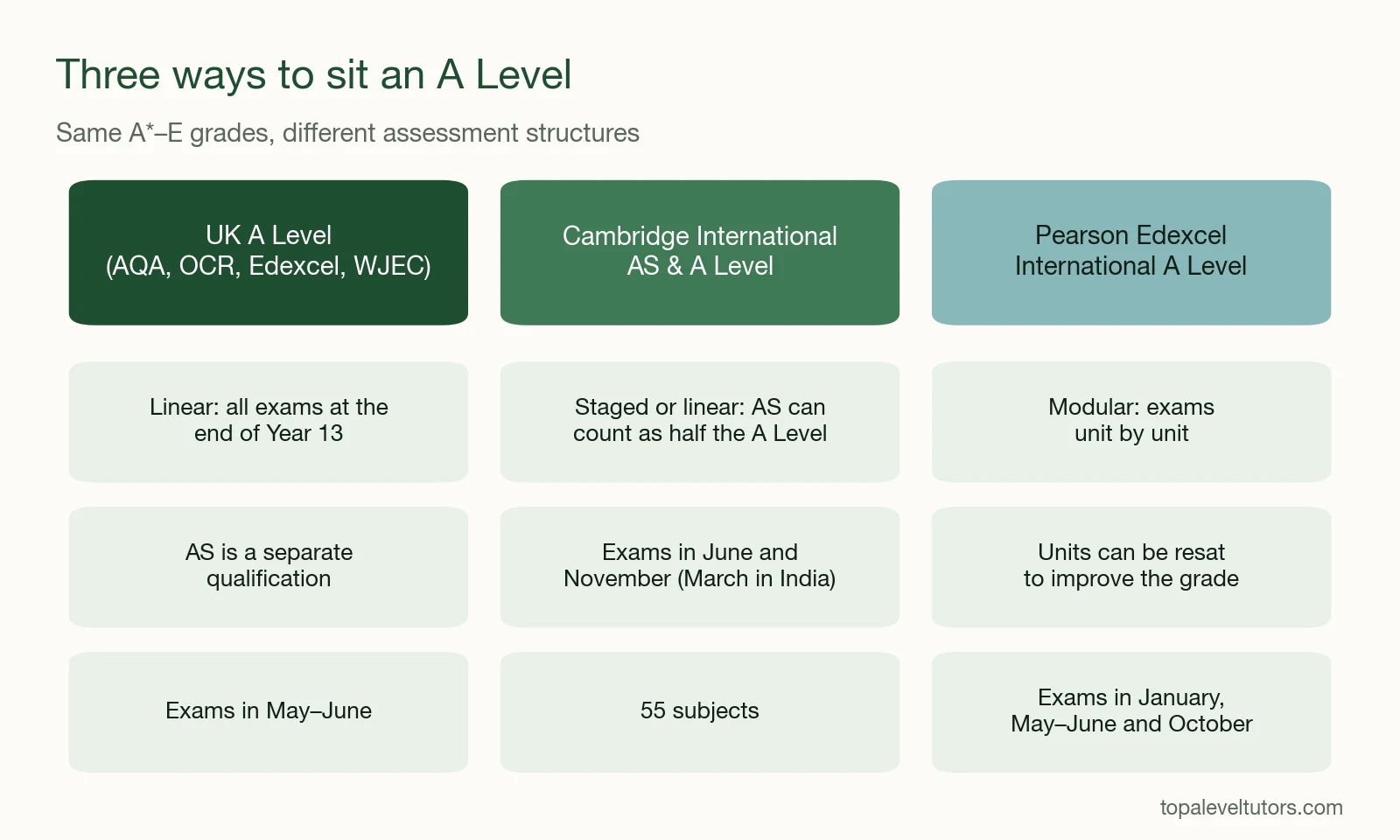
Here's how the three main routes compare:
| Feature | UK A Level | Cambridge International | Pearson Edexcel International |
|---|---|---|---|
| Structure | Linear: all exams at the end | Staged or linear | Modular, unit by unit |
| Does AS count? | No, it's a separate qualification | Yes, AS can count as half | Yes, AS units count |
| Exam sessions | May–June | June and November (March in India) | January, May–June, October |
| Resits | Whole subject, next summer | Whole AS or A Level | Individual units |
Many families abroad don't realise how much the board shapes a student's two years. A modular IAL student can bank AS units in Year 12 and resit a weak unit in January. A UK A Level student gets one chance at the end. Neither is "easier", but they suit different students, and good tutoring adapts to the structure your school follows.
What's the Difference Between AS and A Level?
An AS Level is roughly the first half of a full A Level. AS results are graded A to E, with no A*, and are worth 40% of the UCAS points of a full A Level grade (UCAS Tariff via University of Roehampton, 2026). How AS links to the full A Level depends entirely on the board.
In England, reforms between 2015 and 2017 "decoupled" AS from A Level. An AS is now a stand-alone qualification, and AS marks no longer count towards the final A Level grade. That's why very few UK schools still enter students for AS: England issued just 48,835 AS results in 2026, compared with 835,950 A Level results (Ofqual, 2026).
International boards kept the older approach. With Cambridge, you can take AS papers at the end of Year 12 and carry that result into the full A Level, or sit everything at the end. With Edexcel IAL, the AS units form half of the full qualification. If you're at an international school, check which route your school uses, because it changes when your exams fall and how much each exam counts.
How Are A Levels Graded?
A Levels are graded A*, A, B, C, D and E, and any of these grades is a pass. A result below E is "U" (unclassified). In 2026, 9.6% of UK A Level results were A*, and the A*–E pass rate was 97.5% (JCQ, 2026).
Grades aren't fixed percentages. Each exam board sets grade boundaries after marking, based on how hard that year's papers turned out to be. That means 75% might be an A one year and a B the next. Our guide to A Level grades explains boundaries, the A* rule and how each grade converts into UCAS points.
A pass isn't the same as a useful grade, though. Competitive UK universities typically ask for A*AA to AAA, and many courses name specific subjects. Want to know what that looks like as a points total? See our explainer on A Level points.
How Hard Are A Levels?
A Levels are a big step up from GCSE or IGCSE. You cover more content in more depth, and exams test whether you can apply ideas to unfamiliar questions rather than recall facts. The international data shows how demanding they can be: only 37.1% of Cambridge International A Level Mathematics candidates achieved A or A* in June 2026 (Cambridge International, 2026).
Some subjects make top grades harder to reach than others. In Cambridge International English Language, only 1.3% of candidates got A or A* in 2026, while 30.6% were ungraded. If you're weighing up difficulty before you choose, read our analysis of the hardest A Levels and the easiest A Levels.
The students we see struggle most aren't the least able. They're the ones who coasted through GCSE or IGCSE on memory and then meet A Level questions that demand reasoning. The jump usually shows up in the first set of Year 12 mock exams. Students who change their study habits early, rather than waiting for Year 13, close the gap far more easily.
Why Do Universities Value A Levels?
Universities value A Levels because the grades show sustained, specialised study in the subjects a degree builds on. A Level is the standard entry qualification for UK universities, and Cambridge International A Levels are accepted by universities in the UK, US, Canada, Australia and beyond (Cambridge International, 2026).
Two things matter most in an application: your grades and your subject choices. Some degrees require particular A Levels. Cambridge University, for example, expects Further Mathematics for Mathematics and Computer Science, and usually as a fourth A Level for Engineering and Economics where your school offers it (University of Cambridge, 2026).
That's why the subjects you pick at 16 can shape the courses open to you at 18. Our guide on how to choose A Level subjects walks through how to work backwards from the degree you want.
How Many A Levels Should You Take?
Three A Levels is the standard, and it's what nearly all UK university offers are based on. Taking four only makes sense if the fourth adds something, such as Further Mathematics for a maths-heavy degree. In England in 2026, 7,245 18-year-olds achieved an A* in every subject they took (Ofqual, 2026).
Three excellent grades will almost always beat four good ones. Universities rarely give extra credit for a fourth A Level unless they asked for it. A fourth subject also means about a third less time for each of the others.
Some international schools encourage four subjects at AS and then three at A Level. That can be a sensible way to keep options open in Year 12, as long as you drop the weakest subject before Year 13.
Ready to Make Your A Levels Count?
A Levels reward focused preparation, and the right support makes a real difference. Our tutors combine top recent A Level graduates, who know exactly what the exams feel like, with qualified teachers and examiners who know what the mark schemes reward. We work with students on UK, Cambridge International and Edexcel International A Levels.
Submit an application and we'll match you with a tutor for your subjects and exam board.
Frequently Asked Questions
What age do you take A Levels?
Most students take A Levels between 16 and 18, after GCSEs or IGCSEs. In the UK that's Year 12 and Year 13, often called sixth form. About two-thirds of A Level students in England take three subjects (Ofqual, 2026). Adults can also take A Levels as private candidates at any age.
Is an A Level the same as a high school diploma?
Not exactly. A US high school diploma covers many subjects at a general level, while A Levels go deep into two to four subjects. A Levels sit at Level 3 in the UK framework, alongside the IB Diploma (GOV.UK). Many US universities give credit for strong A Level grades.
Are international A Levels accepted by UK universities?
Yes. Cambridge International and Pearson Edexcel International A Levels are accepted by UK universities in the same way as UK A Levels and carry the same UCAS Tariff points: 56 for an A* and 48 for an A (University of Roehampton, 2026). Always check each course's subject requirements.
What is the most popular A Level?
Mathematics is the most popular A Level in England, accounting for about one in eight of all A Level results in 2026, followed by Psychology and Biology (Ofqual, 2026). Maths is popular because so many degrees, from economics to engineering, either require or prefer it.
Can you resit an A Level?
Yes. UK A Levels can be resat the following summer, and the whole subject is re-examined. Pearson Edexcel International A Levels let you resit individual units in January, May–June or October (Pearson, 2026). Cambridge offers June and November series in most countries.
The Bottom Line
- An A Level is a two-year, single-subject qualification graded A* to E.
- Most students take three, chosen to match the degree they want.
- UK, Cambridge International and Edexcel International A Levels share grades and UCAS points but differ in structure and exam timing.
- Top grades are hard to reach: only 28.3% of results in England were A or A* in 2026.
Next, find out how your grades turn into university entry points in our guide to A Level points.
Find the right A-Level tutor this week
If you are not happy after your first session with your tutor, please let us know and we will give you a full refund and find you another tutor for free.