

What Is an IGCSE? A Guide for Students and Parents
A clear guide to the IGCSE: what it is, who offers it, how it differs from GCSE, how it is graded and assessed, how universities treat it and how it leads on to A Levels.



An IGCSE (International General Certificate of Secondary Education) is a subject-based qualification taken by students aged 14 to 16, usually over Years 10 and 11. Cambridge International calls Cambridge IGCSE "the world's most popular international qualification for 14 to 16 year olds", with "a choice of over 70 subjects in any combination" (Cambridge International, 2026).
This guide explains what IGCSEs are, who offers them, how they're graded and how they lead on to A Levels.
Key Takeaways
- IGCSEs are taken at 14 to 16, usually as a two-year course, with exams at the end.
- The two main boards are Cambridge International and Pearson Edexcel International.
- Cambridge IGCSEs are graded A* to G (or 9 to 1 in some regions); Edexcel International GCSEs use 9 to 1.
- IGCSEs are comparable to UK GCSEs and accepted by universities worldwide.
What Does IGCSE Stand For?
IGCSE stands for International General Certificate of Secondary Education. It was designed for international schools as an alternative to the UK GCSE. Cambridge says it aligns "the standards of Cambridge IGCSE with the GCSE qualification taken in England" (Cambridge International, 2026).
Students usually take between five and ten IGCSEs, each in a separate subject. Each subject is a full qualification on its own, with its own grade. Most students take exams at the end of Year 11, at age 15 or 16.
Who Offers IGCSEs?
Two exam boards offer most IGCSEs. Cambridge International offers Cambridge IGCSE, and Pearson Edexcel International offers the International GCSE. Pearson describes its International GCSEs as "globally recognised qualifications" designed for international learners, offered "in May-June (Summer) and November each year" (Pearson, 2026).
| Cambridge IGCSE | Pearson Edexcel International GCSE | |
|---|---|---|
| Subjects | Over 70 | 37 listed by Pearson |
| Grading | A* to G, or 9 to 1 in some regions | 9 to 1 |
| Exam series | June and November (March in India) | May–June and November |
| Structure | Linear: exams at the end | Linear, with modular options in many subjects |
Sources: Cambridge International, 2026; Pearson, 2026.
Your school usually chooses the board, and many schools mix boards across subjects. Our guide to IGCSE vs GCSE compares them with UK GCSEs.
How Are IGCSEs Graded?
Cambridge IGCSEs are reported on a scale from A\* (highest) to G (minimum pass), with U for ungraded. Schools in Cambridge's administrative zone 3, which covers Europe, Africa and parts of the Middle East, can choose 9 to 1 grading instead (Cambridge International, 2026). Edexcel International GCSEs use 9 to 1.
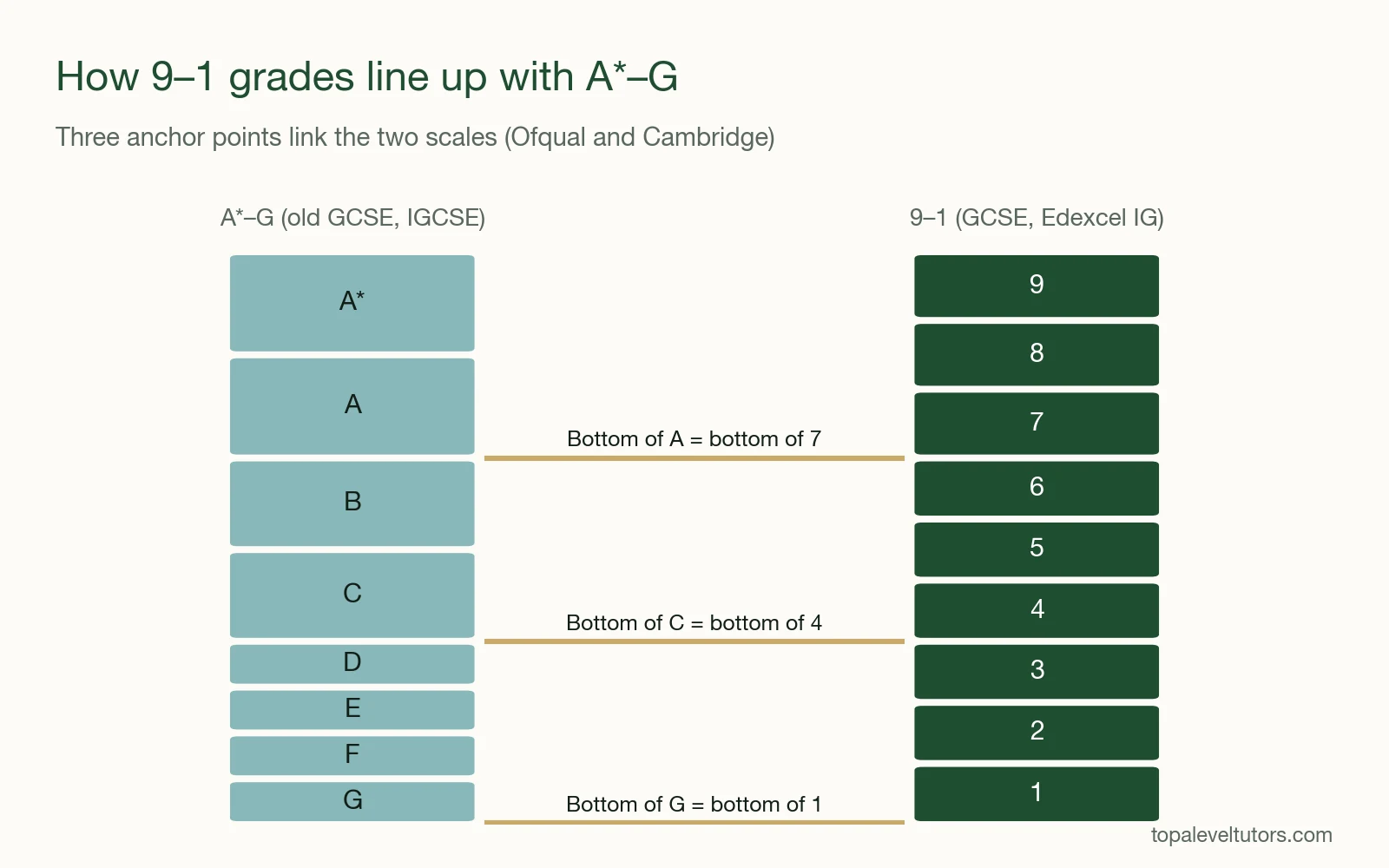
The scales are linked at three points. Cambridge says 9 to 1 standards at grades 7, 4 and 1 "are the same as the standards at the thresholds of grades A, C and G" (Cambridge International, 2026). Our guide to GCSE and IGCSE grades explains the conversion in detail.
How Are IGCSEs Assessed?
Most IGCSEs are assessed mainly by written exams at the end of the course, sometimes with coursework, oral or practical components. Many subjects are "tiered". In Cambridge IGCSE Biology, for example, Core candidates can achieve grades C to G, while Extended candidates can achieve A\* to G (Cambridge International, 2026).
The tier you're entered for decides the top grade you can reach, so it matters. Our guide to IGCSE Core vs Extended explains how schools decide.
For international families, the tier decision is often the most important one in Year 10, and it's easy to miss. A student placed in Core Mathematics can't get above a C, however well they do on the day. If you're aiming for A Level Maths or science, check the tier early and ask what it would take to move up.
Do Universities Accept IGCSEs?
Yes. Cambridge says "leading universities and employers worldwide accept Cambridge IGCSE as evidence of academic ability" (Cambridge International, 2026). An independent UK NARIC benchmarking study found Cambridge IGCSE "comparable to GCSE standards" (Cambridge International, 2026).
UK universities usually treat IGCSE grades exactly like GCSE grades. UCL, for example, asks for English Language and Mathematics at grade 5 or above, "GCSE (or equivalent)" (UCL, 2026). Strong IGCSEs also count in US and other international applications.
What Comes After IGCSE?
Most IGCSE students move on to A Levels, usually Cambridge International AS & A Levels or Edexcel International A Levels, or to the IB Diploma. Cambridge's A Level syllabuses are written with IGCSE in mind: for Physics, Cambridge recommends that learners "have completed a course in Physics or Co-ordinated Science equivalent to Cambridge IGCSE" (Cambridge International, 2026).
Our guides on moving from IGCSE to A Level and what an A Level is explain the next step.
Many of the families we work with in the Middle East and Asia first contact us in Year 10, when IGCSE coursework and mocks begin. The students who do best treat IGCSE as the foundation for A Level, not a separate hurdle: strong Extended-tier Maths and science make the jump to A Level far smoother.
Want Help With IGCSEs?
Our tutors combine top recent graduates and qualified teachers and examiners, and support students on Cambridge IGCSE and Edexcel International GCSE in every core subject.
Submit an application and we'll match you with a tutor for your subjects.
Frequently Asked Questions
Is IGCSE the same as GCSE?
Not quite, but they're at the same level. UK NARIC found Cambridge IGCSE comparable to GCSE standards (Cambridge International, 2026). The main differences are who takes them, the exam series and some content. See IGCSE vs GCSE.
How many IGCSEs should I take?
Most students take between seven and ten. Cambridge's ICE group award, for example, recognises students who pass at least seven Cambridge IGCSE subjects from five curriculum areas (Cambridge International, 2026). See how many GCSEs or IGCSEs to take.
What is a pass at IGCSE?
Technically, any grade from A\* to G (or 9 to 1) is a pass. In practice, schools and universities usually look for C or 4 and above, and often higher in subjects you want to continue. UCL asks for grade 5 in English Language and Maths (UCL, 2026).
Can you take IGCSEs as a private candidate?
Yes, through exam centres that accept private candidates, such as some schools and British Council offices. Pearson Edexcel International GCSEs run in May–June and November (Pearson, 2026), which gives two chances a year.
The Bottom Line
- IGCSEs are international qualifications for 14 to 16 year olds, comparable to GCSEs.
- Cambridge and Pearson Edexcel are the two main boards.
- Grading is A* to G or 9 to 1, linked at grades A/7, C/4 and G/1.
- Tiers decide your highest possible grade, so check them early.
Next, see how IGCSE grades are calculated.
Find the right A-Level tutor this week
If you are not happy after your first session with your tutor, please let us know and we will give you a full refund and find you another tutor for free.