

A Level Points: How UCAS Tariff Points Work (2026 Guide)
How UCAS Tariff points work for A Levels: full points tables for A Level, AS Level and the EPQ, common grade combinations, how international A Levels are counted and when universities use points rather than grades.



A Level points are UCAS Tariff points, a number that UK universities use to compare grades across different qualifications. An A* at A Level is worth 56 points, an A is worth 48, and three A grades (AAA) add up to 144 points (UCAS Tariff via University of Roehampton, 2026).
That sounds simple, and mostly it is. But many students, especially those applying from outside the UK, misread how points are used. This guide gives you the full tables and explains when points matter and when they don't.
Key Takeaways
- A Level grades are worth A* 56, A 48, B 40, C 32, D 24 and E 16 UCAS points.
- AS grades are worth 40% as much: an AS grade A is 20 points.
- Cambridge and Edexcel International A Levels earn the same points as UK A Levels.
- Most competitive universities make offers in grades (such as AAA), not points.
How Many UCAS Points Is an A Level Worth?
Each A Level grade has a fixed UCAS Tariff value: A* is 56, A is 48, B is 40, C is 32, D is 24 and E is 16 (University of Roehampton, 2026). Those values are the same for every subject and every exam board, so an A in Further Maths earns exactly what an A in Media Studies does.
| A Level grade | UCAS points |
|---|---|
| A* | 56 |
| A | 48 |
| B | 40 |
| C | 32 |
| D | 24 |
| E | 16 |
Your total is simply the sum of your grades. The current Tariff has been in place since 2017, and the same values apply to applications for 2027 entry.
What Are Common A Level Point Totals?
Three A Levels at A*A*A* give the maximum of 168 points, while three B grades give 120. A typical "middle" university offer of 112 points can be met with BBC, and a common foundation-year or lower-tariff offer of 96 points with CCC (University of Roehampton, 2026).
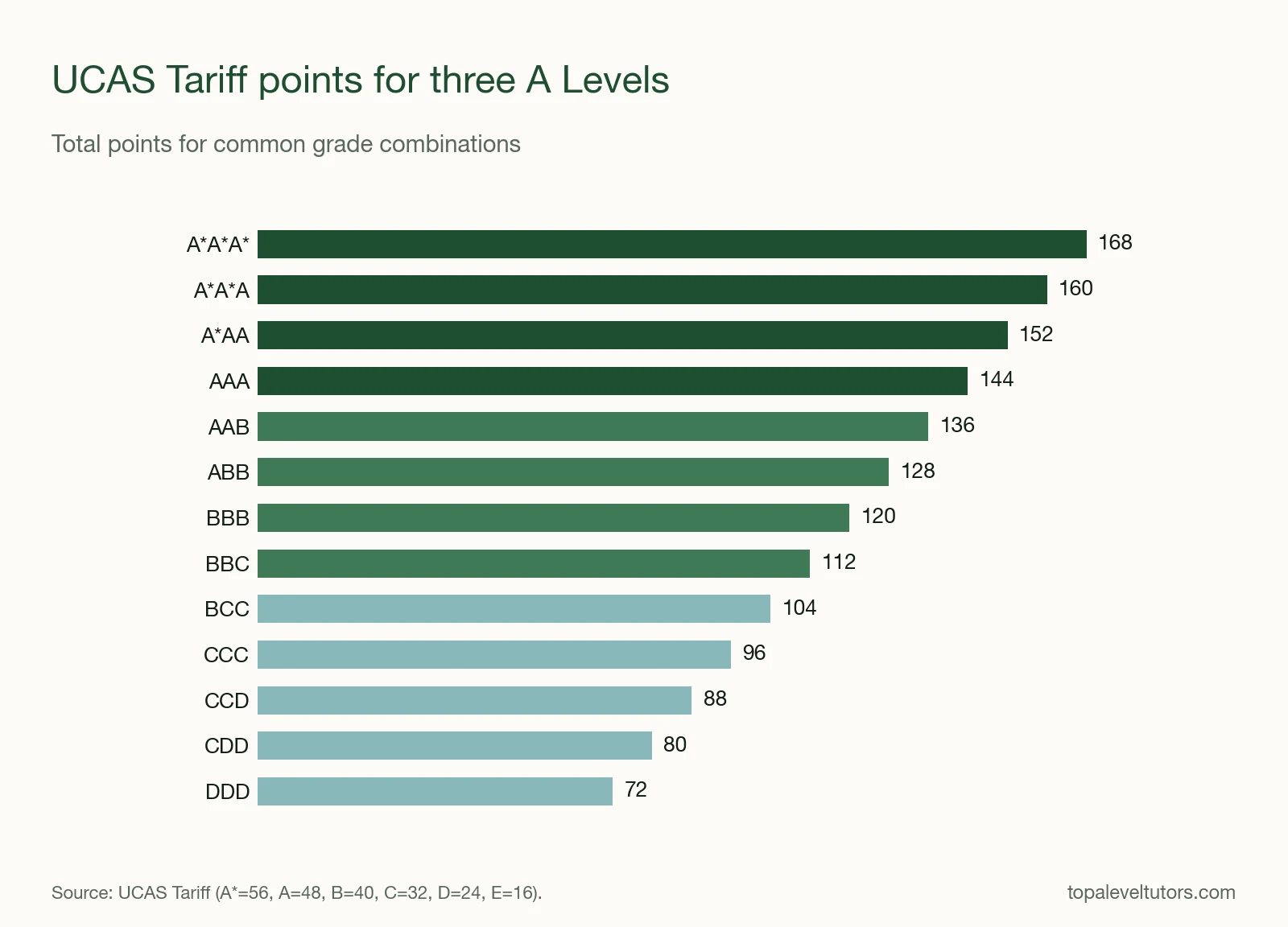
| Grades | Points | Grades | Points |
|---|---|---|---|
| A*A*A* | 168 | BBB | 120 |
| A*A*A | 160 | BBC | 112 |
| A*AA | 152 | BCC | 104 |
| AAA | 144 | CCC | 96 |
| AAB | 136 | CCD | 88 |
| ABB | 128 | DDD | 72 |
Notice that different combinations can reach the same total. A*CC (120) and BBB (120) are equal in points, but a university asking for BBB in grades wouldn't accept A*CC. That's the first trap points can create.
How Many Points Are AS Levels and the EPQ Worth?
An AS Level is worth 40% of the equivalent A Level grade: A 20, B 16, C 12, D 10 and E 6, with no A* available (University of Roehampton, 2026). The Extended Project Qualification (EPQ) is worth half an A Level: A* 28, A 24, B 20, C 16, D 12 and E 8.
| Grade | AS Level | EPQ |
|---|---|---|
| A* | N/a | 28 |
| A | 20 | 24 |
| B | 16 | 20 |
| C | 12 | 16 |
| D | 10 | 12 |
| E | 6 | 8 |
A word of warning about cashing in AS grades. With Cambridge International or Edexcel International A Levels, your AS usually rolls into the full A Level. You can't count the same AS both on its own and inside the A Level. Only an AS in a subject you dropped after Year 12 adds separate points.
Do International A Levels Get UCAS Points?
Yes. Cambridge International A Levels and Pearson Edexcel International A Levels attract the same UCAS points as UK A Levels, so an A* is 56 points whichever board set the exam (University of Roehampton, 2026). That matters, because almost 368,000 students received Cambridge AS & A Level results in June 2026 (Cambridge International, 2026).
UK universities treat these qualifications as equivalent to UK A Levels in their offers. If a course asks for AAB, an AAB in Cambridge International A Levels meets it.
Where international students do get caught out is predicted grades. UCAS applications are usually made in Year 13, before results, so offers are based on your school's predictions. Students on modular IAL or staged Cambridge routes have a real advantage here: strong AS results give their school hard evidence for high predictions. A weak AS result, on the other hand, can pull predictions down before you've had a chance to recover.
How Do Other Qualifications Compare?
The Tariff exists so that universities can compare different qualifications on one scale. The IB Diploma's Higher Level grade 7 earns 56 points, the same as an A* at A Level, while a Standard Level 7 earns 28 (Save My Exams, 2026). A BTEC National Extended Diploma at D*D*D* is worth 168 points, the same as A*A*A*.
| Qualification | Top grade | Points |
|---|---|---|
| A Level | A* | 56 |
| AS Level | A | 20 |
| EPQ | A* | 28 |
| IB Higher Level | 7 | 56 |
| IB Standard Level | 7 | 28 |
| BTEC Extended Diploma (3 A Levels) | D*D*D* | 168 |
| T Level | Distinction* | 168 |
This is useful if your school offers a mix of qualifications, or if you're comparing UK study with other options. But equal points don't always mean universities see two qualifications as equal for every course.
Do Universities Use Points or Grades?
Many universities don't use points at all for their most competitive courses. Oxford, Cambridge and most Russell Group universities make offers in grades, such as A*AA, often with specific subjects attached. Cambridge, for example, usually bases offers on three A Levels taken together in Year 13 (University of Cambridge, 2026).
Points are more common at universities that want flexibility. A course asking for 112 points will accept BBC, ABD or A*CD, and may let you count an EPQ or AS towards the total. Some also accept a range, such as 112–120 points (University of Roehampton, 2026).
In our experience, the biggest mistake is aiming for a points total rather than specific grades. A student who needs AAA for economics gains nothing from an extra AS. They gain everything from moving one subject from a B to an A. So read each course's entry requirements word for word, and plan your study time around the grades that unlock your first-choice offer.
How Can You Maximise Your Points?
The most effective way to raise your points is to improve your weakest A Level grade, because every grade step is worth 8 points. Moving from AAB to AAA adds 8 points; moving to A*AA adds 16. Since only 28.5% of UK A Level results were A or A* in 2026 (JCQ, 2026), each step up puts you ahead of most applicants.
Focus first on the subjects your offer names, then on your weakest subject. Adding qualifications is a distant third. See our guide on how to get an A* at A Level for study methods that move grades, and our explainer on A Level grades for how boundaries work.
Want Help Reaching Your Target Grades?
Hitting an offer usually comes down to one or two grades. Our tutors are a mix of top recent A Level graduates and qualified teachers and examiners, so they know both the content and exactly how marks are awarded. We support students on UK, Cambridge International and Edexcel International A Levels.
Submit an application to get matched with a tutor for the subjects that matter most for your offer.
Frequently Asked Questions
How many UCAS points is AAA?
AAA is worth 144 UCAS points, because each A grade at A Level is worth 48 points (University of Roehampton, 2026). A*AA is 152 and A*A*A* is the maximum of 168 for three A Levels.
How many UCAS points do I need for university?
It depends on the course. Lower-tariff courses may ask for 96–112 points (CCC to BBC), while most competitive courses ask for grades rather than points, typically AAA to A*A*A. In England, only 28.3% of A Level results were A or A* in 2026 (Ofqual, 2026).
Is an AS Level worth any UCAS points?
Yes. An AS grade A is worth 20 points and an E is worth 6, which is 40% of the full A Level value (University of Roehampton, 2026). An AS only adds separate points if it's in a subject you didn't continue to full A Level.
Do Cambridge International A Levels count for UCAS points?
Yes. Cambridge International and Pearson Edexcel International A Levels earn the same UCAS points as UK A Levels: 56 for an A* down to 16 for an E. That equivalence matters for the almost 368,000 students who received Cambridge AS & A Level results in June 2026 (Cambridge International, 2026).
Does the EPQ count towards UCAS points?
The EPQ is worth up to 28 points for an A*, half the value of a full A Level (Save My Exams, 2026). Some universities count it towards a points offer, some make a lower offer if you complete it, and others treat it as a bonus only.
The Bottom Line
- A Level grades convert to UCAS points: A* 56, A 48, B 40, C 32, D 24, E 16.
- Three A Levels range from 168 (A*A*A*) down to 48 (EEE).
- International A Levels earn the same points as UK A Levels.
- For competitive courses, grades and named subjects matter more than the total.
New to A Levels? Start with our guide to what an A Level is.
Find the right A-Level tutor this week
If you are not happy after your first session with your tutor, please let us know and we will give you a full refund and find you another tutor for free.