

AS Level vs A Level: What's the Difference? (UK and International)
The difference between AS Levels and A Levels: content, grading, UCAS points, and how AS works differently on UK boards, Cambridge International and Edexcel International, plus when taking an AS is worth it.



An AS Level (Advanced Subsidiary) covers roughly the first half of a full A Level. It's graded A to E, with no A*, and each AS grade is worth 40% of the UCAS points of the same A Level grade: an AS A is 20 points, against 48 for a full A Level A (University of Roehampton, 2026).
The bigger difference, though, is how AS fits into the full A Level, and that depends completely on your exam board. That's why so many international students are confused by it.
Key Takeaways
- An AS Level is about half the content of an A Level, graded A to E.
- In the UK, AS is a separate qualification and doesn't count towards the A Level.
- With Cambridge International and Edexcel International, AS can count as half of the A Level.
- England issued just 48,835 AS results in 2026, against 835,950 A Level results (Ofqual).
What Is an AS Level?
An AS Level is a Level 3 qualification usually studied over one year, in Year 12. It covers the first-year content of the full A Level, at the same depth but in less volume (GOV.UK, 2026). The second half of the A Level is sometimes called "A2".
AS grades run from A to E. There's no A* at AS on any board. For points, see the chart below, or our full guide to A Level points.
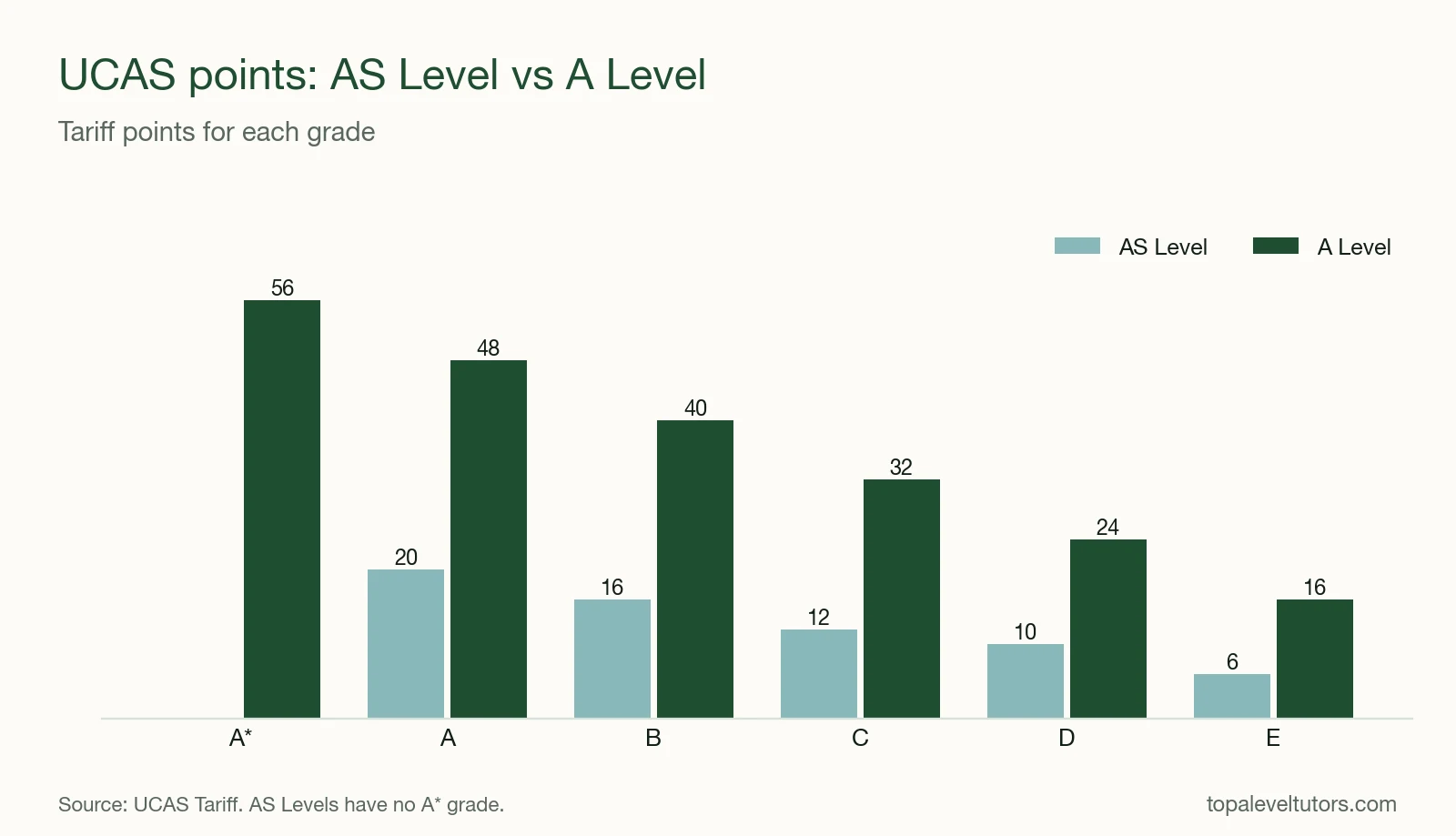
| Grade | AS Level points | A Level points |
|---|---|---|
| A* | N/a | 56 |
| A | 20 | 48 |
| B | 16 | 40 |
| C | 12 | 32 |
| D | 10 | 24 |
| E | 6 | 16 |
How Does AS Work on UK Boards?
In England, AS and A Level were "decoupled" by reforms between 2015 and 2017. AS is now a stand-alone qualification, and its marks don't count towards the A Level (Pearson, 2026). If you take an AS and then continue to A Level, you sit all the A Level papers at the end of Year 13 anyway.
That's why AS has almost disappeared in UK schools. In England in 2026, only 48,835 AS results were issued, compared with 835,950 A Level results (Ofqual, 2026). Across the UK, 24.7% of AS results were grade A (JCQ, 2026).
How Does AS Work With Cambridge International?
Cambridge kept a more flexible system. You can take the "staged" route, sitting AS papers at the end of Year 12 and carrying that result into the full A Level, or the "linear" route, sitting everything at the end (Cambridge International, 2026). You can also stop at AS and keep it as a qualification in its own right.
Cambridge publishes separate grade thresholds for each route. In June 2026 Mathematics, the full A Level A* threshold on the staged route ranged from 219 to 233 out of 250 depending on the paper combination, very close to the linear route's 222 to 234 (Cambridge International, 2026). Our guide to Cambridge A Level grade boundaries explains these tables.
How Does AS Work With Edexcel International?
Pearson Edexcel International A Levels (IAL) are modular. The AS units form half of the full International A Level, and you can sit them across January, May–June and October (Pearson, 2026). You can also resit AS units to improve your overall grade.
But the A* depends on your A2 units. You need an A overall and at least 90% of the uniform marks on the A2 units (Pearson, 2026). Strong AS results help, but they can't secure the A* on their own.
For international students, the AS route is a real strategic advantage. A strong AS result in Year 12 gives your school hard evidence when it sets predicted grades for university applications. UK students on linear A Levels don't have that. Our guide to predicted grades explains why that matters.
Should You Take an AS Level?
Take an AS if it counts towards your A Level (Cambridge staged route or Edexcel IAL) or if you want to try a fourth subject in Year 12 before dropping it. A stand-alone AS in a subject you drop adds 6 to 20 UCAS points (University of Roehampton, 2026), which can help with points-based offers.
Skip it if it's a separate exam that doesn't count and would take time from your main subjects. For most UK students on linear A Levels, that's the case.
A common pattern we see at international schools is four AS Levels in Year 12, then three full A Levels in Year 13. It works well when the student drops their weakest subject, keeps the AS as a bonus qualification and uses the extra time on their three main subjects.
Need Help With AS or A Level?
Whether you're sitting AS papers in Year 12 or the full A Level in Year 13, the right support makes a difference. Our tutors combine top recent A Level graduates and qualified teachers and examiners across UK, Cambridge International and Edexcel International boards.
Submit an application and we'll match you with a tutor for your subjects and board.
Frequently Asked Questions
Is an AS Level half an A Level?
In content, yes: an AS covers roughly the first year of an A Level. In UCAS points, an AS grade is worth 40% of the same A Level grade, so an AS A is 20 points against 48 (University of Roehampton, 2026).
Does AS count towards the final A Level grade?
On UK boards, no: AS is a separate qualification (Pearson, 2026). With Cambridge International on the staged route, or Edexcel International, AS results do count towards the full A Level.
Is there an A* at AS Level?
No. AS Levels are graded A to E on every board, including Cambridge International and Edexcel International. Across the UK, 24.7% of AS results were grade A in 2026 (JCQ, 2026).
What is A2?
A2 is the informal name for the second half of an A Level, usually studied in Year 13. With Edexcel International, A2 units decide the A*: you need 90% of the A2 uniform marks plus an A overall (Pearson, 2026).
The Bottom Line
- An AS Level is about half an A Level, graded A to E with no A*.
- On UK boards, AS is separate and doesn't count towards the A Level.
- With Cambridge (staged) and Edexcel International, AS counts as half.
- Take AS when it counts, or to trial a fourth subject in Year 12.
See how international boards compare in our guide to Cambridge vs Edexcel International A Levels.
Find the right A-Level tutor this week
If you are not happy after your first session with your tutor, please let us know and we will give you a full refund and find you another tutor for free.