

How Are A Level Grades Calculated? Raw Marks, UMS and Thresholds
A clear explanation of how A Level grades are worked out: how raw marks become a grade on UK boards, how Cambridge International weights and totals your papers, how Edexcel International uses UMS, and how the A* is decided.




A Level grades are calculated by adding up your marks across all your papers and comparing the total with grade boundaries set after each exam series. On Cambridge International A Level Mathematics in June 2026, for example, an A* needed 223 out of 250 weighted marks and an A needed 197 on the most common paper combination (Cambridge International, 2026).
The details differ by board. UK boards add up raw marks, Cambridge uses weighted marks, and Pearson Edexcel International converts each unit to a uniform mark (UMS). This guide explains all three, with worked examples.
Key Takeaways
- Your grade comes from your total across all papers, not from grades on individual papers.
- Boundaries are set after marking, so they change every series.
- Cambridge: weighted marks are totalled and compared with that series' thresholds.
- Edexcel International: raw marks become UMS, and the A* needs 90% of the A2 uniform marks.
How Do Raw Marks Become a Grade?
Every A Level starts with raw marks: the marks an examiner gives your answers. Your board adds these up across your papers and compares the total with grade boundaries for that exam series. As Cambridge puts it, syllabus thresholds "are determined from the weighted component thresholds" for the papers you sat (Cambridge International, 2026).
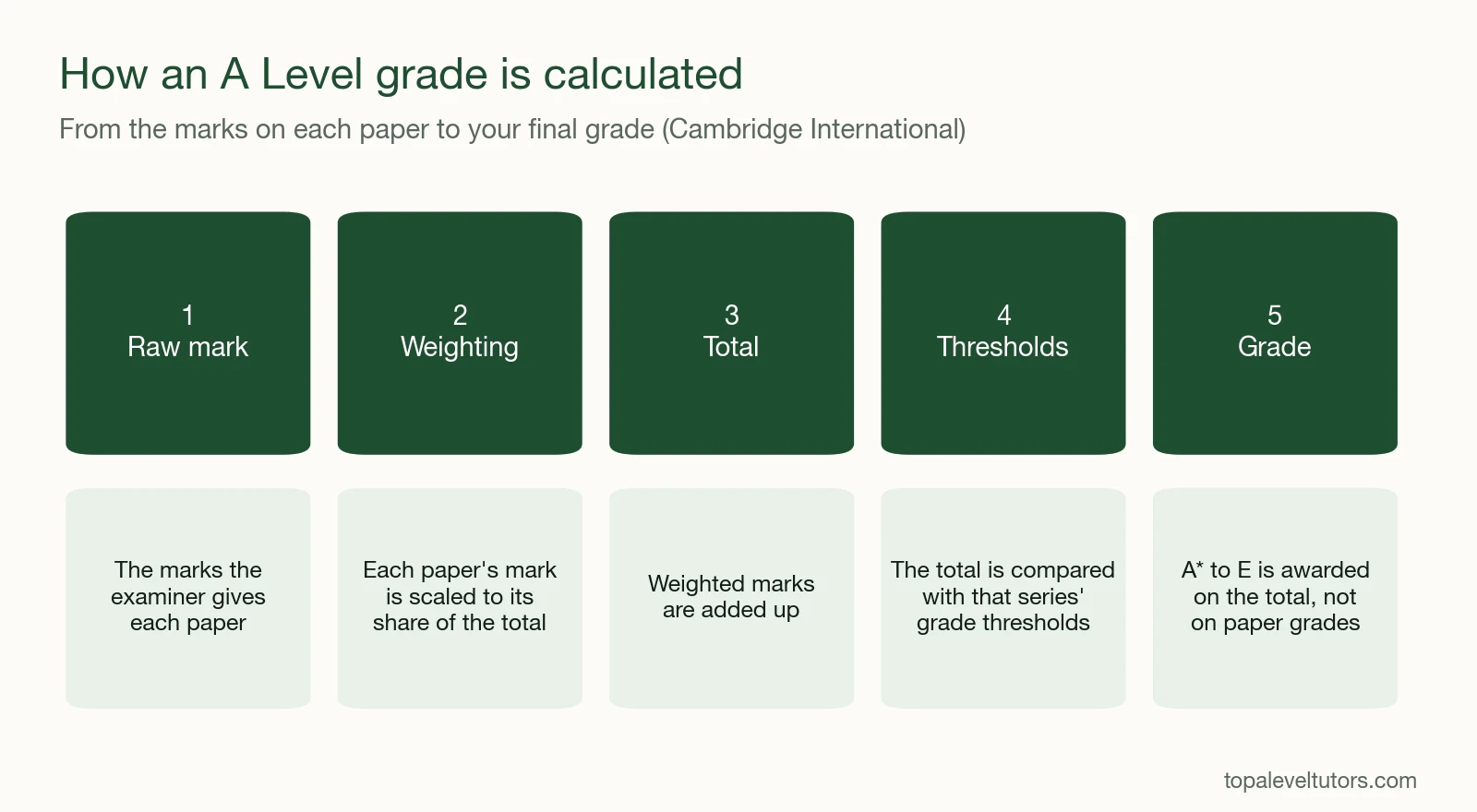
Boundaries aren't fixed percentages. Senior examiners set them after marking, looking at student work and statistics from previous years. If a paper turns out harder than expected, the boundary falls. If it's easier, the boundary rises. That keeps a grade worth the same from one year to the next.
So "80% is an A" isn't a reliable rule. In June 2026 Cambridge Mathematics, an A needed 79% of weighted marks on one paper combination (Cambridge International, 2026). In Cambridge Economics, it needed just 61% (Cambridge International, 2026). Our guide to A Level grades explains what each grade means.
How Are Cambridge International A Level Grades Calculated?
Cambridge calculates your grade in four steps. Your raw mark on each paper may be adjusted for fairness, then multiplied by a weighting factor so each paper carries its intended share. The weighted marks are added to give your syllabus total, which is compared with the grade thresholds (Cambridge International, 2026).
Here's a worked example for Mathematics (9709), where the weighting factors are 1, so weighted marks equal raw marks:
| Paper (June 2026, variant 1) | Your mark | Maximum |
|---|---|---|
| Paper 1: Pure Mathematics 1 | 62 | 75 |
| Paper 3: Pure Mathematics 3 | 58 | 75 |
| Paper 4: Mechanics | 44 | 50 |
| Paper 5: Probability & Statistics 1 | 42 | 50 |
| Total | 206 | 250 |
The A threshold for that combination was 197 and the A* threshold was 223, so 206 is a solid A (Cambridge International, 2026). Another 17 marks, spread across any of the four papers, would have made it an A*.
In subjects such as the sciences, papers have different maximum marks from their intended weightings, so the weighting factors aren't all 1. Cambridge publishes them in its syllabus component weighting factors document.
Why don't paper grades add up to your final grade?
Cambridge gives component grades on each paper, A to E, but they aren't used to calculate your result. Cambridge says a candidate with component grades A, A and B "might receive a syllabus grade of A or B (or even A*)", depending on where they fell within each grade range (Cambridge International, 2026). There's no A* on individual papers at all.
This is good news. Every mark counts the same towards your total, wherever you earn it. A strong paper can make up for a weaker one, so there's no need to panic about one difficult exam. When we plan revision with Cambridge students, we look for the paper where extra marks come cheapest, which is often the shorter applied paper rather than the hardest pure paper.
Why Do Thresholds Differ Between Paper Variants?
Cambridge sets different versions of each paper, called variants, for different time zones. Each variant gets its own threshold. In June 2026 Mathematics, the A* threshold ranged from 222 to 234 out of 250 across the linear paper combinations (Cambridge International, 2026).
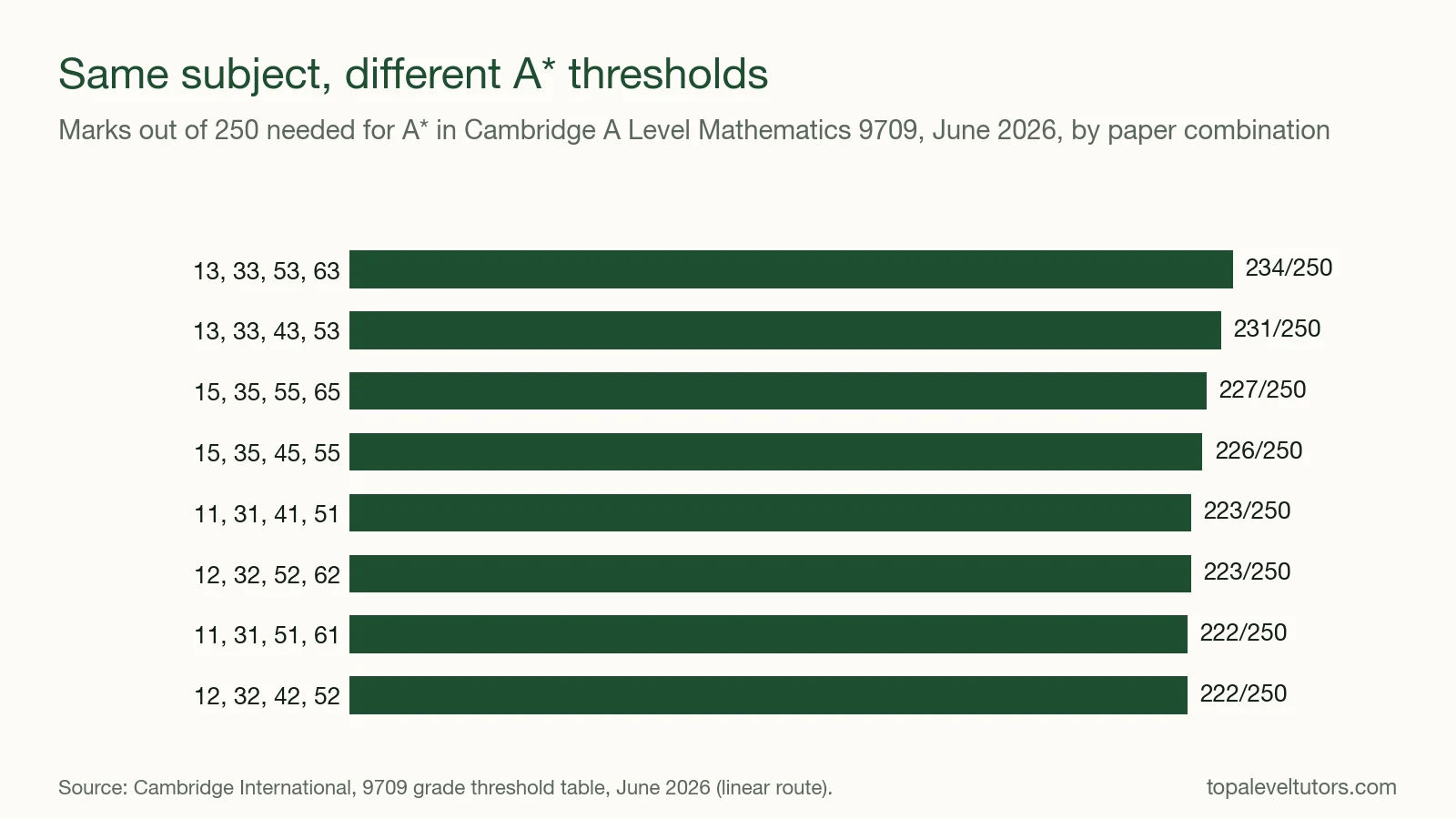
A higher threshold doesn't mean that group was treated unfairly. It usually means their paper was slightly easier, so more marks were needed for the same grade. When you mark a past paper, always use the threshold for that exact series and variant. Our Cambridge A Level grade boundaries guide has the June 2026 figures for popular subjects.
How Does Staged Assessment Work With Cambridge?
Cambridge offers three routes: AS Level only, a staged A Level over two years, or a linear A Level with every paper in one series. On the staged route, you carry your AS result forward and complete the A Level papers the following year, "subject to the rules and time limits described in the Cambridge Handbook" (Cambridge International, 2026).
Staged candidates still get one overall A Level grade from a weighted total. Cambridge publishes separate thresholds for staged combinations, where your AS result appears as its own carried-forward component. In June 2026 Mathematics, staged A* thresholds ranged from 219 to 233 out of 250 (Cambridge International, 2026).
What are percentage uniform marks (PUMs)?
In some regions, Cambridge statements of results also show percentage uniform marks. Cambridge is clear that a PUM "is not the same as the raw or component mark achieved and cannot be used with the grade thresholds documentation" (Cambridge International, 2026). A PUM of 85 doesn't mean you scored 85% of the marks.
How Are Edexcel International A Level Grades Calculated?
Pearson Edexcel International A Levels use the Uniform Mark Scale (UMS). Each unit's raw mark is converted into a UMS mark, and Pearson calculates your grade "by adding together the UMS marks you achieved for each of your individual units" (Pearson, 2026).
UMS exists because papers vary in difficulty. Pearson's example: a raw mark of 53 in one session may be worth the same as 49 in the next, so both receive the same UMS value. Raw boundaries change every session, but UMS boundaries stay fixed (Pearson, 2026).
| Edexcel International A Level | A* requirement |
|---|---|
| Mathematics (6 units) | At least 480 UMS overall, and at least 180 of 200 UMS on P3 and P4 |
| Other six-unit subjects | At least 480 UMS overall, and at least 270 UMS on the A2 units |
| Four-unit subjects | At least 320 UMS overall, and at least 180 UMS on the A2 units |
Source: Pearson, 2026.
In short, you need an A overall plus at least 90% of the A2 uniform marks. If you resit a unit, Pearson uses your best result from your two most recent attempts. Our guide to Cambridge vs Edexcel International A Levels compares the two systems in more detail.
How Are UK A Level Grades Calculated?
UK A Levels from AQA, OCR, Pearson Edexcel and WJEC/Eduqas are linear: you sit every paper at the end of the course, and your raw marks are added up. The A* is simply the top boundary on your total, because AS results no longer count towards the A Level (Pearson, 2026).
AQA explains how its boundaries are set. Examiners review students' work to decide the A and E boundaries, B, C and D are then spaced evenly between them, and the A* is set statistically to carry forward the previous standard (AQA, 2026). Boards publish their boundaries on results day.
| UK boards | Cambridge International | Edexcel International | |
|---|---|---|---|
| How marks combine | Raw marks across all papers | Weighted marks across all papers | UMS marks across all units |
| Boundaries | Set each series on the total | Set each series for each paper combination | Raw boundaries per unit UMS fixed |
| A* | Top boundary on the total | Top threshold on the weighted total | A overall plus 90% of A2 UMS |
| Do AS results count? | No | Yes, on the staged route | Yes, AS units count |
International families often ask us why a friend on a different board "needed fewer marks" for the same grade. Usually they're comparing a Cambridge raw total with an Edexcel UMS score, or two different paper variants. Once you know which system you're on, the numbers make sense, and you can set realistic targets for each paper.
Want Help Turning Marks Into Grades?
Knowing how your grade is calculated tells you where the marks are. Our tutors combine top recent A Level graduates and qualified teachers and examiners, and they know exactly how Cambridge, Edexcel International and UK boards award marks.
Submit an application and we'll match you with a tutor for your subjects.
Frequently Asked Questions
What percentage do you need for an A* at A Level?
There's no fixed percentage, because boundaries change every series. In June 2026, a Cambridge A* needed about 89% of weighted marks in Mathematics but about 69% in Economics on the first paper variant (Cambridge International, 2026). Check the thresholds for your subject and series.
Can you get an A* on a single paper?
No. Cambridge states that "Grade A* does not exist at the level of an individual component" (Cambridge International, 2026). Papers are graded A to E, and the A* is awarded only on your overall total.
Do AS results count towards the final A Level?
It depends on your board. For UK A Levels they don't. For Cambridge, they do if you take the staged route and carry your AS forward. For Edexcel International, AS units always count, although the A* depends on 90% of the A2 uniform marks (Pearson, 2026).
What is UMS in A Levels?
UMS stands for Uniform Mark Scale. Pearson converts each unit's raw mark into a UMS mark so that results from harder and easier papers are worth the same. A raw 53 in one session might equal a raw 49 in another (Pearson, 2026).
The Bottom Line
- Grades come from your total across all papers, compared with boundaries set each series.
- Cambridge totals weighted marks; component grades don't decide your result.
- Edexcel International adds UMS marks, and the A* needs 90% of A2 uniform marks.
- UK boards add raw marks, and the A* is the top boundary on the total.
Next, learn how to get an A* at A Level.
Find the right A-Level tutor this week
If you are not happy after your first session with your tutor, please let us know and we will give you a full refund and find you another tutor for free.