

A Level Maths Past Papers: Where to Find Them and How to Use Them
Where to find official A Level Maths past papers and mark schemes for AQA, Edexcel, OCR, Cambridge International and Edexcel International, how each board's exams are structured, and how to use past papers to reach an A*.



Official A Level Maths past papers come from your exam board: AQA, Pearson Edexcel or OCR in the UK, and Cambridge International or Pearson Edexcel International at most international schools. Whichever board you take, top grades need near-perfect accuracy. In 2026, about 42% of A Level Maths results in England were A or A\* (tutor2u, 2026), and a Cambridge A\* needed 223 out of 250 marks on the most common paper combination (Cambridge International, 2026).
This guide shows where to find official papers for each board, how each board's exams are structured and how to turn past papers into a higher grade.
Key Takeaways
- Use official papers and mark schemes from your own board and specification.
- UK boards set three 2-hour papers; Cambridge sets four papers; Edexcel International sets six units.
- Mark strictly and grade each paper with that series' boundaries.
- Recent papers are often restricted to teachers, so ask your school for them.
Where Can You Find Official A Level Maths Past Papers?
Every board publishes papers free, but access rules differ. Pearson keeps papers from the most recent 12 months for teachers only (Pearson, 2026). AQA publishes summer 2026 papers on its public website on 9 July 2027, and keeps them there for three years because of copyright (AQA, 2026).
| Board | Specification | Where to find papers | Access |
|---|---|---|---|
| AQA | Mathematics 7357 | AQA past papers | Public about a year after the exam |
| Pearson Edexcel (UK) | Mathematics 9MA0 | Pearson past papers | Free, except papers from the last 12 months |
| OCR | Mathematics A H240 | OCR past paper finder | Public The newest papers may be restricted |
| Cambridge International | Mathematics 9709 | Cambridge 9709 past papers | Public selection Full archive for schools |
| Pearson Edexcel International | Mathematics YMA01 | Pearson past papers | Free, except papers from the last 12 months |
Cambridge's public page offers "only a selection", such as the June 2024 9709 papers, mark schemes and examiner report. Registered schools get the full archive through the School Support Hub (Cambridge International, 2026). Whatever your board, schools often keep the newest papers for mocks, so ask your teacher.
How Are AQA, Edexcel and OCR Maths Papers Structured?
UK A Level Maths is linear: you sit every paper at the end of Year 13. All three main boards set three 2-hour papers worth 100 marks each, covering pure maths, statistics and mechanics (AQA, 2026; OCR, 2026).
| Board | Paper 1 | Paper 2 | Paper 3 |
|---|---|---|---|
| AQA (7357) | Pure, 2 hr, 100 marks | Pure and Mechanics, 2 hr, 100 marks | Pure and Statistics, 2 hr, 100 marks |
| Pearson Edexcel (9MA0) | Pure Mathematics 1, 2 hr, 100 marks | Pure Mathematics 2, 2 hr, 100 marks | Statistics and Mechanics, 2 hr, 100 marks |
| OCR (H240) | Pure Mathematics, 2 hr, 100 marks | Pure and Statistics, 2 hr, 100 marks | Pure and Mechanics, 2 hr, 100 marks |
Practise papers from your own board. The content is very similar, but the way pure, statistics and mechanics are split across papers differs, and so do question styles. Older papers from before 2018 follow the old modular specifications, so use them for topic practice only.
How Are the Cambridge 9709 Maths Papers Structured?
Cambridge A Level Mathematics has six possible papers, and you take four. Paper 1 is worth 30% of the A Level, Paper 3 another 30%, and each applied paper 20% (Cambridge International, 2026).
| Paper | Time | Marks | Weighting |
|---|---|---|---|
| 1: Pure Mathematics 1 | 1 hr 50 min | 75 | 60% of AS / 30% of A Level |
| 2: Pure Mathematics 2 | 1 hr 15 min | 50 | 40% of AS (AS only) |
| 3: Pure Mathematics 3 | 1 hr 50 min | 75 | 30% of A Level |
| 4: Mechanics | 1 hr 15 min | 50 | 40% of AS / 20% of A Level |
| 5: Probability & Statistics 1 | 1 hr 15 min | 50 | 40% of AS / 20% of A Level |
| 6: Probability & Statistics 2 | 1 hr 15 min | 50 | 20% of A Level |
For the full A Level you take Papers 1, 3 and 5, plus either Paper 4 or Paper 6. The syllabus includes the MF19 list of formulae and statistical tables, so practise with it beside you, exactly as in the exam.
How Are Edexcel International Maths Papers Structured?
Pearson Edexcel International A Level Mathematics (YMA01) is modular, with six units you can sit in different exam series. You take Pure Mathematics P1 to P4 plus two applied units, chosen from Mechanics, Statistics and Decision Mathematics. Each unit is a 1 hour 30 minute, 75-mark exam.
The A\* has its own rule. You need at least 480 uniform marks overall and at least 180 of the 200 uniform marks on P3 and P4 (Pearson, 2026). That makes P3 and P4 past papers the priority for A\* candidates. Our guide to how A Level grades are calculated explains uniform marks.
How Should You Use Maths Past Papers?
Use them as tests, not reading material. A major review of learning techniques rated practice testing one of only two "high utility" methods (Dunlosky et al., 2013). A past paper sat under exam conditions is the most realistic test you can take.
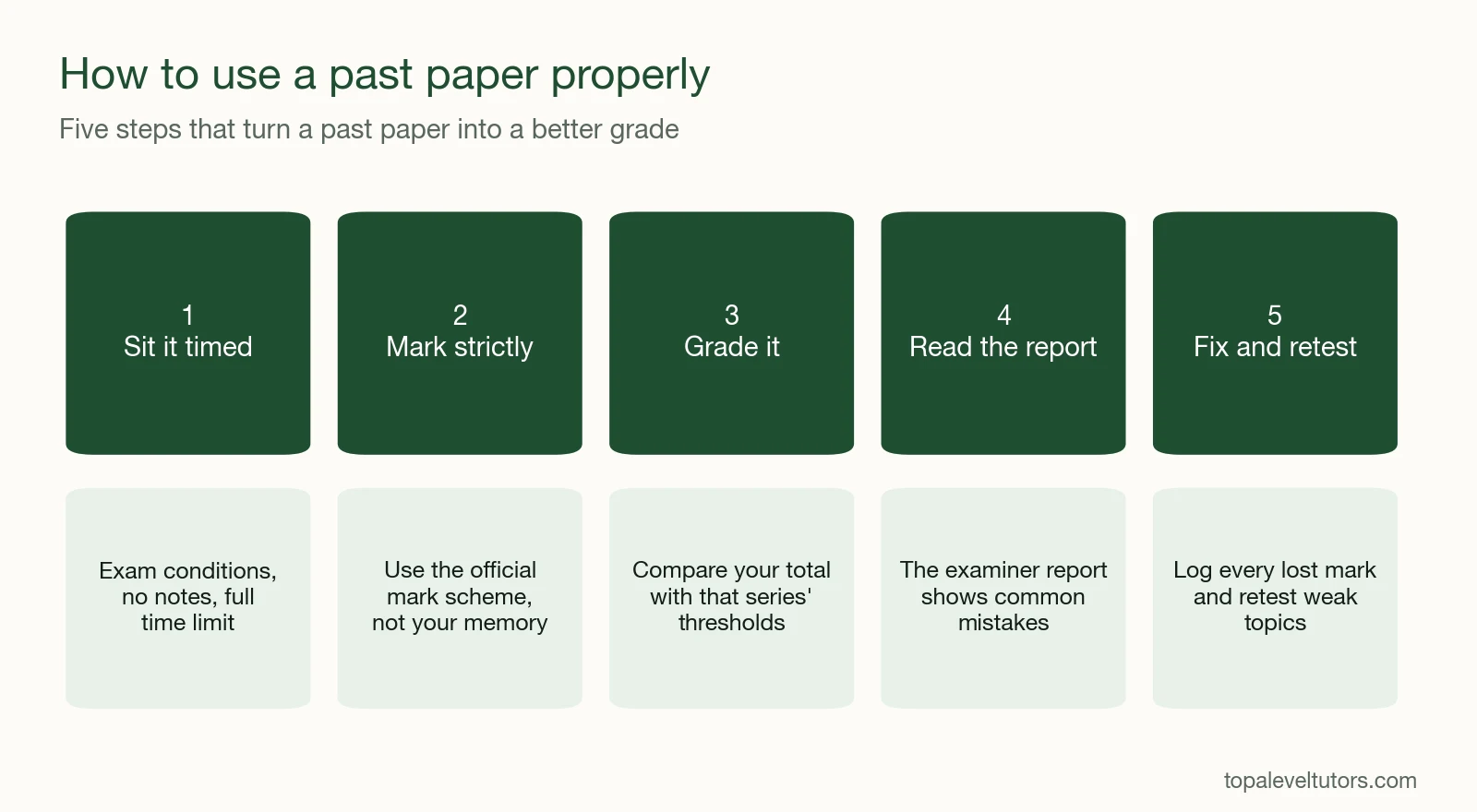
Mark every question strictly with the official mark scheme. Maths mark schemes on every board award method marks (M), accuracy marks (A) and independent marks (B) separately, so a correct method with an arithmetic slip still earns marks. Knowing this tells you how much working to show.
Then grade the paper with the boundaries for that exact series. AQA, OCR and Pearson publish boundaries for each series on results day; Cambridge publishes threshold tables for each paper variant.
Grade with the right boundaries, not a rough percentage. In Cambridge's June 2026 series, the A threshold for Paper 3 was 56 out of 75 on variant 31 but 66 out of 75 on variant 33 (Cambridge International, 2026). UK boundaries move from year to year in the same way. Using the wrong ones gives you a false picture of where you stand.
When Should You Start Maths Past Papers?
Start topic questions from past papers as soon as you finish each topic in Year 12, then move to full papers once you've covered the course. Most students should be sitting full timed papers by early Year 13. Spacing your practice over months works better than cramming (Dunlosky et al., 2013).
Save the most recent series for the final month. They're closest in style to your exam and make the best mocks. Our guide on how to revise for A Levels includes a month-by-month plan.
What Grade Can You Expect in A Level Maths?
Maths has more top grades than most subjects, but the A\* is demanding on every board. In England in 2026, 17.6% of Maths results were A\* and 42.1% were A or A\* (tutor2u, 2026). Among Cambridge International candidates worldwide, 16.9% got A\* and 37.1% got A or A\* (Cambridge International, 2026).
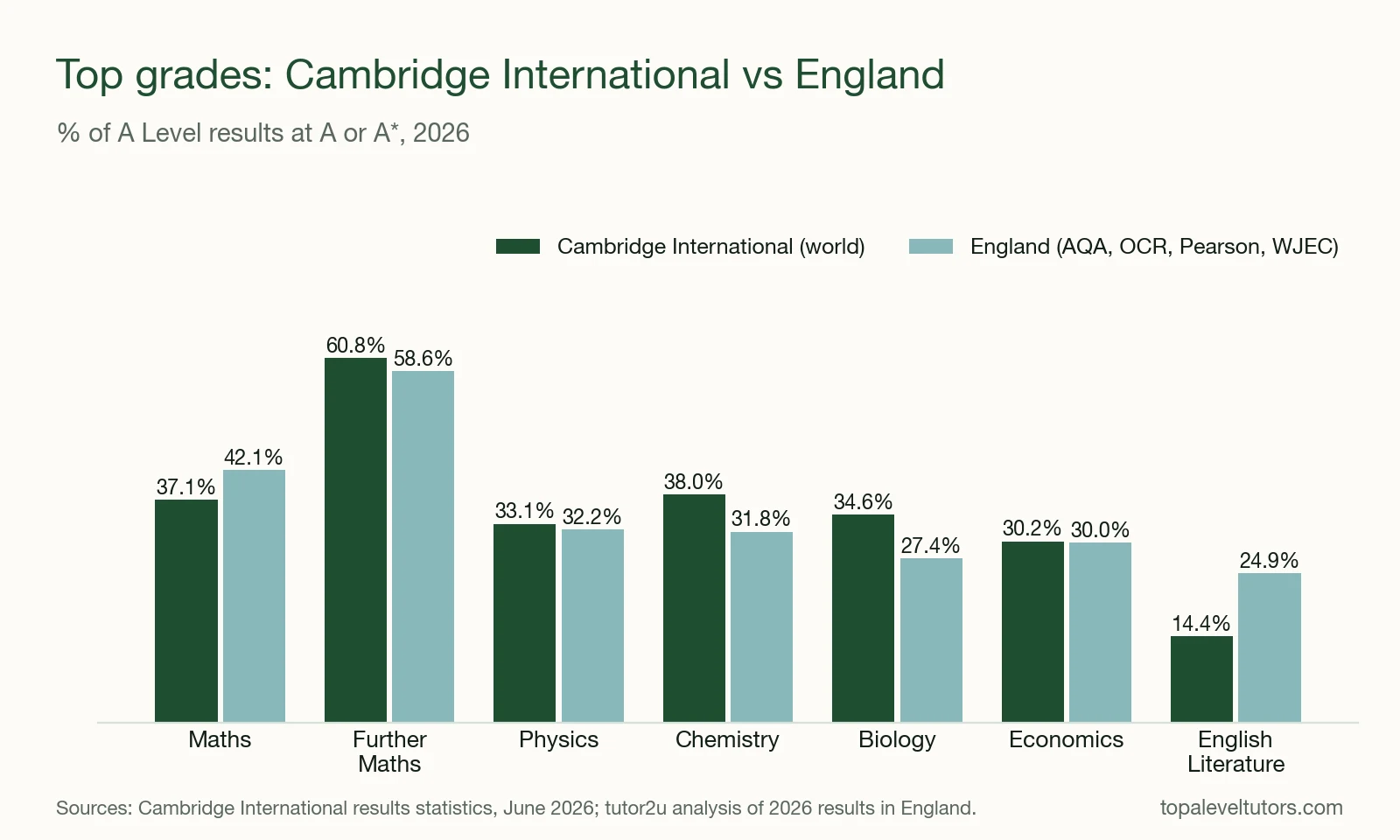
These groups of students differ, so the figures aren't a measure of which board is easier. They do show that roughly one in six students reaches an A\*, wherever they sit the exam.
Students we tutor who aim for an A\* in Maths usually find their marks plateau around the A boundary. The last 20 marks rarely come from new topics. They come from fixing careless errors, showing every step on "show that" questions and finishing papers with time to check. Tracking where every lost mark went is the fastest way through that plateau.
Want Help With A Level Maths?
Past papers show you where marks are lost; an expert shows you how to win them back. Our tutors combine top recent A Level graduates and qualified teachers and examiners, with specialists in AQA, Edexcel, OCR, Cambridge and Edexcel International Maths. See our A Level Mathematics tutoring.
Submit an application and we'll match you with a Maths tutor.
Frequently Asked Questions
Where can I find AQA and Edexcel A Level Maths past papers?
On each board's website: AQA publishes papers about a year after the exam, and Pearson makes papers free once they're more than 12 months old (AQA, 2026; Pearson, 2026). Your teacher can access the newest papers.
Are Cambridge A Level Maths past papers free?
A selection is free on Cambridge's website, such as the June 2024 9709 papers, mark schemes and examiner report. Registered schools access the full archive through the School Support Hub (Cambridge International, 2026). Ask your school for more.
How many past papers should I do for A Level Maths?
Quality matters more than quantity. Aim for at least five to eight full timed papers of each type before the exam, each marked strictly and reviewed. Practice testing is among the most effective revision methods (Dunlosky et al., 2013), but only if you learn from every mistake.
Can I use other boards' papers for practice?
For extra practice on shared topics, yes, but your main practice should be your own board's papers. Boards differ in structure, question style and mark schemes. In England, about 42% of 2026 Maths results were A or A\* (tutor2u, 2026), and the students who get there know their own board's papers inside out.
The Bottom Line
- Use official papers and mark schemes from your own board and specification.
- UK boards: three 2-hour papers; Cambridge: four papers; Edexcel International: six units.
- Mark strictly and grade with that series' boundaries.
- Start topic questions in Year 12; save recent papers for final mocks.
Taking Further Maths too? See our A Level Further Maths past papers guide.
Find the right A-Level tutor this week
If you are not happy after your first session with your tutor, please let us know and we will give you a full refund and find you another tutor for free.