

A Level Further Maths Past Papers: Where to Find Them and How to Use Them
Where to find official A Level Further Maths past papers for AQA, Edexcel, OCR, Cambridge International and Edexcel International, how each board's exams are structured, and how to practise for an A*.



Official A Level Further Maths past papers come from your exam board: AQA, Pearson Edexcel or OCR in the UK, and Cambridge International or Pearson Edexcel International at most international schools. The competition at the top is intense on every board. In 2026, 28.7% of Further Maths results in England were A\* (tutor2u, 2026), and 24.2% of Cambridge International candidates achieved an A\* (Cambridge International, 2026).
This guide shows where to find official papers for each board, how the exams are structured and how to use past papers to secure the top grade.
Key Takeaways
- Every board combines compulsory pure maths with optional or applied papers.
- Further Maths archives are smaller than Maths, so use every official paper you can get.
- Proof questions reward clear, complete reasoning, so practise writing it out in full.
- Roughly a quarter of Further Maths students get an A\*, so the top is crowded.
Where Can You Find Official Further Maths Past Papers?
Every board publishes papers free, with different rules. Pearson keeps its most recent 12 months of papers for teachers only (Pearson, 2026). AQA's summer 2026 papers go on its public website on 9 July 2027 and stay there for three years (AQA, 2026).
| Board | Specification | Where to find papers | Access |
|---|---|---|---|
| AQA | Further Mathematics 7367 | AQA past papers | Public about a year after the exam |
| Pearson Edexcel (UK) | Further Mathematics 9FM0 | Pearson past papers | Free, except papers from the last 12 months |
| OCR | Further Mathematics A H245 | OCR past paper finder | Public The newest papers may be restricted |
| Cambridge International | Further Mathematics 9231 | Cambridge 9231 past papers | Public selection Full archive for schools |
| Pearson Edexcel International | Further Mathematics YFM01 | Pearson past papers | Free, except papers from the last 12 months |
Cambridge offers a public selection on its 9231 page, and registered schools get the full archive through the School Support Hub (Cambridge International, 2026). Further Maths has fewer candidates than Maths on every board, so each archive is smaller.
How Are AQA, Edexcel and OCR Further Maths Papers Structured?
UK Further Maths is linear, and each board mixes compulsory pure maths with options. AQA sets three 2-hour, 100-mark papers (AQA, 2026). OCR sets two compulsory Pure Core papers plus any two of four optional papers (OCR, 2026).
| Board | Compulsory papers | Optional papers |
|---|---|---|
| AQA (7367) | Papers 1 and 2: 2 hr, 100 marks each | Paper 3: 2 hr, 100 marks, from a choice of mechanics, statistics and discrete options |
| Pearson Edexcel (9FM0) | Core Pure 1 and Core Pure 2: 1 hr 30 min, 75 marks each | Two option papers, 1 hr 30 min, 75 marks each |
| OCR (H245) | Pure Core 1 (Y540) and Pure Core 2 (Y541): 90 min, 75 marks each | Two of Statistics, Mechanics, Discrete Mathematics and Additional Pure Mathematics, 75 marks each |
Check which options your school teaches before you collect past papers, because option papers aren't interchangeable.
How Are the Cambridge 9231 Papers Structured?
Cambridge A Level Further Mathematics has four papers, and A Level candidates take all four. The two Further Pure papers are each worth 30% of the A Level, and the two applied papers 20% each (Cambridge International, 2026).
| Paper | Time | Marks | Weighting |
|---|---|---|---|
| 1: Further Pure Mathematics 1 | 2 hr | 75 | 60% of AS / 30% of A Level |
| 2: Further Pure Mathematics 2 | 2 hr | 75 | 30% of A Level (A Level only) |
| 3: Further Mechanics | 1 hr 30 min | 50 | 40% of AS / 20% of A Level |
| 4: Further Probability & Statistics | 1 hr 30 min | 50 | 40% of AS / 20% of A Level |
Cambridge expects you to have studied most of the Mathematics 9709 content before starting Further Maths, so gaps in your Maths will show up here (Cambridge International, 2026).
How Are Edexcel International Further Maths Papers Structured?
Pearson Edexcel International A Level Further Mathematics (YFM01) has six units, each a 1 hour 30 minute, 75-mark exam. They include the Further Pure units FP1, FP2 and FP3 alongside applied units in mechanics, statistics or decision maths. Check the specification for permitted combinations, especially if you're also taking Edexcel International Maths.
For six-unit subjects, the A\* needs at least 480 uniform marks overall and 270 on the A2 units (Pearson, 2026). Our guide to how A Level grades are calculated explains how uniform marks work.
How Should You Use Further Maths Past Papers?
Treat each paper as a test. Practice testing was rated one of only two "high utility" learning techniques in a major review (Dunlosky et al., 2013). In Further Maths, the gains come from seeing many question styles, because the same idea can be tested in surprising ways.
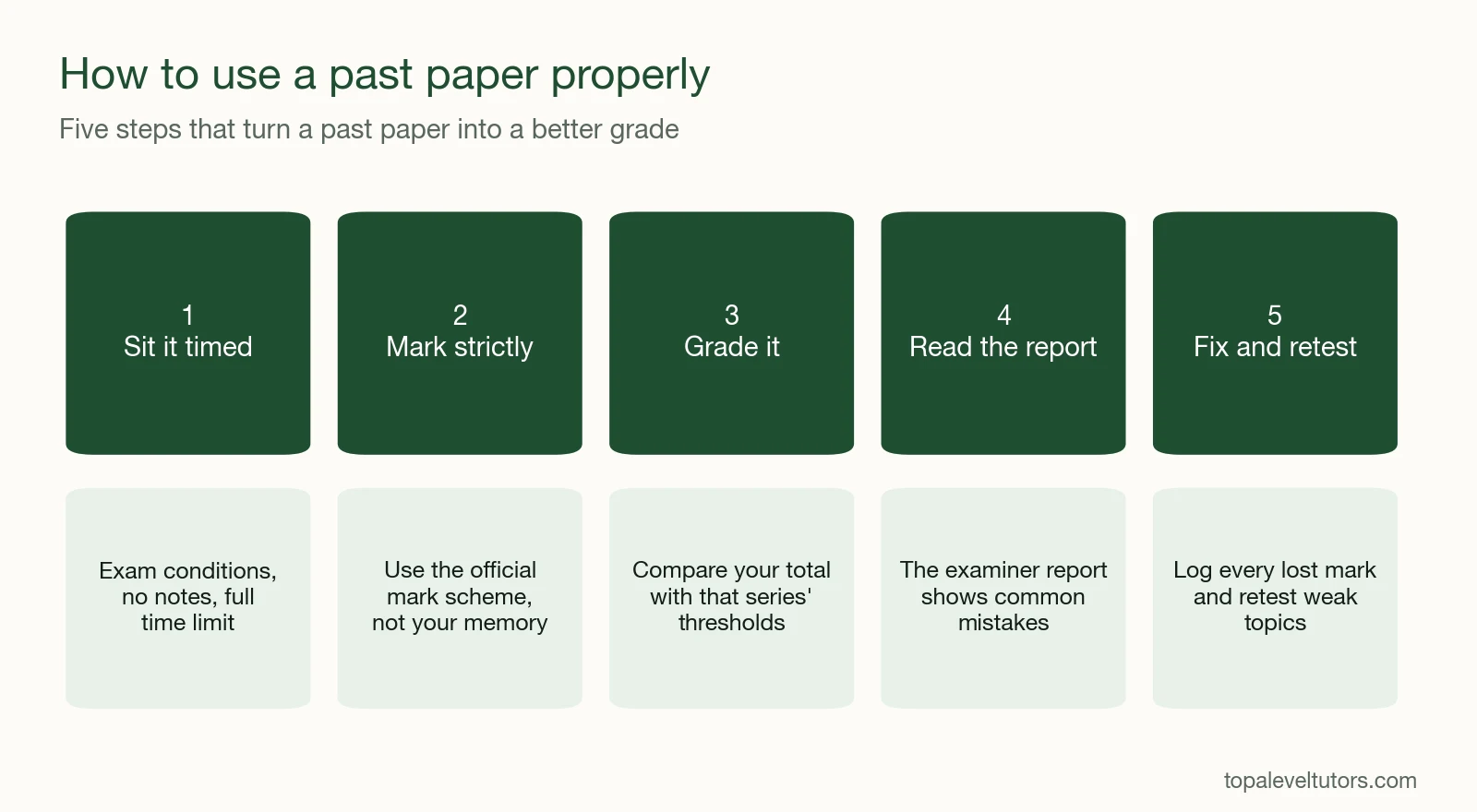
Mark against the official mark scheme, line by line. Cambridge defines "prove" as confirming a statement "using a chain of logical mathematical reasoning" (Cambridge International, 2026), and every board's mark scheme rewards each link in that chain. A correct answer with gaps in the reasoning loses marks.
Grade each paper with its own boundary. Difficulty varies a lot between papers: in Cambridge's June 2026 series, an A needed 51 out of 75 on Further Pure Mathematics 1 but 63 out of 75 on Further Pure Mathematics 2 (Cambridge International, 2026). A low score on a hard paper may still be on track.
When Should You Start Further Maths Past Papers?
Start with topic questions as soon as each topic is taught, and move to full papers by early Year 13. Because Further Maths builds on Maths, strong Maths foundations make the past papers much more productive. Spaced practice over months beats cramming (Dunlosky et al., 2013).
Keep the most recent series for timed mocks in the final month. Our guide on how to revise for A Levels has a month-by-month plan.
What Grade Can You Expect in Further Maths?
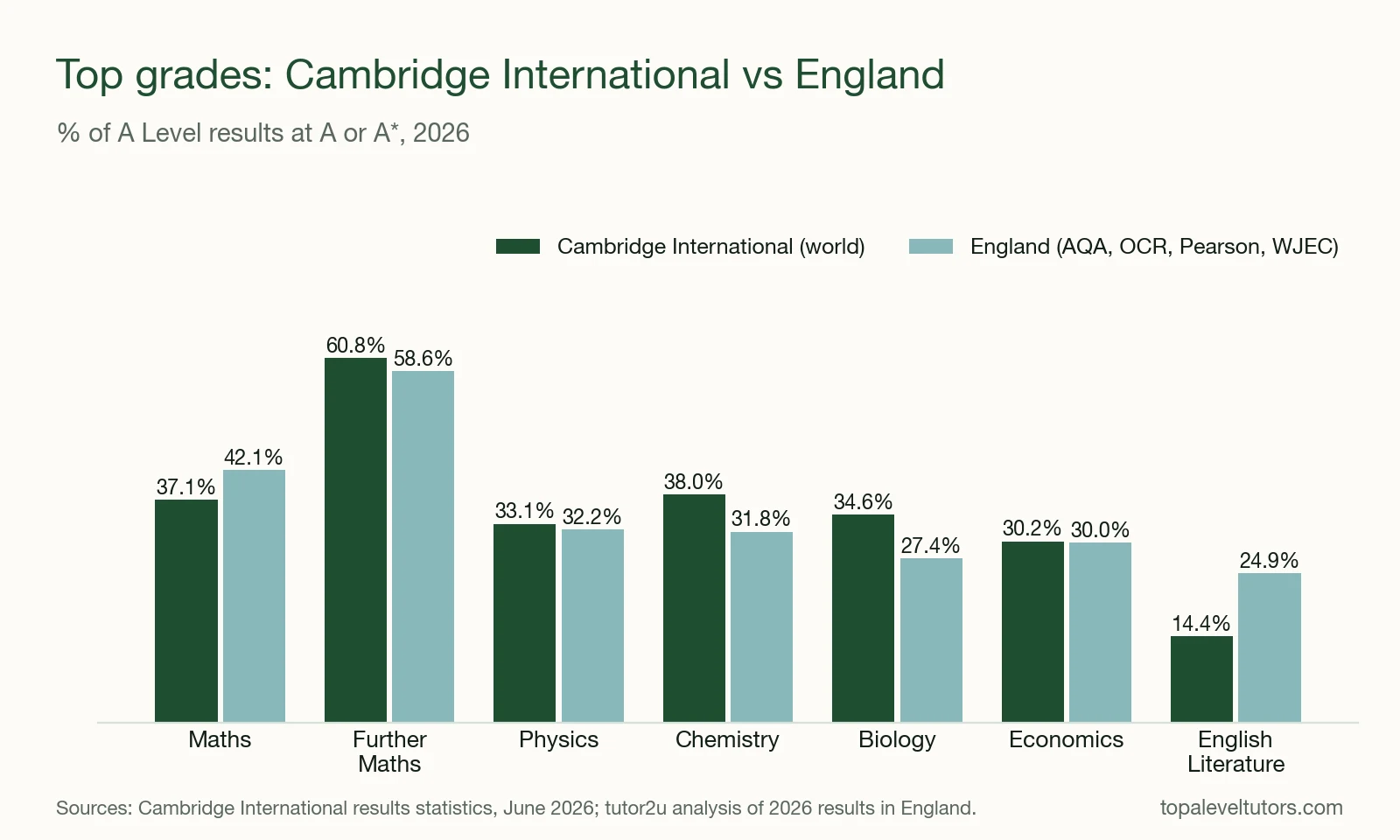
Further Maths students are a strong group, so top grades are common but competitive. In England in 2026, 58.6% of results were A or A\* (tutor2u, 2026). For Cambridge International, the figure was 60.8% (Cambridge International, 2026).
The Further Maths students we work with rarely struggle with effort. Where they lose marks is in written reasoning: proofs that skip a step, or a correct answer with no justification. Writing full solutions to past paper questions, then comparing them line by line with the mark scheme, closes that gap quickly. Our guide on whether Further Maths is worth it covers the bigger picture.
Want Help With Further Maths?
Further Maths is where expert guidance pays off most. Our tutors combine top recent A Level graduates and qualified teachers and examiners, with specialists in AQA, Edexcel, OCR, Cambridge and Edexcel International Further Maths. See our A Level Further Mathematics tutoring.
Submit an application and we'll match you with a Further Maths tutor.
Frequently Asked Questions
Where can I find Edexcel and AQA Further Maths past papers?
On each board's website. Pearson makes papers free once they're more than 12 months old, and AQA publishes them about a year after the exam (Pearson, 2026; AQA, 2026). Ask your teacher for anything newer.
Where can I find Cambridge 9231 past papers?
Cambridge publishes a selection of 9231 question papers and mark schemes on its public syllabus page, and the full archive is on the School Support Hub for registered schools (Cambridge International, 2026).
Is Further Maths harder than Maths?
The content is harder, but the students are also stronger, so grades look high. In England in 2026, 58.6% of Further Maths results were A or A\, against 42.1% in Maths (tutor2u, 2026). The competition for an A\ is real.
How many Further Maths past papers should I do?
Do as many official papers as your board offers, sat timed and marked strictly, and add topic questions where the archive runs out. Practice testing is one of the most effective revision methods (Dunlosky et al., 2013).
The Bottom Line
- Every board mixes compulsory pure maths with optional or applied papers.
- Use official papers for your board and options, and grade each with its own boundary.
- Write complete reasoning: proofs and "show that" questions reward every step.
- Around a quarter of students get an A\*, so the top is competitive.
Taking Maths too? See our A Level Maths past papers guide.
Find the right A-Level tutor this week
If you are not happy after your first session with your tutor, please let us know and we will give you a full refund and find you another tutor for free.