

Cambridge vs Edexcel International A Levels: Which Is Better?
A clear comparison of Cambridge International and Pearson Edexcel International A Levels: structure, subjects, exam series, resits, the A* rule, difficulty and university recognition, plus how to decide which suits you.



Neither is better overall: Cambridge International and Pearson Edexcel International A Levels (IAL) carry the same UCAS points and are accepted by UK universities in the same way. The real differences are structure and flexibility. Cambridge offers 55 AS & A Level subjects with mainly end-of-course exams (Cambridge International, 2026), while Edexcel IAL is modular across 21 subjects (Pearson, 2026).
These two boards set most international A Levels outside the UK. If your school offers both, or you're choosing a school, this comparison will help.
Key Takeaways
- Both earn the same UCAS points: 56 for an A* and 48 for an A.
- Cambridge is linear or staged; Edexcel IAL is modular, with exams unit by unit.
- Edexcel IAL offers January, May–June and October exams; Cambridge offers June and November (plus March in India).
- The best choice depends on how you learn, which subjects you need and how your school teaches.
How Do Cambridge and Edexcel International A Levels Compare?
The biggest difference is how you're assessed. Cambridge students usually sit AS papers at the end of Year 12 and A Level papers at the end of Year 13, or everything at the end. Edexcel IAL students sit individual units across up to three series a year: January, May–June and October (Pearson, 2026).
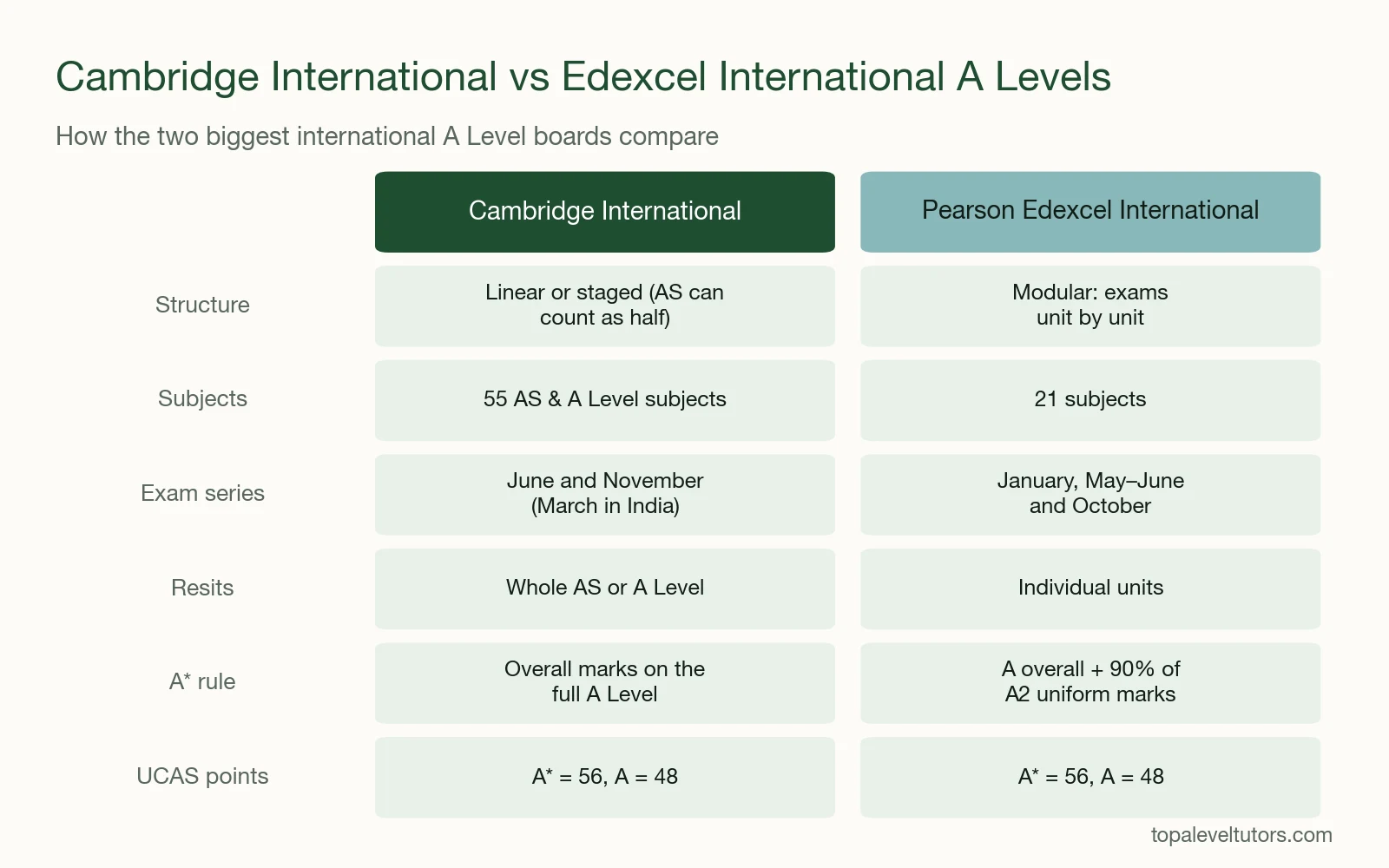
| Feature | Cambridge International | Pearson Edexcel International |
|---|---|---|
| Structure | Linear or staged | Modular (units) |
| Subjects | 55 at AS & A Level | 21 |
| Exam series | June, November, March (India) | January, May–June, October |
| Resits | Whole AS or A Level | Individual units |
| A* | Overall marks on the full A Level | A overall plus 90% of A2 uniform marks |
| UCAS points | A* 56, A 48 | A* 56, A 48 |
Is Edexcel International Easier Than Cambridge?
Not in content. Both are designed to the same standard as UK A Levels and lead to the same grades and UCAS points (University of Roehampton, 2026). What differs is how the difficulty is spread. IAL's modular structure means smaller, more frequent exams, while Cambridge's structure tests more content at once.
The A* rules are also different. For Edexcel IAL, you need an A overall and at least 90% of the uniform marks on your A2 units (Pearson, 2026). With Cambridge, the A* depends on your weighted total for the full A Level.
In practice, IAL's A* rule rewards consistency in Year 13 specifically. A student with excellent AS units but uneven A2 units can miss the A* even with a high overall total. With Cambridge, a strong overall total is what counts. Knowing this changes how you should prioritise revision in Year 13.
Which Board Has More Flexibility?
Edexcel IAL is more flexible. You can sit units in January, May–June or October, and resit individual units to improve your grade. Pearson counts only your two most recent attempts at a unit, except in IAL Mathematics, where the best result counts (Pearson, 2026).
Cambridge is less flexible but simpler. Most schools enter students for the June series, with November available for resits. November 2026 Cambridge results arrive on 7 January 2027 (Cambridge International, 2026), early enough for UK university applications.
Which Board Offers More Subjects?
Cambridge offers far more choice, with 55 subjects at AS & A Level (Cambridge International, 2026), including Further Mathematics, Global Perspectives & Research, Marine Science and many languages. Edexcel IAL covers 21 subjects, focused on the most popular ones: Mathematics, Further Mathematics, the sciences, Economics, Business, English, History, Geography, Law and languages.
In practice, your choice is limited to what your school offers. Many international schools offer one board for most subjects and the other for a few. Mixing boards is fine; universities don't mind.
How Do Results Compare?
Cambridge publishes detailed world results by subject. In June 2026, 37.1% of Cambridge International A Level Mathematics candidates achieved A or A*, and 38.0% in Chemistry (Cambridge International, 2026). Pearson also publishes IAL grade statistics for each series.
Direct comparisons between boards are risky, though. Each board's candidates come from different schools and countries, and that affects results as much as the exams do. Our guides to the hardest A Levels and easiest A Levels explain why.
Do Universities Prefer One Board?
No. UK universities treat Cambridge International and Edexcel International A Levels as equivalent to UK A Levels, and both earn the same UCAS Tariff points (University of Roehampton, 2026). Cambridge says all UK universities and over 600 US universities accept its A Levels (Cambridge International, 2026).
What universities care about is your grades and subjects. Choose the board that helps you get the best grades in the subjects your degree needs.
Which Should You Choose?
Choose Edexcel IAL if you like regular checkpoints, want the option to resit units and do well in shorter exams. Choose Cambridge if you prefer to build understanding over a full course, want a wider subject choice or perform well in end-of-course exams.
We teach students on both boards, and the pattern is clear. Students who get anxious before big exams often do better with IAL's smaller units. Students who need time for ideas to connect, especially in Mathematics and Physics, often prefer Cambridge's longer runway. Neither is wrong; it's about fit.
Want Support on Either Board?
Our tutors combine top recent A Level graduates and qualified teachers and examiners, with specialists for both Cambridge International and Edexcel International A Levels. We know the mark schemes, the A* rules and the exam timing for each board.
Submit an application and we'll match you with a tutor for your board and subjects.
Frequently Asked Questions
Is Edexcel IAL accepted by UK universities?
Yes. Pearson Edexcel International A Levels are accepted by UK universities and earn the same UCAS points as UK A Levels: 56 for an A* and 48 for an A (University of Roehampton, 2026). Always check individual course subject requirements.
Can I switch from Cambridge to Edexcel after AS?
It's possible but not simple. Cambridge AS results don't count towards an Edexcel IAL, so you'd need to sit the IAL AS units too. Edexcel IAL runs three exam series a year (Pearson, 2026), which can make catching up easier.
Which is harder, Cambridge or Edexcel A Level Maths?
The content is similar. Edexcel IAL Maths is split into units (P1–P4 plus applied units), while Cambridge 9709 combines papers into a single qualification. In June 2026, 37.1% of Cambridge 9709 candidates achieved A or A* (Cambridge International, 2026).
How many times can I resit an Edexcel IAL unit?
You can resit any unit, but Pearson only counts your two most recent attempts, except in IAL Mathematics, where your best result counts (Pearson, 2026). Plan resits carefully so a weaker final attempt doesn't replace a better one.
The Bottom Line
- Cambridge and Edexcel International A Levels carry equal weight with universities.
- Cambridge offers 55 subjects; Edexcel IAL offers 21, with a modular structure.
- Edexcel IAL has three exam series and unit resits; Cambridge has June and November.
- Choose the board that fits how you learn and the subjects you need.
See the 2027 exam dates for both boards in our A Level exam timetable 2027.
Find the right A-Level tutor this week
If you are not happy after your first session with your tutor, please let us know and we will give you a full refund and find you another tutor for free.