

A Level English Past Papers: English Language and Literature Guide
Where to find official A Level English Language and Literature past papers for AQA, Edexcel, OCR, Cambridge and Edexcel International, how each board's exams work, and how to practise timed essays.



Official A Level English past papers come from your exam board: AQA, Pearson Edexcel or OCR in the UK, and Cambridge International or Pearson Edexcel International at most international schools. Check first which English you take: English Literature and English Language are separate A Levels with different papers. Top grades are hard to reach in both. In 2026, 24.9% of English Literature results in England were A or A\*, and just 12.4% in English Language (tutor2u, 2026).
This guide shows where to find official papers, how each board's exams are structured and how to use past papers to write better essays under time pressure.
Key Takeaways
- English Literature and English Language are separate A Levels; use papers for the right one.
- Most UK boards include coursework (non-exam assessment) worth 20% of the A Level.
- Set texts change, so check older papers against your own texts.
- English past papers are for timed planning and writing, not just reading.
Where Can You Find Official English Past Papers?
Every board publishes papers free, with different rules. Pearson keeps papers from the most recent 12 months for teachers only (Pearson, 2026). AQA's summer 2026 papers reach its public website on 9 July 2027 and stay there for three years (AQA, 2026).
| Board | English Literature | English Language | Where to find papers |
|---|---|---|---|
| AQA | English Literature A 7712 (or B 7717) | English Language 7702 | AQA past papers |
| Pearson Edexcel (UK) | English Literature 9ET0 | English Language 9EN0 | Pearson past papers |
| OCR | English Literature H472 | English Language H470 | OCR past paper finder |
| Cambridge International | Literature in English 9695 | English Language 9093 | Cambridge 9695 and Cambridge 9093 |
| Pearson Edexcel International | English Literature YET01 | English Language YEN01 | Pearson past papers |
Cambridge's public pages offer a selection, such as the June 2024 9093 papers, mark schemes and examiner report, with the full archive on the School Support Hub for registered schools (Cambridge International, 2026). Ask your teacher for anything newer.
How Are AQA, Edexcel and OCR English Papers Structured?
UK English A Levels are linear, and most include coursework. AQA English Literature A has a 3-hour paper and a 2 hour 30 minute paper, each worth 40%, plus a non-exam assessment worth 20% (AQA, 2026). AQA English Language has two 2 hour 30 minute papers and a 20% coursework investigation (AQA, 2026).
| Specification | Exams | Coursework (NEA) |
|---|---|---|
| AQA English Literature A (7712) | Paper 1: 3 hr, 75 marks (40%) Paper 2: 2 hr 30 min, 75 marks (40%) | Independent critical study, 50 marks (20%) |
| AQA English Language (7702) | Paper 1: 2 hr 30 min, 100 marks (40%) Paper 2: 2 hr 30 min, 100 marks (40%) | Language in action, 100 marks (20%) |
| OCR English Literature (H472) | Two 2 hr 30 min papers, 60 marks each (40% each) | Literature post-1900 coursework, 40 marks (20%) |
| Pearson Edexcel English Literature (9ET0) | Three papers: drama, prose and poetry | Comparative essay |
Sources: AQA 7712, AQA 7702 and OCR H472 specifications.
Past papers only cover the exams, so plan your coursework separately with your teacher. For the exam papers, check whether each paper is open book or closed book on your specification, because that changes how you revise quotations.
How Are the Cambridge English Papers Structured?
Cambridge has no coursework in either subject: each A Level is four 50-mark exams, each worth 25%. Literature in English covers drama, poetry, prose, Shakespeare and an unseen text (Cambridge International, 2026). English Language covers reading, writing, language analysis and language topics (Cambridge International, 2026).
| Literature in English 9695 | Time | English Language 9093 | Time |
|---|---|---|---|
| 1: Drama and Poetry | 2 hr | 1: Reading | 2 hr 15 min |
| 2: Prose and Unseen | 2 hr | 2: Writing | 2 hr |
| 3: Shakespeare and Drama | 2 hr | 3: Language Analysis | 2 hr 15 min |
| 4: Pre- and Post-1900 Poetry and Prose | 2 hr | 4: Language Topics | 2 hr 15 min |
Papers 1 and 2 make up the AS Level; Papers 3 and 4 complete the A Level. Cambridge's set texts change between exam years, so a past question on a text you haven't studied is still useful for timing and structure, but not for content.
How Are Edexcel International English Papers Structured?
Pearson Edexcel International A Levels in English are modular, with four units each. English Literature (YET01) covers Post-2000 Poetry and Prose, Drama, Poetry and Prose, and Shakespeare and Pre-1900 Poetry. English Language (YEN01) covers Language: Context and Identity, Language in Transition, Crafting Language (Writing) and Investigating Language.
Pearson describes the English Language papers as "equally weighted" external exams (Pearson, 2015). For four-unit subjects, the A\* needs at least 320 uniform marks overall and 180 on the A2 units (Pearson, 2026).
How Should You Use English Past Papers?
Use them for timed essay practice. Practice testing was rated one of only two "high utility" learning methods in a major review (Dunlosky et al., 2013). In English, the "test" is planning and writing a full answer in the time allowed, which is a skill in itself.
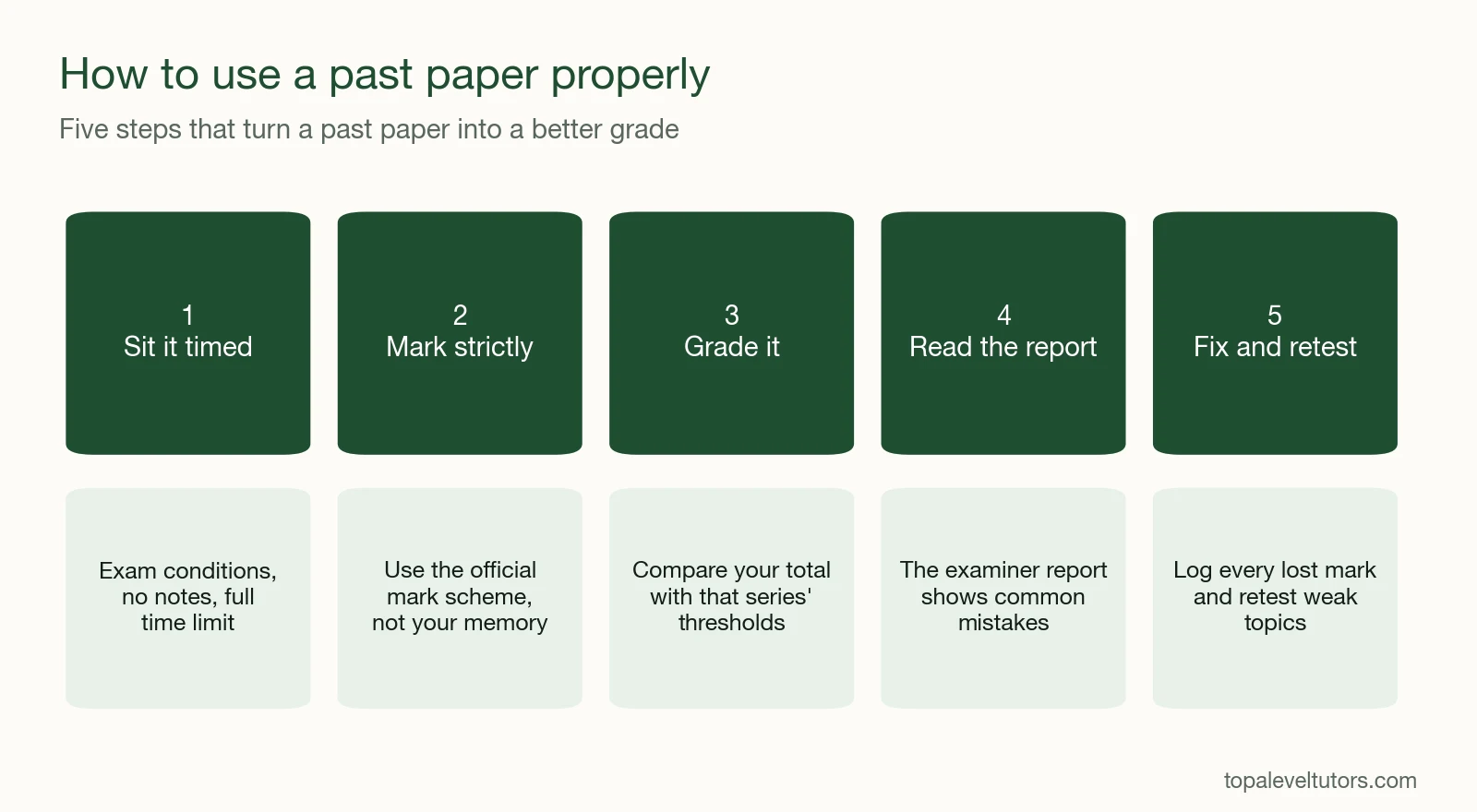
You don't have to write every essay in full. Mix three types of practice:
1. Plans only: 10 minutes per question to outline an argument, with quotations. You can do several in one session. 2. Timed paragraphs: one analytical paragraph in 10 minutes, to sharpen close analysis. 3. Full timed essays: at least one a week in Year 13, marked against the levels descriptors.
Mark with the mark scheme's levels and assessment objectives, not just its indicative content. Examiners reward a relevant argument, close analysis of language and form, and context where the specification asks for it. Our A Level command words guide explains what "analyse", "discuss" and "evaluate" ask for.
English boundaries are often higher than students expect. In Cambridge's June 2026 series, an A on Literature in English Paper 4 needed 40 out of 50, or 80%, and an A on English Language Paper 1 needed 34 out of 50 (Cambridge International, 2026; Cambridge International, 2026). In essay subjects, the difference between a B and an A is usually precision and argument, not length.
When Should You Start English Past Papers?
Start planning answers to past questions as soon as you finish each text or topic in Year 12, and write timed essays from the middle of Year 12. Full papers can wait until you know all your texts. Spacing practice over months beats cramming (Dunlosky et al., 2013), and it gives quotations time to stick.
Keep the most recent series for timed mocks in the final month. Our guide on how to revise for A Levels includes a month-by-month plan.
What Grade Can You Expect in A Level English?
Top grades in English are scarcer than in most subjects. In England in 2026, 9.5% of English Literature results were A\* and 24.9% were A or A\. In English Language, 2.6% were A\ and 12.4% A or A\* (tutor2u, 2026). Among Cambridge International candidates, 14.4% of Literature in English candidates got A or A\* (Cambridge International, 2026).
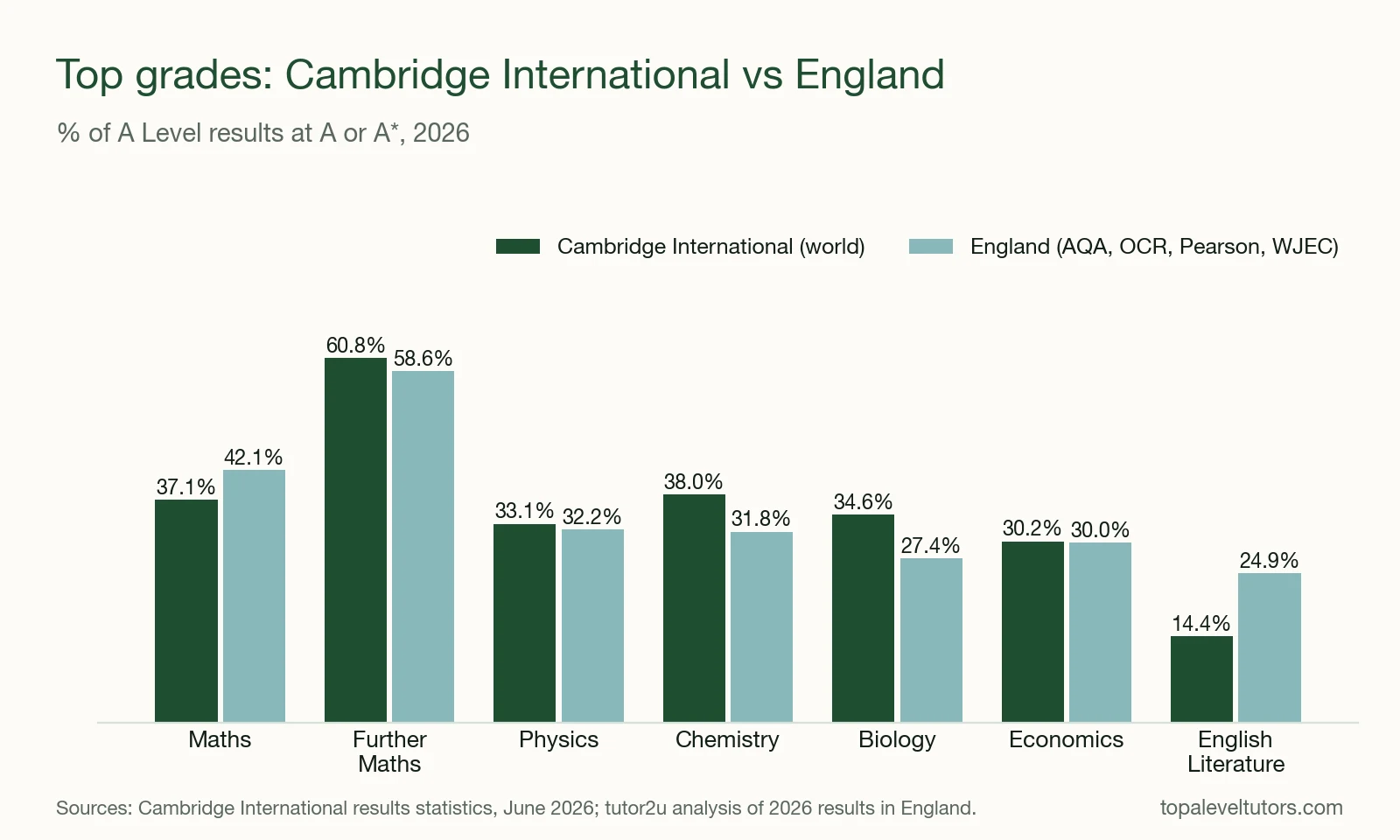
On the most common Cambridge paper combination, an A\* in Literature in English needed 169 out of 200, and in English Language 159 out of 200 (Cambridge International, 2026; Cambridge International, 2026).
Many of the international students we support write fluently but lose marks on structure: strong points that don't build into an argument, or quotations explained rather than analysed. Feedback on full timed essays, followed by a rewrite, makes the biggest difference. Our hardest A Levels guide explains why English grades are so tough to reach.
Want Help With A Level English?
English is where expert feedback on your writing pays off most. Our tutors combine top recent A Level graduates and qualified teachers and examiners, with specialists in AQA, Edexcel, OCR, Cambridge and Edexcel International English. See our A Level English Literature tutoring and A Level English Language tutoring.
Submit an application and we'll match you with an English tutor.
Frequently Asked Questions
Where can I find AQA A Level English Literature past papers?
On AQA's website, which publishes papers about a year after the exam and keeps them for three years (AQA, 2026). Check whether you take English Literature A (7712) or B (7717), because their papers differ.
Where can I find Cambridge 9695 and 9093 past papers?
Cambridge publishes a selection of papers, mark schemes and examiner reports on each public syllabus page, such as the June 2024 papers for 9093. The full archive is on the School Support Hub for registered schools (Cambridge International, 2026).
Are English past papers useful if my set texts are different?
Yes. Questions on other texts still train timing, structure and how to answer each command word. Unseen and language analysis questions are useful whatever texts you study. Cambridge's Paper 2 includes an unseen section, for example (Cambridge International, 2026).
Is English Language or English Literature harder?
For top grades, English Language had fewer in England in 2026: 12.4% of results were A or A\*, against 24.9% in English Literature (tutor2u, 2026). Choose the subject you enjoy and write best in, as both need strong analysis.
The Bottom Line
- Check which English A Level and which board you take before collecting papers.
- Most UK boards include 20% coursework; Cambridge is all exams.
- Use past papers for plans, timed paragraphs and full timed essays.
- Top grades are scarce, so precise analysis and argument matter most.
Planning your subjects? See our guide on how to choose A Level subjects.
Find the right A-Level tutor this week
If you are not happy after your first session with your tutor, please let us know and we will give you a full refund and find you another tutor for free.