

Levels of Education in the UK: Qualification Levels Explained
A clear map of UK education for families in the UK and abroad: school stages and year groups, the eight qualification levels from Entry level to doctorate, where A Levels and GCSEs sit, and how Scotland's system compares.



The UK groups qualifications into levels so that very different courses can be compared. In England, Wales and Northern Ireland there's an Entry level plus eight numbered levels, from Level 1 (GCSE grades 3–1) up to Level 8 (a doctorate), and A Levels sit at Level 3 (GOV.UK, 2026). Scotland runs its own framework with 12 levels (SCQF, 2026).
If you're a parent or student outside the UK, this system can look confusing at first. This guide explains the school stages, the qualification levels and where international qualifications such as IGCSE and Cambridge A Levels fit.
Key Takeaways
- UK qualifications run from Entry level to Level 8 (doctorate) in England, Wales and Northern Ireland.
- GCSEs at grades 9–4 are Level 2; A Levels, the IB Diploma and T Levels are Level 3.
- A bachelor's degree is Level 6 and a master's is Level 7 (GOV.UK).
- Scotland uses 12 SCQF levels, with Highers at Level 6.
What Are the Stages of Education in the UK?
UK education runs through five broad stages: early years, primary, secondary, post-16 (sixth form or college) and higher education. In England, young people must stay in some form of education or training until they turn 18, although they can leave school at 16 for college, an apprenticeship or training (GOV.UK, 2026).
| Stage | Ages | Year groups (England) | Main qualifications |
|---|---|---|---|
| Primary | 4–11 | Reception to Year 6 | None (national tests) |
| Lower secondary | 11–14 | Years 7–9 | None |
| Upper secondary | 14–16 | Years 10–11 | GCSEs |
| Post-16 (sixth form) | 16–18 | Years 12–13 | A Levels, T Levels, BTECs |
| Higher education | 18+ | University | Degrees |
School years are also grouped into "Key Stages". Key Stage 4 covers Years 10 and 11, when students take GCSEs. Key Stage 5 is the sixth form, Years 12 and 13, when students take A Levels.
British-curriculum international schools usually follow the same year names. A student in "Year 12" in Doha or Bangkok is at the same point as a Year 12 student in Manchester, normally starting A Levels.
What Are the Qualification Levels in the UK?
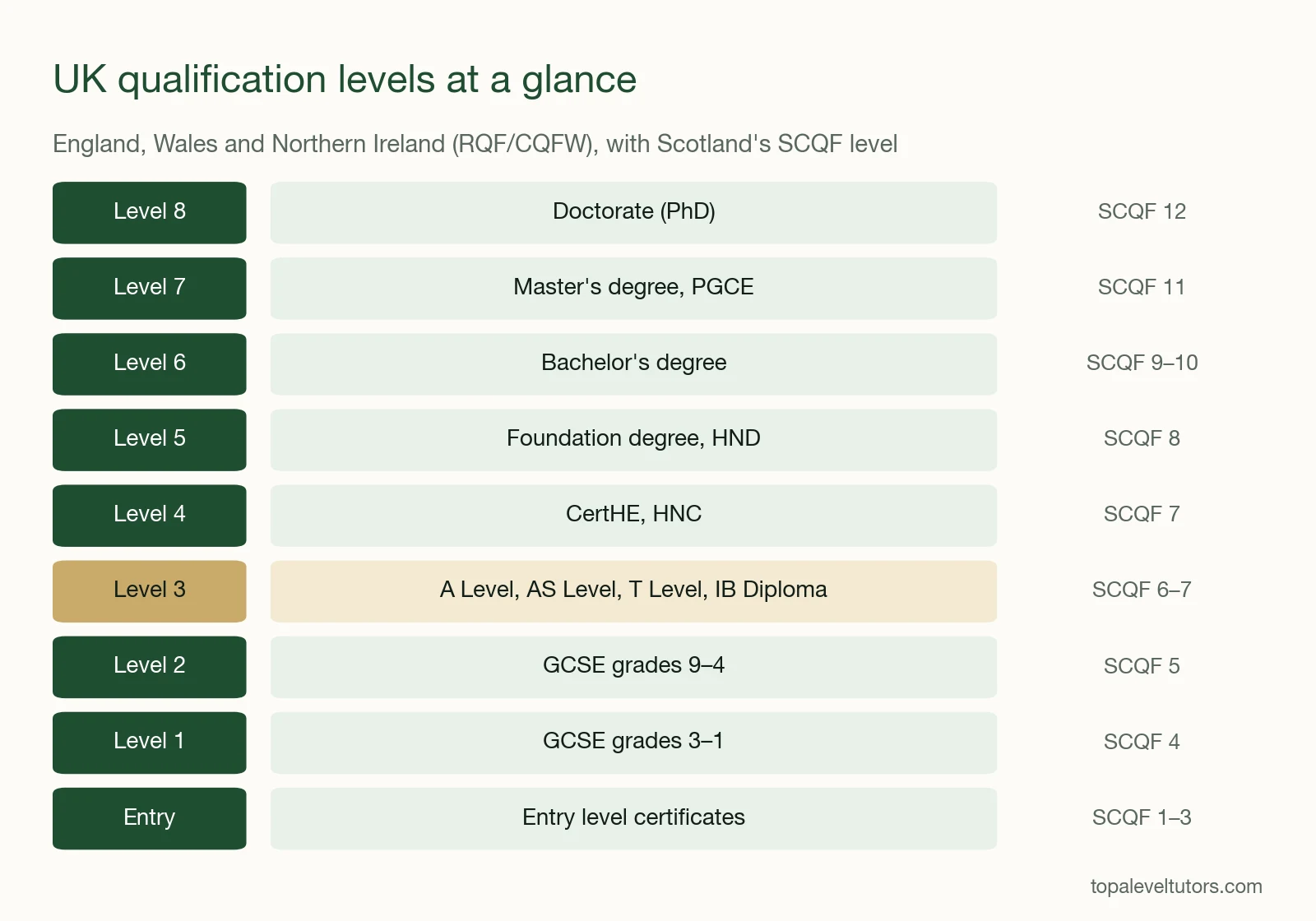
The levels describe how demanding a qualification is, not how long it takes. The official list puts GCSE grades 9–4 at Level 2, A Levels and AS Levels at Level 3, bachelor's degrees with honours at Level 6 and PhDs at Level 8 (GOV.UK, 2026). Each level is harder than the one below it.
| Level | Examples |
|---|---|
| Entry (1–3) | Entry level certificates, Entry level functional skills |
| Level 1 | GCSE grades 3, 2, 1 (or D–G), Level 1 NVQ |
| Level 2 | GCSE grades 9–4 (or A*–C), intermediate apprenticeship |
| Level 3 | A Level, AS Level, IB Diploma, T Level, advanced apprenticeship |
| Level 4 | Certificate of Higher Education (CertHE), HNC |
| Level 5 | Foundation degree, HND, Diploma of Higher Education |
| Level 6 | Bachelor's degree, degree apprenticeship |
| Level 7 | Master's degree, PGCE, postgraduate diploma |
| Level 8 | Doctorate (PhD or DPhil) |
In England and Northern Ireland this is the Regulated Qualifications Framework (RQF). Wales uses the Credit and Qualifications Framework for Wales (CQFW), which lines up with the same eight levels.
Where Do A Levels Fit?
A Levels are Level 3 qualifications, alongside AS Levels, T Levels and the IB Diploma (GOV.UK, 2026). Level 3 is the standard entry point for university. In England, 320,505 students received A Level results in 2026 (Ofqual, 2026).
An AS Level is also Level 3, even though it's smaller. "Level" measures difficulty, not size. That's why UCAS gives an AS grade A only 20 points against 48 for a full A Level grade A. Our guide to A Level points has the full tables.
Level 3 is a real step up from Level 2. If you're about to start sixth form, our guide on what an A Level is explains what changes.
The jump from Level 2 to Level 3 is the steepest one most students ever face. GCSEs test a broad base across around nine subjects. A Levels ask for depth and independent reasoning in three. That's why a student with top GCSE or IGCSE grades can still find the first term of Year 12 hard. Skills such as extended writing and multi-step problem solving matter far more at Level 3.
How Does Scotland's System Differ?
Scotland has its own framework, the Scottish Credit and Qualifications Framework (SCQF), with 12 levels instead of eight. National 5 sits at SCQF Level 5, Highers at Level 6 and Advanced Highers at Level 7 (SCQF, 2026). An honours degree is SCQF Level 10 and a doctorate is Level 12.
| SCQF level | Example | Rough RQF equivalent |
|---|---|---|
| 5 | National 5 | Level 2 (GCSE 9–4) |
| 6 | Higher | Level 3 |
| 7 | Advanced Higher | Level 3 to 4 |
| 9 | Ordinary (bachelor's) degree | Level 6 |
| 10 | Honours degree | Level 6 |
| 11 | Master's degree | Level 7 |
| 12 | Doctorate | Level 8 |
Scottish students usually apply to university with Highers, often taken in S5, and many add Advanced Highers in S6. Scottish honours degrees also usually last four years rather than three.
Where Do International Qualifications Fit?
Most international British-curriculum qualifications map onto the same levels. Cambridge IGCSE and Edexcel International GCSE are designed as GCSE-level qualifications, so strong grades are treated like Level 2. Cambridge International and Edexcel International A Levels are Level 3, and they earn the same UCAS points as UK A Levels (University of Roehampton, 2026).
The international route is large. Cambridge offers 55 AS & A Level subjects (Cambridge International, 2026). Almost 368,000 students received Cambridge AS & A Level results in June 2026 (Cambridge International, 2026).
Parents who moved from another system often ask us which UK year their child "should" be in. The answer is usually simple: match the child's age to the year group, then check whether they're ready for the qualification that year leads to. Students joining a British-curriculum school in Year 10 or Year 12 can catch up quickly. They just need focused support on the exam style, which differs a lot from many national systems.
Why Do Qualification Levels Matter?
Levels matter because universities, employers and visa systems use them to judge whether you meet a requirement. Most UK bachelor's degrees (Level 6) require Level 3 qualifications such as A Levels for entry. Many jobs and apprenticeships ask for Level 2 maths and English, meaning GCSE grade 4 or above (GOV.UK, 2026).
For A Level students, though, the level alone won't get you a place. Universities look at your grades and subjects too. In England, just 28.3% of A Level results were A or A* in 2026 (Ofqual, 2026). Read our guides to A Level grades and choosing A Level subjects to plan ahead.
Need Support at Level 3?
Moving from GCSE or IGCSE to A Level is the biggest academic jump in school. Our tutors include top recent A Level graduates and qualified teachers and examiners, so students get support from people who've passed the exams and people who mark them. We work with UK, Cambridge International and Edexcel International A Level students worldwide, in subjects from Mathematics and Biology to History.
Submit an application and we'll match you with the right tutor.
Frequently Asked Questions
What level is an A Level?
An A Level is a Level 3 qualification in England, Wales and Northern Ireland, the same level as AS Levels, T Levels and the IB Diploma (GOV.UK, 2026). It's the usual entry requirement for a bachelor's degree, which sits at Level 6.
What level is a GCSE?
GCSEs at grades 9–4 (or A*–C) are Level 2, and grades 3–1 (or D–G) are Level 1 (GOV.UK, 2026). Grade 4 is widely treated as a "standard pass", and grade 5 as a "strong pass".
What level is a bachelor's degree in the UK?
A bachelor's degree with honours is Level 6, and a master's degree is Level 7 (GOV.UK, 2026). In Scotland, an honours degree is SCQF Level 10 and an ordinary degree is SCQF Level 9 (SCQF, 2026).
Are international A Levels the same level as UK A Levels?
Yes. Cambridge International and Pearson Edexcel International A Levels are Level 3 qualifications and earn the same UCAS points as UK A Levels, with 56 points for an A* (University of Roehampton, 2026). The main differences are structure and exam timing.
How many levels of education are there in the UK?
England, Wales and Northern Ireland use nine: Entry level plus Levels 1 to 8 (GOV.UK, 2026). Scotland uses 12 SCQF levels. In terms of school stages, there are five: early years, primary, secondary, post-16 and higher education.
The Bottom Line
- UK qualifications run from Entry level to Level 8, with A Levels at Level 3.
- GCSEs are Level 2 (grades 9–4) or Level 1 (grades 3–1).
- Degrees start at Level 6; master's degrees are Level 7 and doctorates Level 8.
- Scotland has 12 SCQF levels, and international A Levels sit at the same Level 3 as UK A Levels.
Next, read our guide to how A Level grades work.
Find the right A-Level tutor this week
If you are not happy after your first session with your tutor, please let us know and we will give you a full refund and find you another tutor for free.